Archeology for Interpreters > 5. How Do Archeologists Figure Out How Old Things Are?
Introduction
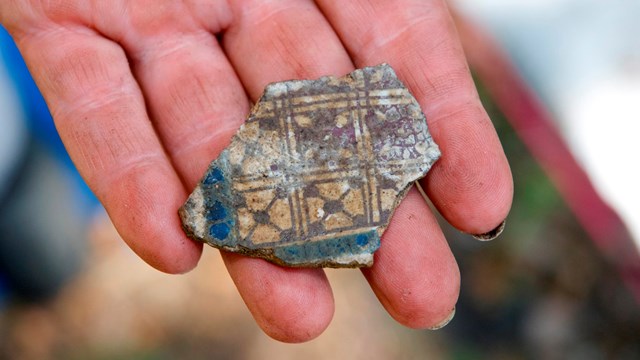
These artifacts and ecofacts helped archeologists date the early nineteenth-century Hooe Dependency Site at Manassas National Battlefield Park. (Matthew Reeves, University of Maryland)
Archeology is a chronicle of past cultures through the centuries and millennia. The concept of time varies among world cultures. Westerners think of time in linear terms, extending back over more than 2.5 million years of human existence. In contrast, many Native American groups and African societies conceive of time in cyclical terms, as an endlessly repeating passage of seasons, years, and longer periods of time. While some archeologists working with indigenous people incorporate traditional concepts of time into their research, the linear view of time lies behind most archeological research.
Archeologists seek to date sites and their associated artifacts and events as accurately as possible so to interpret past human behavior. This section explores dating techniques that archeologists use to establish relative time and absolute time to date sites and the corresponding artifacts and events. In some cases archeologists date the objects themselves; in others they date the context from which artifacts were recovered.
Try it yourself
Chronological
Methods
This
web site introduces many techniques by which archeologists establish
dates for artifacts and sites. Relative dating techniques of stratigraphy,
seriation and cross dating as well as absolute dating techniques
of dendrochronology, Potassium Argon dating, radiocarbon dating
and objects of known age are illustrated with videos and interactives.