Absolute
dating
Dates are expressed in absolute terms, that is in specific units of
measurement such as days, years, centuries, or millennia. For example,
the village was inhabited between AD 1400 and 1650. Absolute dates may
be expressed with a standard deviation (see Radiocarbon dating.) Absolute
dating and relative dating are contrasting concepts.
Archeopedology
The study of ancient soils in an archeological context.
Artifacts
Portable objects that are used, modified, or created by human activity.
Assemblage
A collection of artifacts.
Attribute
An artifact's physical property, such as the material(s) from which
the artifact is made, its size, shape, function, and decoration.
Backfilling
Covering an archeological site with fill to stabilize and preserve it.
Cataloging
The process of describing and recording an artifact's many attributes.
Ceramics
Artifacts that are modeled or molded from clay and then made durable
by firing.
Collection
Material remains that are excavated or removed during a survey, excavation,
or other study of a prehistoric or historic resource, and associated
records that are prepared or assembled in connection with the survey,
excavation or other study.
Compliance
work
Archeology undertaken to comply with requirements mandated by law. Often
compliance refers to work done to satisfy requirements of Section 106
of the National Historic Preservation Act of 1966, as amended, or comparable
state laws.
Conservation
Measures taken to prolong the life of an object or document and its
associated data as long as possible in its original form. May involve
chemical stabilization or physical strengthening.
Context
The arrangement or position of artifacts, ecofacts, and features within
the soil matrix.
Cross-dating
Relative dating of objects based on consistencies in stratigraphy between
parts of a site or different sites, and objects or strata with a known
relative chronology.
Curation
The long-term, professional management and care of objects, associated
records, and reports.
Debitage
Debris produced during stone tool manufacture.
Distortion
Event occurring during or after the formation of a site that may cause
strata to disappear in one area of the site and reappear farther along
at a different distance from the surface. Distortion could result from
processes such as landfilling, dumping, a landslide or other earth movement.
Dendrochronology
Also referred to as tree-ring dating, this absolute dating technique
uses annual growth rings of trees from a single region to compare and
match sequences of growth rings to determine that date when the tree
was first cut down. Dendrochronology is also used to calibrate radiocarbon
dates.
Disturbance
Event that changes the contexts of materials within a site, moving and
mixing materials from and between strata. Some causes of disturbance
are farming, heavy construction, rodent burrowing, and natural forces
such as floods.
Ecofacts
Natural remains, such as those of wild and domesticated animals and
plants, that are found in the archeological record.
Features
Nonportable elements such as hearths, postholes, soil stains and architectural
elements such as walls and trenches.
Flotation
Suspending soil samples in liquid, usually water, to recover tiny materials.
Geoarcheology
Science by which archeologists incorporate geomorphological studies
to gain an understanding of what earlier landforms were like, where
sites potentially may be located, and insights regarding prehistoric
raw material availability, site formation processes, and landscape history.
Geologic
dating
Relative dating technique used by geologists to develop dates for various
geological stages by relating them to other climactic and geologic events.
Geomorphology
The science that studies the general configuration of the earth's surface,
specifically the study of the classification, description, nature, origin,
and development of present landforms and their relationships to underlying
structures, and the history of geologic changes as recorded by these
surface features.
GIS
Abbreviation for Geographic
Information System, an analytic tool used to create a computerized,
layered composite of spatial information about an area.
GPS
Abbreviation for the Global
Positioning System, a "constellation" of satellites that
orbit the Earth and make it possible for people with ground receivers
to pinpoint their geographic location. GPS allows archeologists to determine
location coordinates in the field. Archeological sites and their environments
can be mapped quickly and accurately using GPS to measure control points.
Historical
archeology
Text-aided archeology that studies that portion of human history that
begins with the appearance of written records and continues until today.
Historical
science
Sciences such as geology, evolutionary biology and archeology that deal
with past events that no longer can be directly observed or replicated,
although the evidence they left behind can be studied to reconstruct
what took place.
Horizon
Ties and uniformity across space at a single point in time. In archeology,
a horizon is a pattern characterized by widespread distribution of a
complex of cultural traits that lasts a relatively short time. Factors
that might create the pattern of a horizon would include a rapid military
conquest or effective religious mission. Horizon and tradition are contrasting
concepts.
In
situ
The position in which an archeological object is first uncovered during
an excavation or survey.
Interruption
Elements that break the continuity of a stratum such as stones, tree
roots, walls, wells and post holes.
Law
of Superposition
This law holds that, under normal circumstances, deeper layers of soil,
sediment, or rock are older than those above them.
Material
culture
Elements of the physical environment that people have modified through
cultural behavior. Tangible material culture may reveal information
about intangible cultural elements such as social practices and ideology.
Mean
ceramic dating
Technique used in historical archeology to date sites based on the average
age of recovered ceramics. A mean ceramic date (MCD) provides a weighted
average of manufacturing dates and does not indicate a range of occupation.
Midden
A trash deposit, located either in a contained feature such as a pit,
or spread over the ground surface. The latter is referred to as a sheet
midden.
Obsidian
hydration
Absolute dating technique that measures the microscopic amount of water
absorbed on freshly broken obsidian surfaces. The principle behind obsidian
hydration dating is simple-the longer the artifact surface has been
exposed, the thicker the hydration band will be-but its application
requires careful analysis of absorption rates for different obsidian
sources. Obsidian hydration can indicate an artifact's age if the datable
surfaces tested are only those exposed by deliberate flintknapping,
rather than by accidental breakage.
Paleoethnobotany
The analysis and interpretation of plant remains from archeological
sites in order to understand the past interactions between human populations
and plants (Thomas 1998:325).
Phytolith
A plant microfossil composed of silica.
Pipe
stem dating
Technique used in historical archeology to date sites based on the statistical
analysis of English clay smoking pipe bore widths.
Primary
context
The soil layer and location in which an artifact, ecofact or feature
was originally deposited or constructed.
Provenience
The precise location on a site where artifacts were recovered.
Radiocarbon
dating
Absolute dating technique based on the knowledge that living organisms
build up organic carbon. When the organism dies, the carbon 14 (C14)
atoms disintegrate at a known rate, with a half-life of 5,700 years.
It is possible to calculate the date of an organic object by measuring
the amount of C14 left in the sample. Because the concentration of radiocarbon
in the atmosphere has varied considerably over time, radiocarbon dates
as far back as 7,000 years may be corrected by calibrating them against
accurate dates from radiocarbon-dated tree rings and developing a master
correction curve (see Dendrochronology).
Relative
dating
Dates are expressed in relation to one another, for instance, earlier,
later, more recent, and so forth. For example, the habitation of the
east end of the site is older than the one on the west end. Relative
and absolute dating are contrasting concepts.
Research
design
A plan in which the objectives of an archeological investigation are
described and justified. It states research questions and describes
methods and techniques to be used to identify, recover, study and store
associated archeological materials.
Sampling
Methods for identifying portions of an archeological site or resource
area to be examioned. Sampling methods vary according to each research
design.
Seriation
Relative dating technique whereby artifacts are ordered temporally based
on the assumption that cultural styles (fads) change and that the popularity
of a particular style or decoration can be associated with a certain
time period. The fattest part of the cluster is the central part of
the fad (Thomas 1998:246).
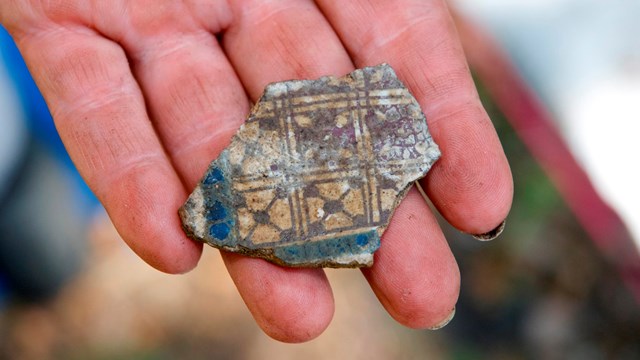
Sherd
A fragment of a ceramic artifact.
Sites
Location where there is evidence for the human past. A site is often
a spatial cluster of artifacts, features, or ecofacts that can be quite
sparse.
Social
context
Interpretations
of an artifact's technical production and use, its value to the people
who used it, and perhaps how and if the object symbolized those peoples'
ideology.
Spalled
Condition when pieces of material have come off an artifact.
Stabilization
Preserving an archeological site or artifact by supporting or strengthening
it to reduce the possibility of deterioration.
Stratum
(plural strata)
A soil layer, visually separable from other layers by a distinct change
in color, texture, or other characteristic.
Stratigraphy
Analysis of sequences of layered, or stratified, deposits. Like geological
exposures, archeological sites usually contain stratified layers, some
of them the results of human activity, like house building, and others
from natural phenomena like rain and wind.
STP
Abbreviation for shovel test pit, a type of subsurface probe. Archeologists
place shovel test pits at systematic or random patterns in an area being
investigated. Each pit is approximately one foot in diameter and extends
deep enough to penetrate sterile subsoil.
Terminus
post quem (TPQ) dating
The date after which a stratum, feature, or artifact must have been
deposited. The TPQ is determined by the most recent date. A 1962 penny,
for example, indicates that the feature in which it was found dates
to after 1962.
Thermoluminescence
Absolute dating technique used for rocks, minerals and ceramics. It
is based on the fact that almost all natural minerals are thermoluminescent-they
emit light when heated. Energy absorbed from ionizing radiation frees
electrons to move through the crystal lattice and some are trapped at
imperfections. In the lab, ceramic samples are heated, releasing the
trapped electrons and producing light that is measured to fix a date.
Tradition
A pattern of long persistence of cultural traits in a restricted geographical
area. Traditions not only suggest a strong degree of conservatism, but
a stable pattern of permanent settlement that allows such developments
to take place relatively undisturbed. Tradition and horizon are contrasting
concepts.
Typology
Arrangement of artifacts into idealized categories or types.
Zooarcheology
(or archeozoology)
The study of faunal (animal) remains from archeological sites.
References
Sections of this Glossary were adapted from:
Childs, S. Terry
and Eileen P. Corcoran
2000 Managing Archeological Collections. Archeology Program, National Park Service, Washington, DC.
Deetz, James
1996 In Small Things Forgotten: An Archaeology of Early American Life,
Revised Edition. Doubleday, New York.
Thomas, David Hurst
1998 Archaeology, Third Edition. Harcourt Brace College Publishers,
Fort Worth.
|