[NPS Arrowhead] U.S. Dept. of Interior National Park Service Archeology Program
Quick Menu Features
* Sitemap * Home
 

What's New

May is Asian Pacific American Heritage Month. Here are a few examples of the ways archeologists explore the history of Asian Americans' cultural heritage in America's national parks and beyond.

National parks in Hawaii reveal Native Hawaiian heritage through archeology. See the stone walls used by fishermen to trap fish at the Kaloko Kuapa, or footprints from the last march of a warrior party killed by the volcanic eruption of Kilauea in 1790. Visit places considered sacred to Native Hawaiians, such as royal grounds and sanctuaries or petroglyph fields. The Ala Kahakai National Historical Trail takes trekkers through settlements, temples, and past a stone slide (see Na Ala Hele for more information). On the mainland, Hawaiians left their mark at places like the Hawaiian Village at Fort Vancouver, where they participated in the Pacific Northwest's economic development. Learn more about Hawaiian archeology at Hawaii Volcanoes NP, Kalaupapa NHP and Fort Vancouver NHS.

Asian immigrants living in nineteenth-century ethnic communities helped each other combat racism and discrimination. Visit the Chinatowns in Riverside and the Market Street, Heinlenville, and Woolen Mills Chinatowns in San Jose, California. Archeologists dug through concrete and the detritus of contemporary urban life to investigate homes and businesses, while oral historians interviewed former residents to gather their memories. Together, they recovered the remnants of a commercial and residential villages and preserved the significance of their stories to contemporary peoples.

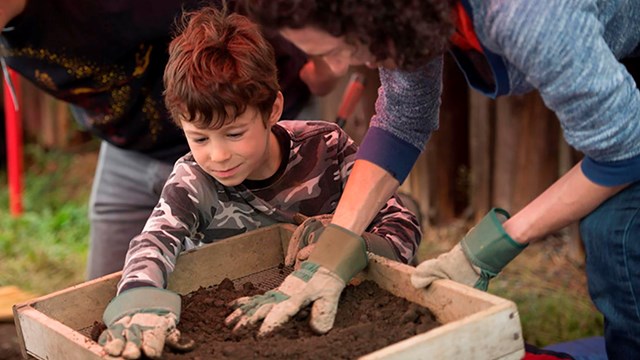
During World War II, Japanese Americans were held at internment camps in the western United States. Archeology at the Manzanar War Relocation Center in eastern California, now Manzanar NHS, shows how people coped with internment. One such place is a community garden called Merritt Park. In the early 1940s, Kuichiro Nishi used his nursery and garden design skills to make the desert bloom. In 2008, his children and grandchildren volunteered on an archeological dig at the park. Learn more in an interview with the archeologist, or about internment camps throughout the U.S. in an online book. Archeology at Manzanar and other internment camps, like Minidoka, provides a tangible reminder of the impacts of withheld civil liberties on everyday Americans. You can help! Check the Manzanar NHS website or contact a park in your area to learn about volunteer opportunities on archeological digs.

Asian Pacific history is represented throughout the national parks systems. Learn more through Teaching with Historic Places lesson plans, National Register travel guides here or here, a reading list, or by checking with a park in your area.

The national parks are home to a wide variety of research and educational projects. Our Projects in the Parks series touches on all aspects of archeology, including site survey, analysis, curation, consultation, education, technology, and ongoing efforts to recover sites being destroyed by erosion.

Most recently we looked into the Hawaiian presence at Fort Vancouver National Historic Site. Fort Vancouver, as the colonial “Capital” of the Pacific Northwest in the 1820s-1840s, supported a multi-ethnic village of 600-1,000 occupants. A number of the villagers were Hawaiian men who worked in the agricultural fields and sawmills of the Hudson’s Bay Company (HBC) operations. Identification of Hawaiian residences and activities has been an important element of studies of Fort Vancouver since the 1960s.

Kauanui calls for a “broad research agenda that accounts for Hawaiian movements in their respective contexts of conditions, periods, reasons, and desires, to allow us to better account for Hawaiian presence on the North American continent.” Her call is to counter attempts to minimize or alter modern Hawaiian cultural identity and to better define the Hawaiian diaspora history. Research on fur trade Hawaiians dispels the notion that Hawaiian history is limited to Hawaii and allows us to better contextualize the broader issues of fur trade identity and social transition in the Pacific Northwest associated with indigenous, fur trade, and American immigrant eras. Archeologists hope to learn more about Hawaiian life at Fort Vancouver by further studying the village site adjacent to the fort.

It appears that most of the Hawaiians hired by the HBC were of the Hawaiian commoner class (maka'ainana). That there are some difficulties in assessing exactly what Hawaiian occupations were in the fur trade is illustrated in the outfit records for 1845, where most of the identifiable Hawaiians at the Vancouver Depot (Fort Vancouver) were identified solely as “laborer,” exceptions being “Spunyarn,” who was a cooper, and William Kaulehelehe, the Hawaiian preacher, who was referred to as a “teacher”. Hawaiians primarily served as canoe middlemen (paddlers, but not bowmen or sternmen), sailors, farmers, and woodworkers. Some specialized as shepherds, sawyers, cooks, coopers, and woodcutters/stokers (for the Beaver steamship).

In addition to Hawaiians, the village was the home of a surprisingly diverse community of Fort Vancouver’s working class employees and their families, including French Canadians, Scots, English, Métis, and Native Americans representing tribes from across the North American continent. Seasonally, trapping parties (called “Brigades”) would deliver furs to the fort and to refit, which would swell the population of the village.

Many people of the fur trade spoke languages that were not intelligible to their comrades and exhibited unique racial and ethnic qualities. George Simpson called his bateau-load of people on the lower Columbia “the prettiest congress of nations, the nicest confusion of tongues, that has ever taken place since the days of the Tower of Babel.” To confuse things further, it is clear that, like the other inhabitants of the village, some Hawaiians took American Indian wives and raised multiethnic families. Learn more >>


Archeology Program Twitter feed

Archeology E-gram Newsletter

April 2013 (.pdf)

  • NPS Archeologist Jeff Richner Retired
  • Southwest Archeologist Linda Cordell Dies
  • NPS Director Signs MOU with Spanish Government
  • ArcheoThursday Webinars Available on NPS Archeology Program Website
  • Archeological Survey of the Bark Canada, a Gold Rush Era Shipwreck
  • NPS Announces a New Archeological Teaching with Historic Places Lesson Plan
  • Grave Marker Preservation Project Completed
  • Obama Administration Opposes Bills to Limit Antiquities Act
  • Abandoned Mineral Lands Report Issued
  • NPS Student Employee Network Launches Newsletter
  • National Park Service's 2013 Archeological Prospection Workshop Reminder
  • Navy Offers Advanced NHPA Section 106 Training
  • Projects in Parks is taking a break this month

download current e-gram (.pdf)
go to e-gram archive >>

MJB/EJL