|
|||||||||||
|
|||||||||||
|
Most scholars think America’s first people arrived before 15,000 years ago, likely from northeast Asia, but there is a lively debate about exactly when, how, and from where in northeast Asia. They were modern biologically; there is no evidence for earlier humans like Neanderthals in the New World. It’s a misconception to think of the first people as noble hunters in harmony with the environment. This obscures the complex realities of life in ancient North America. They were tough, resilient, and ingenious, and survived by exploiting their surroundings. The first people were nomadic. Many archeologists
think they traveled in small groups, following game, harvesting what
they needed from the land, and moving on. As groups moved into areas,
they likely established a pattern of cyclic movement linked to the seasonal
availability of resources. When an area filled to capacity, some groups
moved on to colonize new regions. |
![]() |
||||||||||
|
![]() |
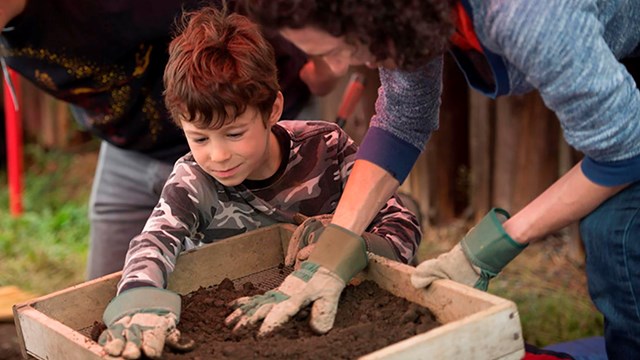
Field work at Virginia’s Thunderbird site. |
|||||||||
MJB/EJL
From the north, they would have threaded their way through glacial wilderness, encountering tundra at the waning edge of the ice, then forests as they continued south. Some, perhaps the earliest immigrants, probably traveled south along the western coast of the Americas. Many of the places where they stopped are now submerged due to sea level rise since glacial times. Modern animals were in evidence amidst creatures in the twilight of their existence like mammoths, mastodons, saber tooth tigers, giant beavers, and other species. Some suggest that humans hastened their demise; recent research offers new insight. What little is left from the era is all scholars
have to determine the details of the past. For years, it was largely
a story
of stone tools–seemingly all that had survived thousands of
years in the soil. Today, with a wider range of researchers and techniques,
the remnants of food remains and plant matter are giving a clearer picture
of the material life of the first Americans. |