Archeology for Interpreters > 2. What Is Archeology? >
Introduction
Archeologists work underwater to lay out an excavation grid.
Archeology is perhaps best thought of as the study of past ways of life. To pursue this study, archeologists focus on the relationship between the material objects made by past peoples on the one hand, and the makers' behavior on the other. Sometimes written records help; often no such records exist.
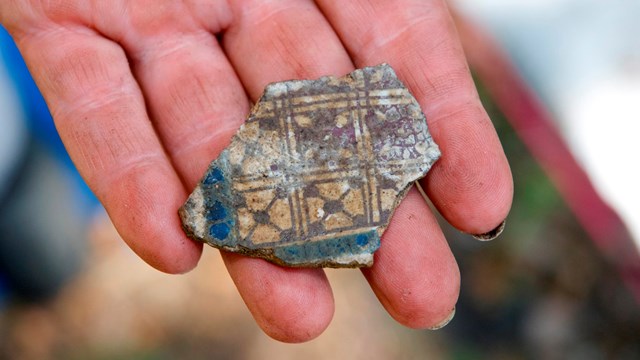
In previous centuries archeologists were content simply to find objects. Today, armed with computers, laboratory analysis, theories about society and culture, and a wide range of questions about human behavior, they may try to reach into the minds of those that made and used the artifacts. Thus their analysis acts as a bridge between the two sets of things: one an invisible realm that includes human ways of survival, religious beliefs, family structure, and social organization; the other a visible, tangible accumulation of material remains such as trash, tools, ornaments, and buildings. The latter group provides the raw material for understanding the former through logical reasoning. In making this all-important link, archeologists have at least three main goals:
- To obtain a chronology of the past, a sequence of events and dates that, in a sense, is a backward extension of history. For example, an archeologist may wish to determine when agriculture developed in a particular society or when a certain kind of pottery was made. Such basic information not only contributes to charting individual sequences of culture change, but also allows comparisons among culture histories in different parts of the world.
- To begin to reconstruct the ways of life that no longer exist. For example, excavations at the huge Cahokia site in western Illinois give us intriguing glimpse of the area as it was around A.D. 1200 by providing numerous clues to the nature of everyday life, the richness of ceremonial activity, and the workings of economic systems in the Mississippi Valley at that time.
- To give us some understanding of why human culture has changed through time. Given the delicate and complicated interplay between environment and people—either different segments of past societies or peoples of different cultures—archeologists can often isolate the occurrence of small changes in the past, such as shifts in gathering methods, changes in art motifs, or new sets of social relationships. These, in turn, may allow investigators to track changes through time and to understand the reasons for them.
The quest for cause-and-effect explanations of human behavior over the centuries is perhaps the most important ingredient of the discipline, for it has the potential to help us understand the present. This is but one of many reasons why archeology plays such a vital part in the overall study of humanity (Stuart and McManamon 1996).
For your information
Archeology and You
Archeology and You is a booklet describing what archeology is and how and why it is practiced.
Try it yourself
Work with your park partners to develop a list of questions that visitors may ask about archeology. Develop answers that address your park's specific themes, resources and concerns.
Use What You Know: Assess Your Knowledge (#1 of 9)
- What do you know about archeology already?
- What resources do you use to learn about archeology?
- What do you hope to learn from this distance learning course?