|
|
Absolute
dating
Absolute
dating
techniques
attempt to pinpoint a discrete, known interval in time such
as a day, year, century, or millennia. Very few artifacts recovered
from an archeological site can be absolutely dated. Archeologists use
several methods to establish absolute chronology including radiocarbon
dating, obsidian hydration,
thermoluminescence, dendrochronology,
historical records, mean ceramic
dating, and pipe stem dating.
Each of these methods is explained in this section.
Radiocarbon
dating
Radiocarbon
dating is a widely applied absolute dating method in archeology. It
is based on the knowledge that living organisms build up their own organic
matter by photosynthesis or by using atmospheric carbon dioxide. Radiocarbon
dates can be obtained from many types of organic material including
charcoal, shell, wood, bone and hair. The amount of carbon dioxide in
the living organism is equal to that in the atmosphere. When the organism
dies, the carbon 14 (C14) atoms disintegrate at a known rate, with a
half-life of 5,700 years. It is possible then to calculate the date
of an organic object by measuring the amount of C14 left in the sample.
Because the concentration of radiocarbon in the atmosphere has varied
considerably over time, radiocarbon dates as far back as 7,000 years
may be corrected by calibrating them against accurate dates from radiocarbon-dated
tree rings and developing a master correction curve.
Archeologists
use a statistical standard deviation to increase the range of dates
for a sample that has been given a C14 date. Radiocarbon dates are usually
calculated to one standard deviation. For example, if a sample is tested
and given a radiocarbon date of 1000 BC. with a standard deviation of
plus or minus 120 years, the chances are two in three that that sample
dates from between 1120 and 880 BC. Here's how:
Calculations
based on one standard deviation of 120 years:
1000 + 120 = 1120 BC (Oldest date) 1000 - 120 = 880 BC (Most
recent date)
To increase the
range of possible dates of a sample, archeologists may calculate the
radiocarbon date to two standard deviations. Calculations based on two
standard deviations increases the possible date range, increasing the
probability of the sample lying within this range to 95 percent. Here's
how:
Calculations
based on two standard deviations of 120 years (120 x 2 = 240)
1000 + 240 = 1240 BC (Oldest date) 1000 - 240 = 760 BC
(Most recent date)
As a rule, the
more standard deviations used, the larger the probable date range for
the sample and consequently, the higher the probability is for that
sample to fall within the expanded date range.
|
FUN FACT

|
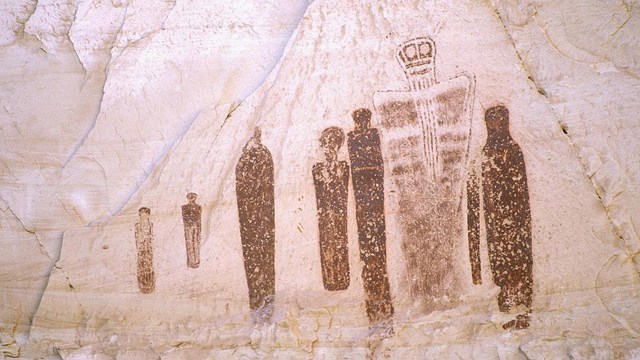
Researchers have developed a method to eliminate or reduce organic
contamination on prehistoric rock paintings, enabling them to
use radiocarbon dating technology to date
rock art sites. (4/30/01)
|
Rock paintings at Nevada's Christmas Tree Pass (National Center
for Preservation Technology and Training) |
|
TRY IT YOURSELF
Radiocarbon
Dating
This
web site describes radiocarbon dating and includes six short movies
illustrating different stages in the radioactive and radiocarbon
dating processes. (4/30/01)
Quick Time Playerİ required.
|
|
|
Home
1.
Introduction
2.
What is Archeology?
3.
What are Archeological Resources?
4.
What do Archeologists Do?
5.
How do Archeologists Figure Out How Old Things Are?
Introduction
Relative
dating
Absolute
dating
Radiocarbon
dating
Obsidian
Hydration
Thermoluminescence
Dendrochronology
(Tree-ring dating)
Historical
records
Artifacts
as time markers
Suggested
reading
Links
to additional resources
6.
What are Our Personal and Professional Responsibilities?
7. What are Issues of Sensitivity?
8.
Cultural Resource Management (CRM)
9.
Use What You Know: Highlighted Case Study
10.
Additional Resources
Glossary
Course Certificate
Credits
Table
of Contents
|
 |