Archeology for Interpreters > 4. What Do Archeologists Do?
How do we preserve archeological resources?
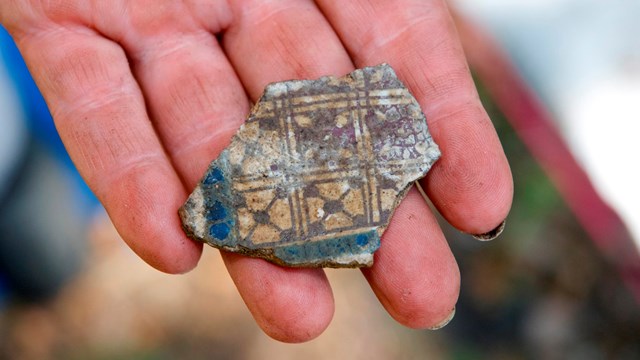
Canton porcelain from Fort Vancouver's digitized collections. (NPS)
Long-term storage and curation
After objects have been analyzed and stabilized, they should be labeled, cataloged, and then packed in containers for curation. This should be done in a manner that is consistent with the standards of the repository where the collections are to be housed. Once these procedures have been completed, the collection is ready for long-term storage and curation. Again, it is important to make sure that all procedures have been fully documented along the way. All the associated records must be given to the repository along with the collection, as is usually required (Childs and Corcoran 2000).
There are numerous types of repositories that curate archeological collections. Each one is unique in its size, staff, funding, organization, and collections. Many repositories fit into more than one of these categories. Each of the broad categories of repositories that curate archeological collections outlined below are not mutually exclusive:
- Academic repositories occur at a wide range of institutions and include several repository types. Some academic repositories are museums that are open to the public, while others may only be used by researchers, staff, and students affiliated with the academic institution.
- Tribal museums and cultural centers are institutions that are usually run by Native American tribes or organizations.
- Historical societies usually contain a variety of objects collected from the society's local, state, or regional geographic area.
- Government repositories, such as public museums or repositories, are solely concerned with caring for and providing access to the collections for research, interpretation or heritage purposes.
- Archives house records and documents associated with archeological collections including the personal papers of archeologists, such as letters, diaries, photos, and draft documents.
- Museums are probably the most common type of repository. Museums that house archeological collections range in size from large museums like the National Museum of Natural History with millions of objects to local museums with just a few artifacts. The thematic nature of museums that house archeological collections is just as varied. They may include natural history, history, anthropology, and art museums. The common thread that sets museums apart from other types of repositories is their concentration on an educational mission usually through exhibits and public programming.
Fun fact
The curatorial staff at Fort Vancouver National Historic Site is in the process of placing its Archeological Collection Online. Eventually digital images of 25% of the park's study collection - 50,000 of 200,000 artifacts - will be available.
For your information
The Museum Resource Center / Regional Archeology Program Move
Out!
See the National Capital Regional Archeology
Program's recent move to its new state-of-the-art museum support
center in Maryland.