[NPS Arrowhead] U.S. Dept. of Interior National Park Service Archeology Program
Quick Menu Features
* Sitemap * Home
  Archeology For Interpreters: A Guide To Knowledge Of The Resource   What do archeologists do? Distance Learning


How do we preserve archeological resources?

Stewardship of archeological resources is wide-ranging. It includes their treatment, preservation, and protection. It includes monitoring resource condition and assessing threats and disturbances. It also includes staff involvement and training in protection concerns and methods, preservation of significant features, sites, and recovered materials, recording resource management information in a database such as the NPS Archeological Sites Management Information System (ASMIS), and their interpretation for public benefit (NPS 1997:84-85).

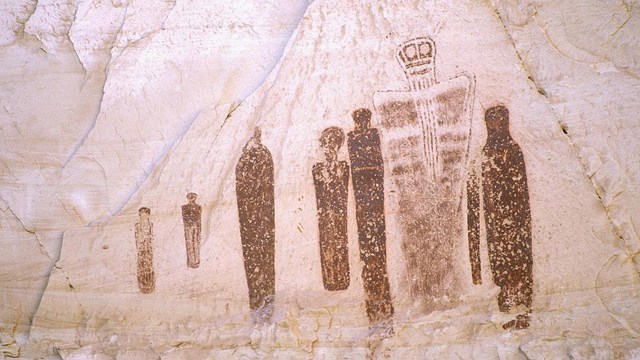
(photo) Animal petroglyphs at Mesa Verde National Park.

Archeological resources such as these petroglyphs at Mesa Verde National Park require preservation. (NPS)


The National Park Service guidelines for the preservation of archeological resources are summarized here:

- All resources will be protected against natural and human agents of destruction and deterioration whenever practicable

- Preservation will maintain the resource's existing form, integrity, and materials

- Preservation includes techniques of arresting or retarding deterioration through a program of ongoing maintenance. Deteriorated areas will be backfilled or otherwise stabilized

- Excavation and other destructive techniques will be employed only when necessary to provide sufficient information for research, interpretation, and management needs. Excavated areas (including potholes excavated by looters) will be backfilled or otherwise stabilized

- Stabilization of a resource to arrest and inhibit deterioration will be done in such a way as to detract as little as possible from its appearance and significance and not adversely affect its research potential unless adequate data recovery has occurred, and

- Data recovery will precede and be completed before physical intervention into any archeological resource, including sites associated with historic structures.

Archeological resources to be preserved include far more than the site or the recovered artifacts. Field data, objects, specimens, and structural elements, such as stones and bricks, retrieved for preservation during data recovery and treatment projects, together with associated records and reports, are all retained and managed within the park's museum or other designated repository. The long-term care and management, or curation, of preserved archeological resources is an ongoing process. It also involves their accessibility to a variety of users for a number of purposes (Childs and Corcoran 2000).

Every archeological project yields a collection. A collection of material remains may result from work at a single site or from a single investigation or project that involves a number of sites. Academic research and some contracted projects may yield a collection or series of collections from work at a single site over a number of years (Childs and Corcoran 2000).

(photo) Artifacts stored in acid free plastic bags, on pull out shelves.
Appropriately stored archeological collections. (U.S. Army Corps of Engineers, St. Louis District)
 

While many people might think of an archeological collection as only the objects or artifacts collected during an excavation or survey, other items are involved. These include:

- non-cultural materials (e.g., ecofacts, soil samples, radiocarbon and other dating samples), - associated records (e.g., field notes, maps, photos, laboratory data),

- digital data (e.g., Global Positioning data, field and laboratory data collected in a database, Computer Assisted Design (CAD) models), which should be considered a component of associated records, and

- research results or interpretation (e.g., site reports, results of "no finds", books, articles) (Childs and Corcoran 2000).

It is important to understand that certain projects may yield an archeological collection that only consists of associated records. Such a project might be a survey during which no artifacts were recovered or no sites were found, but a contract and scope of work were written and signed, field notes were made, and a final report was written and distributed (Childs and Corcoran 2000).

Everyone involved in the archeological profession is responsible for curation. Many archeologists in the field do not fully understand or think about their responsibilities to the collections that they unearth, especially after they complete analysis. Instead, they make assumptions that repositories, such as museums, are responsible with little or no interaction from archeologists. Also, some federal or state agencies, contract archeology firms, and universities do not always understand or take full responsibility for the care and management of their collections. These responsibilities can be legally, ethically, or professionally mandated (Childs and Corcoran 2000).


  back  next  


MJB/MDC