|
|||||||||||
|
Subsurface testing Four common types of subsurface tests are useful for site discovery and often also for site investigation. However, all of these tests are limited in depth and therefore useful only for sites close to the surface (AEP et al. 1997: 6-8):
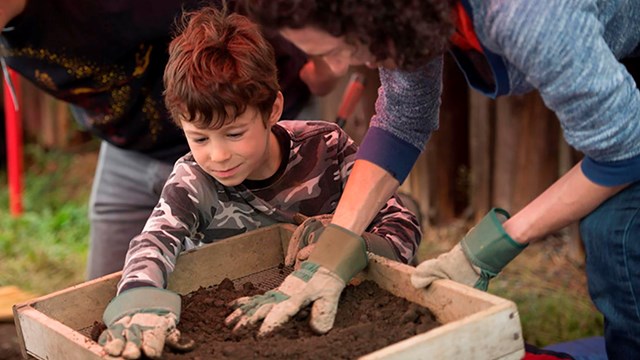
- Soil cores of approximately 1-inch diameter are better for investigating known sites where artifacts deposits are dense, such as trash deposits, than for discovering new ones. Unfortunately, such dense deposits are relatively infrequent on archeological sites and tend to be spatially concentrated rather than widespread within site areas. This limits the effectiveness of soil cores as a discovery technique. - Soil auguring can be an effective technique for site discovery, especially where artifact concentrations are dense. Because auger holes are 4-6 inches wide, they extract more soil and detect more artifacts than soil cores do. However, soil stratigraphy is difficult to see in the samples. Experience suggests that augers do not effectively yield artifacts within site boundaries unless the distribution of artifacts is both abundant and widespread. - Divots are wider than auger holes. They expose an area of the surface and are useful in dense artifact concentrations. - Shovel tests, also called shovel test pits (STPs), are the largest volume subsurface probes and may reveal not only artifacts, but features and stratigraphy as well. Shovel testing is more effective than soil cores and auger holes at discovering artifacts and archeological features. Shovel testing is time consuming. Soils removed from STPs are described and screened and artifacts are bagged and labeled. Archeologists place STPs at systematic or random patterns in the area being investigated. Each pit is approximately one foot in diameter and extends deep enough to penetrate sterile subsoil. Deep
trenching
is used on floodplains, urban areas or other areas where industrial
operations have left deep deposits. Trenching-digging rectangular
test pits by hand or with machinery-can be used to obtain cross sections
of sites and is important in stratigraphic interpretation because
it provides a single, long vertical profile. Trenching can expose
features buried under later structures (Hester et al. 1997:78-79).
|
||||||||||||
MJB/MDC