National Park Service arrowhead logo National Park Service, US Department of Interior
Visit ParkWise!Home for ParkWiseTeacher Resources Student Resources
Activities
Data
Reference Library
Park Facts
Links
Maps
Photo Gallery

ParkWise > Students > Documents

Selected National Parks
with Fossil Treasures

Agate Fossil Beds National Monument, Harrison, Nebraska

Geology Field Notes: http://www2.nature.nps.gov/grd/parks/agfo/index.htm

Agate Fossil Beds National Monument in Nebraska preserves a wealth of information about the “Age of Mammals” including the animals that lived there, the environment they inhabited, and how the climate has changed over time.  About 19 million years ago, the area was covered with a savannah, somewhat like those of east Africa today.  Herds of grazing animals and their predators once roamed the plains.  To the west, the growing Rocky Mountains started to block the warm moist air moving across the land. With time the plains became cooler and drier, and droughts became increasingly common.  With less food and water, animals gathered at the remaining shallow waterholes.  At one of these waterholes, hundreds of animals died as the water ran out.  Their skeletons were preserved under layers of sand, silt and ash carried by wind and streams when the waters later returned.  The Monument preserves the remains of many different mammals, including numerous complete skeletons.  Over time, the plains have been uplifted, with rivers such as the Niobrara River, cutting channels down through the soils and rocks, exposing these ancient layers and the fossils within.

 Example animals from Agate Fossil Beds include:

Artist rendering of Menoceras, an ancient rhinocerosMenoceras was a rhinoceros with 2 horns, but smaller than pony, that once moved across the plains in great herds. 

Moropus was something like a cross between a horse and a giraffe.  It was 7 feet tall at the shoulder, and heavily built.  Its hooves had claws that might have been used from digging roots and bulbs or for defense.

Dinohyus was also 7 feet at the shoulder.  This ferocious pig had large tusks, a massive head and long, slender legs.

Stenomylus were small, only 2 feet tall, looking like delicate deer.  They also roamed the plains in large herds.


Badlands National Park, South Dakota

Geology Field Notes: http://www2.nature.nps.gov/grd/parks/badl/index.htm
Paleontology: http://www.nps.gov/badl/exp/home.htm

Fossil jaw bone and teeth embedded in stoneAbout 34 million years ago, during the Tertiary Period, the area that is now Badlands National Park was a broad marshy plain crossed by sluggish streams flowing out of the highlands of the new Rocky Mountains to the west.  Ancestors and ancient cousins to the rhinoceros, horse, pig, cat and others roamed the plains.  Countless animals lived and died on these plains. Remains left intact were buried by periodic floods and converted into fossils.  Rocks laid down as sediments during the Eocene and Oligocene epochs are now laid bare, constituting one of the richest fossil beds known.


Big Bend National Park, Texas

Geology Field Notes: http://www2.nature.nps.gov/grd/parks/bibe/index.htm
Paleontology in Big Bend National Park: http://www2.nature.nps.gov/grd/parks/bibe/paleo.htm
Dinosaurs, Pterosaurs and Crocodiles in Big Bend National Park: http://www.nps.gov/bibe/dinosaur.htm

 Big Bend displays dinosaur remains from the last 35 million years of the dinosaurs' existence, continuing uninterrupted from the Age of Reptiles into the Age of Mammals.  The geologic layers help paleontologists learn the story of earth’s history.  The rocks chronicle times when the area was part of a deep ocean trough (500 – 300 mya), which then rose to become part of an ancient mountain system, which then eroded for some 160 million years, until 135 mya when a warm shallow sea (an extension of the current Gulf of Mexico) covered the area.  The sea retreated 100mya leaving lowlands where crocodiles and turtles lived.  Another period of uplift and erosion followed.  Eventually similar plains mammals to those seen in Agate Fossil Beds and Badlands lived here. Ancient mountains and volcanoes, rivers and seas have all written their history in the geology of the park.

 Big Bend’s rocks are important to the study of how the earth changed between the Cretaceous and Tertiary periods – the time when massive extinctions occurred.  One theory is that a massive meteor hit the earth, causing severe changes that the dinosaurs and other animals were unable to adjust to.  Big Bend is relatively close to the area of the Yucatan where such a meteor might have hit the earth. 

Enormous crocodile jaw with human for scaleBig Bend includes fossils for the three major groups of ruling reptiles: dinosaurs, crocodiles, and pterosaurs.  Over 90 dinosaur species, nearly 100 plant species, and more than two dozen fish, frogs, salamanders, turtles, crocodiles, lizards, and even early mammals have been discovered here, giving us one of the most complete pictures of a prehistoric ecosystem known anywhere on earth.  Fossil remains include the jaw of a crocodile, Deinosuchus riograndensis¸ whose body was over 40 feet long, the wing bone of the largest pterosaur ever discovered, Quetzalcoatlus northropi with a wing-span approximately 35 feet long, and Mosasaurus, a 30-foot long reptile that lived in the sea, the skull of the triceratops-like Chasmosaurus the largest known skull of any land animal, and vertebrae from an Alamosaurus, over 100 feet long, as well as fossils of hadrosaurs, tyrannosaurs and others.


Dinosaur National Monument, Utah and Colorado

Geology Field Notes: http://www2.nature.nps.gov/grd/parks/dino/index.htm
Dinosaurs and Dinosaur National Monument: http://www.nps.gov/dino/dinos.htm

 About 160 mya the area that is now Dinosaur National Monument was covered by ocean waters, the evidence of which is still in the rocks today.  Not until about the midpoint of dinosaur history, about 145 million years ago, did a suitable habitat develop here: a low-lying plain crossed by several large rivers and many intermittent streams, where a variety of ferns, cycads, clubmosses, and clumps of tall conifers grew.  In at least one spot, river floodwaters washed a great number of carcasses and bones onto a sandbar. There, mixed with the remains of turtles, crocodiles, and clams that lived in the river, the bones were preserved in the sand.    

 Fossils from several different dinosaur families have been found here.  Sauropods were herbivores (plant eaters) that walked on all fours with long necks and tails; they were often huge.  Apatosaurus (better known as Brontosaurus) was 70 to 75 feet long and weight about 34 tons.  The only known Apatosaurus skull was found here.  Barosaurus and Diplodocus were close relatives weighing in at 25 and 13 tons respectively.  Camarasaurus was a much smaller cousin.  The most complete sauropod skeleton found anywhere was found here of the CamarasaurusStegasaurus, another four-legged vegetarian is the largest and most famous of the stegasaurs.  A juvenile was found here, about the size of a dog, although in adulthood it would have weighted from 2 to 5 tons.  The ornithopods were two-legged plant eaters, of which a Dryosaurus and a Camptosaurus have been found. 

 Three predatory dinosaurs have been found, although their fossil remains are much less common here.  Allosaurus is considered to be the most dangerous predator of the Late Jurassic period.  Two skeletons and a near perfect skull have been found.  Ceratosaurus is thought to be the only predatory dinosaur with a horn on its head.  It also had a row of small bony plates down the center of its back and tail.  Ceratosaurs may have hunted in packs to kill larger dinosaurs.  The small Ornithoestes name means bird robber and it weighed only 200-300 pounds.


Florissant Fossil Beds National Monument, Colorado

Geology Field Notes: http://www2.nature.nps.gov/grd/parks/flfo/index.htm
Fossils of Ancient Lake Florrisant: http://www.nps.gov/flfo/ancientf.htm

The rich deposits discovered at Florissant Fossil Beds give us an unusually detailed look at what life may have been like in ancient North America during the close of the Eocene Epoch, about 35 million years ago.  This was approximately 30 million years after the age of dinosaurs and at least 33 million years before the first humans appeared.  During that time, Lake Florissant stretched 15 miles through an ancient forested valley.  Lush ferns and shrubs thrived under a towering forest of redwoods, cedars, pines, and a colorful mix of maples, hickories, elms, and oaks. In this warm, humid climate, thousands upon thousands of insects crawled, flew, and buzzed about. Fish, mollusks, birds, and mammals inhabited the lake and its shores.

 Fossil plantsFossil insects

 Exploding volcanic eruptions showered the area with millions of tons of ash, dust, and pumice. Caught in the cloud were insects, leaves, and fish; anything that could not escape died.  Many fell to the lake bottom and were buried. These volcanic eruptions occurred over and over for perhaps as many as 700,000 years. Each time, fragments of life become trapped in a layer of volcanic sediments at the bottom of the lake. Eventually these sediments became finely layered shale and the buried plant and animal life became fossils. Even tiny creatures as fragile as butterflies have been preserved as fossils, including antennae, legs, hairs, and the pattern of their wings. Massive petrified redwood stumps are evidence that ancient plant life here had its giants, too.  Paleontologists have collected more than 60,000 specimens from this park for museums and universities around the world.


Fossil Butte National Monument, Wyoming

Geology Field Notes: http://www2.nature.nps.gov/grd/parks/fobu/index.htm

Three ancient great lakes existed in the region of Wyoming, Utah, and Colorado 50 million years ago, one of which was Fossil Lake.  A flat-topped remnant of rock (a butte) stands where the center of Fossil Lake once was and reveals a wealth of fossils in the ancient lake sediments.  Fossil Butte National Monument preserves the butte and its invaluable record of the past.

The numbers and variety of species found here is amazing: more than 20 kinds of fish, 100 varieties of insects, and an as yet uncounted number of plants. Paleontologists, have unearthed thousands of specimens during the past 100 years.  Many billions more lie buried in the butte and surrounding ridges protected and preserved for future paleontologists to study. The fossils are remarkable for their detail. Many of the fish, for example, retain not only their entire skeletons, but their teeth, delicate scales, and skin as well. And perhaps most fascinating of all is the story the fossils tell of an ancient life and landscape.

Fossil TurtleThe scene 50 million years ago, during the Eocene Epoch of the Cenozoic Era, was quite different from that today. Fossil Lake, 50 miles long and 20 miles wide, was nestled among mountains in a lush green forest of palms, figs, cypress, and other subtropical trees and shrubs. Willows, beeches, oaks, maples, and ferns grew on the lower slopes, and on the cool mountain sides was a spruce and fir forest. In and around the warm waters of the lake, animal life was diverse and abundant. A broad range of fish inhabited the tributaries, shallows, and deep water of Fossil Lake during its unusually long life of more than 2 million years. Gars, paddlefish, bowfins, and stingrays, though they may appear primitive to some, still survive today, as do herring, perch, and mooneyes. The lakeshore was alive with crocodiles and turtles; insects, dog-sized horses.  Early primates inhabited the land.  Birds and bats mastered the air.


Guadalupe Mountains National Park, Texas

Geology Fieldnotes: http://www2.nature.nps.gov/grd/parks/gumo/index.htm
Geology: http://www.nps.gov/gumo/gumo/geology.html

Guadalupe Mountains National Park includes one of the finest examples of an ancient fossil reef, which formed about 250 million years ago.  This was the time even before the dinosaurs, when the earth’s diversify of life included amphibians, fishes, and insects as well as algae and fungus.  The supercontinent of Pangaea had not yet broken apart. A vast ocean surrounded Pangaea with a narrow inlet connecting it to tropical inland seas including the Delaware Sea which was 150 miles long and 75 miles wide in what is now New Mexico and Texas, along the western edge of Pangaea, near the equator.   During the late Permian Period, the Capitan Reef developed near the border of the Delaware Sea and grew for several million years until near the close of the Permian Period when the Delaware Sea’s connection to the outer ocean closed off and the sea slowly evaporated away over thousands of years.

The Delaware Sea supported a rich diversity of Permian life. The reef sustained an abundance of organisms, including algae and sponges. Inhabitants of the rocky sea bottom were sea urchins, bivalve clams, and flower-like crinoids on long, slender stems.  There were trilobites, a now extinct class of arthropods with segmented, three-lobed shells. Ammonoids and nautiloids, ancient cephalopods related to squid and octopi, propelled their chambered bodies through the sea in search of prey.  Deeper on the reef, large, clam-like brachiopods clustered together clinging to the seafloor by a single fleshy muscle, called a pedicle.  Tiny bryozoans formed in colonies that resembled delicate, lacy fans.


Hagerman Fossil Beds National Monument, Idaho

Geology Field Notes: http://www2.nature.nps.gov/grd/parks/hafo/index.htm
Paleontology
and Critter Corner  http://www.nps.gov/hafo/paleontology.htm

Fossil dinosaur skullHagerman Fossil Beds National Monument is internationally significant because it protects the world's richest known fossil deposits from the late Pliocene epoch. The plants and animals preserved here represent the last glimpse of time before the Ice Age, and the earliest appearances of modern plants and animals.  The sediments span some 550,000 years, from 3.7 to 3.15 million years ago, revealing grassy plains dotted with ponds and forests that received more than 20 inches of rain and snow each year, over twice what it is today. Mastodons, sabre-tooth cats, beavers, muskrats, otters, camels, antelope, deer, ground sloths, hyena-like dogs, and fish, frogs, snakes, and waterfowl lived here.  Scientists have found fossils from more than 140 animal species of both vertebrates and invertebrates.  Eight species have not been found anywhere else, and 44 were found here first.  The Hagerman Horse, Equus simplicidens, a zebra-like ancestor of the modern horse gives the park its name.  Hagerman Fossil Beds is one of the few sites that preserves the number and variety of fossil evidence needed to study past climates and ancient ecosystems.

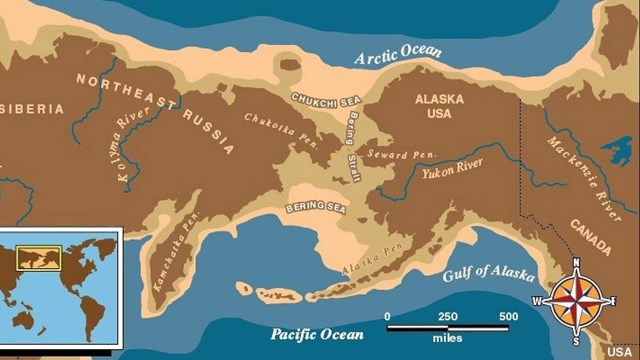
When significant environmental change occurs, most plants and animals have three options: adapt, migrate, or become extinct. The ancient ecosystem represented by fossil plants and animals illustrates each response as the region changed from a wetter grassland savanna to drier, high-desert conditions similar to those still seen today.   Hagerman's beaver and muskrat and many birds adapted giving rise to similar species that are still here today.  Llamas migrated to South America, while camels and horses traveled across the Bering Land Bridge to Eurasia. Ground sloths became extinct, along with mastodons and other large herbivores. With the disappearance of their primary prey, sabre-tooth cats and hyena-like dogs also became extinct.


John Day Fossil Beds National Monument, Kimberly, Oregon

Geology Field Notes:  http://www2.nature.nps.gov/grd/parks/joda/index.htm
Paleontology: http://www.nps.gov/joda/paleo.htm

The John Day River Valley holds some of the richest fossil beds in the world, a record of remarkable continuity during the Tertiary Period of the Cenozoic Era, or the “Age of Mammals”.   While fossil beds that span five million years are rare, this valley records more than 40 million years of the diverse plant and animal life that existed here from 45 million to 5 million years ago.  It is a record of such continuity and duration that scientists can test paleontological theories against the fossil record. Fossil beds contain vestiges of the actual soils, rivers, ponds, watering holes, mudslides, ashfalls, floodplains, middens, trackways, prairies, and forests.  Fossil plants are generally more helpful than animals for understanding ecosystems.  The John Day paleontology staff is working to identify the plant types over time and so they can reconstruct the ancient ecosystems and climates of eastern Oregon.

Artist's rendering of prehistoric forest and mammalsThe climate here changed from warm and moist tropical and subtropical forests into cooler, drier grasslands over the course of 40 million years.  The plant and animal life changed as well.  The evolution of mammals can be followed here from early browsers and scavengers to dogs, cats, pigs, horses, camels, rhinos, and rodents. To these were added bears, bear-dogs, weasels, and a species of early elephant.  Finally the latest formation includes horses, sloths, rhinos, camels, peccaries, pronghorns, dogs, bears, looking more like what we are familiar with today.


Petrified Forest National Park, Arizona

Geology field notes: http://www2.nature.nps.gov/grd/parks/pefo/index.htm
Trees to stone: http://www.nps.gov/pefo/treestostone.htm
Triassic reptiles and dinosaurs: http://www.nps.gov/pefo/triassicreptilesamphibians.htm

During the Late Triassic Period, (225 million years ago) the area of Arizona that is now Petrified Forest National was located near the equator on the southwestern edge of the landmass known as "Pangaea".  This tropical location resulted in a climate and environment very different from today, a large lowland basin with numerous rivers and streams flowing through. The lush landscape included coniferous trees up to nine feet in diameter and towering almost two hundred feet tall. Ferns, cycads and giant horsetails grew abundantly along the waterways.  Crocodile-like reptiles, giant fish-eating amphibians and small dinosaurs inhabited the land and water. Petrified Forest National Park is one of the world's greatest storehouses of knowledge about life on earth when the "Age of the Dinosaurs" was just beginning.

Petrified woodOver time, as trees died, some were deposited on the flood plain adjacent to the rivers and others were buried in the stream channels. Most of the trees decomposed and disappeared. But a few trees were petrified, becoming the beautiful fossilized logs visible today. Most of the fossilized logs are from a tree called Araucarioxylon arizonicum. Two others, Woodworthia and Schilderia, occur in small quantities in the northern part of the park. All 3 species are now extinct.

 Fossils of many different kinds of early dinosaurs have been found.  Just a few are described here.   Chindesaurus was an early primitive dinosaur.  It was 8 to 12 feet long from head to tail, with sharp, sickle-shaped teeth indicating a meat diet. Lightly built with exceptionally long hind legs, it may have been one of the fastest land-dwellers in this area. This speed helped it overtake its prey.  Placerias gigas, a large, bulky plant-eating reptile weighing up to 2 tons. It had strong but toothless jaws and probably lived on a diet of tough, fibrous plants.  Large tusks may have been used to dig up roots and tubers for food.  Smilosuchus gregorii may have reached 30 feet in length. They lived a crocodile-like life in the rivers and lakes preying on fish and smaller animals. Bony plates protected the body and tail.