My home was always over at Birch Creek. That is where I grew up. It was only us who lived there--my father (Chief Peter), mother (Celia), my poor little sister (Helen), my old grandpa--Evan--who was the father of the one I stayed with (married). And my little uncle (Roosevelt John) and his mother, who was also my real grandma. It was after I grew up that we started traveling to Minchumina. Two of my dad's brothers (Andrew and William) lived at Minchumina.
All of us are like one. I had relatives all over--distant ones at Toklat and different places. People would always come among us from down around K'os Chak'et (Cos Jacket), and from down the Kuskokwim River and Birch Creek. My mother was from Nenana. Our real grandparents, my dad and his siblings used to live down in Telida . . . my poor old uncle called Sesui was my dad's brother-in-law.
That one (Sesui) really liked and cared for us. He talked to us lovingly like he was really related to us--like the one who raised us. He would start from way down near Telida. He would come up this way from under the mountain following the hills to the head of Birch Creek area; there are creeks curving right behind one another. Around there he crossed them. Finally he made his way into K'eeyh Tl'ot No' (Birch Creek headwaters). Now, an old beat-up canoe was around there. He would take it down from where it hung and repair it with pitch. He put it into the water and then he would travel.
He brought us special things. He put bone marrow in the canoe for us. And caribou kidney and feet, too. In the canoe it's like this--he would have a lot of things in a bundle lashed down. As he approached us, he would say, "Come, my children. Wait there."
From the bank we would call, "Mom, uncle is coming!" So we stood there after having come down to the beach. We stood there and meanwhile, from under the bow--from there he pulled out the bag. He also had some good dried meat.
Every year he came to see us, summer as well as winter. Really, really `uncle'!, we always called him. Though not a blood relative, he was really related to us because he was so caring.
I lived with my parents at Denalee, at the foot of it. We moved around on the hills. From Birch Creek we went up and over hills. We came to Toyan' Kok'e ("straight stretch" along the McKinley River). We went around and then over on the other side we came to another bend in the river. Back from there we came to the uppermost long stretch. Across from there are hills. At that spot is a sharp overhanging ledge. It is like under a porch. There we would always camp--there under the hill. From above there you could see the mountains. Way up we would move over another hill looking for caribou where the river comes out from the mountains. At the head of the river the ice is like this (glacier?). It is dangerous there because of the ice. Around there where the caribou would be found, we would go annually.
Beneath the overhanging ledge it is like a porch--like on a house. Willows grow around there, so when it rains it is sheltered. That is where we camped all the time--way out there where the hill sticks out. It is really nice. Underneath the overhang is where we put up our tents. There is lots of room there. Part of it looks like a doorway; that is where we went. Over this way is where we made a smokehouse. We dried caribou, sheep--everything. Anything we caught, we dried it there. We made dry meat just like drying fish. After that we would start back down to Toyan' Kok'e. Down to the middle (halfway?), is a big cache. I grew up seeing that cache; it was built before I was born.
At Tegheelenhdenh ("where current flows to the side," slough; Slippery Creek?) there is a two-story cache--one cache on top of another. A post extends even farther up. It is bound with roots. My dad's father built it a long time ago. It is made from four standing trees. The stumps have been smoothed off where the roots are showing. The roof is made of bark--two layers facing each other. On the inside of the roof the bark faces up. On the floor, the bark is crisscrossed--in opposite directions. Holes were drilled with an auger and pegs driven in. The ladder was from a tree with steps cut out. So that is how he built it. One summer when we stayed there (about 1910), we repaired it--braced it from the top on down with two poles. Then it was covered with overlapping pieces of bark. It was real nice in there. The trees have been cleared off around it so squirrels and things like that won't be able to jump on it. Nothing is able to get at the food. I wonder if my old grandpa's cache is still standing.
Around Toyan' Kok'e was where I used to hook up two dogs and they would take off with me. I used to go real fast. My dogs would be racing me along and there was no one around to see me. I would go through the trail real fast with the dogs breaking sticks along the way on a real nice smooth area--level ground.
It looks like there was a forest fire around there a long time ago. There was a new growth of trees and they were just thick. There were patches of moss or something, here and there, otherwise it was smooth. There were some big trees around the riverbank in places where the fire had not reached. So there were occasional wide spaces.
Across the way--very far--it appears the forest fire reached across, because there was an open distance between the trees on the other side. That's why that area used to be really good for traveling around--smooth like a sandbar. There were some berries, those berries with long strings. The ground was red with them.
The trees were easy to clear because the topsoil burned up and you could just push the tree over. So we would knock over spruce trees, and drag them away with the stump. The area we cleared was like a mail trail, like a road. The last time I was there, there wasn't that much growth (between 1910-1920).
We just traveled back and forth around there for fun--on this wide area. There was a place around there the whitepeople called Diamond. Diamond was a little ways back from there. So you'd go over the trail from there (Diamond?) and there was the place called Khutenal'eedenh ("hidden place"). That was where we used to camp for fishing every year.
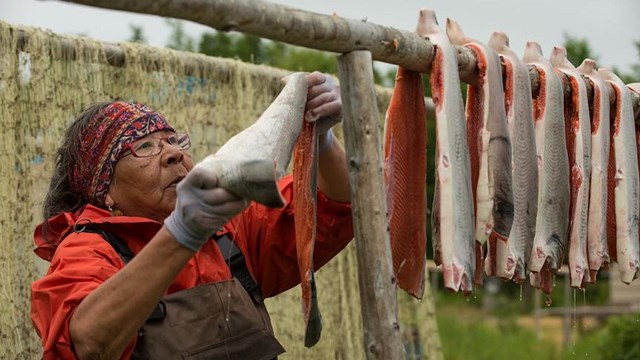
There were a lot of chum salmon around Khutenal'eedenh, at that time. They would go there and make (summer) dry fish. They would also put away frozen fish after freeze up. Just during the freezing up month (October) the last of the chums would come with all their faces worn away from traveling over rocks and so on. They fished for those with hooks or spears. They picked out the good ones, split them, and hung them up. It is called Ch'enok'et ("mineral lick"). So that was a really good area; it provided us a good living.
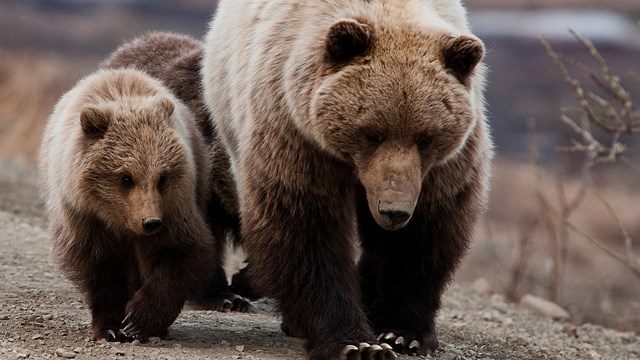
From way up at the (Moose Creek?) canyon--it goes like this around a bend--like this and that is where Khutenal'eedenh is at. There was also Neech'oolakhdenh ("where something swims to and spawns"). Oh, that was a dangerous place because the old living things (brown bears) went there for the dead fish. Those animals used to walk back and forth in the water up there.
I was with my parents--mother, me, dad, and my younger sister. We camped at the foot of Denalee again. On our way down, we crossed streams feeding into the headwaters
Finally, we turned towards Telida. On a tributary we made camp inside a bend, as my dad was going to make another trip to Tanana. That was the time my mother got hurt.
It happened at the head of the Telayde on a stream that runs off of Denalee, where there is a canyon. A little ways down stream . . . there is a place where the river rechanneled and that is where we used to live. It glaciers over there. It had rained. She was making a trip to pack out meat and slipped with the pack on her back. She smashed three vertebra in toward her stomach. My dad was gone at that time. He was staying at the church school down at Tozee Chak'et (Tanana). He was gone a long time. He didn't know that mom was near death.
So it was in the fall, after the leaves had fallen and it was almost time to snow. My dad said to the ministers, "I came here from a long ways--from under the Denalee and so I have to go home to my family before it gets too late." So they let him go.
So he started back up the river. He came to the fish camp on the Khenteeth No' (Kantishna River) where people were staying at a place where the wind blows. They said to him, "Stay overnight." They wanted him to make medicine for two people who were sick. So he started to make medicine and all of a sudden he fell to the ground and spirits who predicted things for him entered his body. They said to their father, "There's lots of trouble back home. Things are really poor there. You should really try and rush home."
He told his children (spirits), "Go home and keep her alive." So it was that one of the spirits returned home and one stayed with my dad, watching over him. That was when he traveled from far down the Kantishna River all the way to Birch Creek without stopping, paddling in the dark. The current around there gets very swift sometimes.
From the head of Telida where we were, it took four days to move down to Telida. Normally it would take two days. Dad made some sort of hammock in the sled for mom to lie on while we traveled, but it was still painful for her. He'd have to be real careful about not bumping the sled too much.
We were home by ourselves and we tried our best. We would take a little marrow and give her some. We tried putting plant juice mixed with water with food, but it didn't help much. He would also add a little bit of sugar to the gravy, but we didn't have much sugar. We could not get birch sap in the fall because it dries up. But we had berries that we'd picked earlier in the summer.
While we were at Telida, people came to help mom from a place a little ways down river called Ch'idrohtanedinh (East Fork of the Kuskokwim River) and also from further down river. Medicine people, who spoke differently, came. My grandpa, who was a medicine person, was at Telida, too. My dad kept her alive all this time waiting to receive help from the others. When they arrived, it was as if he was scolding the other medicine people in an effort to solicit their help.
We stayed at Telida for four years. Five years after she got hurt we finally got back to Minchumina. After she got better, we started moving around again, seasonally. But she would always have to have a brace on her back when she walked.
After my mother was able to walk around with a cane, then my dad and others had a memorial potlatch (between 1900-1910) for their parents at Khutenal'eedenh under Dineedzeel T'oh Denh.
My mom had gotten better so she would lean back and sew things for the potlatch. She made boots, moccasins, socks, hats, beaver hats--a lot of those. They made a lot of clothing. The valuable moose skin that I tanned with my dad's help--they used that just for boot bottoms. Lighter skins for the tops and mittens. Some of the heavy moose skin was used for the palm where it would wear most. That way they would save it and make it go a long way--the skin I tanned. They were also saving things they had gotten from Tanana. They had some commercially-made clothes, too. My dad would practice singing his potlatch songs. He sang all the songs that he would sing at the potlatch and he did a lot of sewing, too.
Before he died--just before he died (1913)--he made a "good time" for the last time. He had a memorial potlatch at Minchumina in the winter (1911). It was for his little brother, William, and his aunt, Saaggon. That was the time people came from the Mission (Tanana). People came from Cos Jacket--all the people from down around there came up. There was no room in the houses. There were only three houses there and we were all crowded.
That was the time my dad, Ella, and my small uncle--Ella's husband--started out to K'os Chak'et (Cos Jacket) with the news of the potlatch. There was a trail down there. They started out, but people had heard about the potlatch earlier, so they met them coming up near an ancient village--where the trail forks. There was a big camp and they were on their way to Minchumina. They were informed of the potlatch, but they had known about it since last summer.
One year it took him to get ready for this potlatch. In the springtime he hunted otter and beaver. He finished that and then he came out with this little boat. He went back up the Kantishna River to Birch Creek. Before the potlatch, he practiced singing his potlatch songs. It was after freeze up in the fall. He stayed at a place all by himself, hunting and trapping. When he came home he got sick. Then he got a little better.
He also acquired things from the Mission and wherever the white people were staying. He had a pile of blankets--this high. They were in bundles. There was a lot of food, too. There was men's and women's clothing and furs. The furs were marten, otter, beaver, and others; a lot of the fur bearing animals my dad had worked to get--the winter and summer before.
About two years before the potlatch, I had started hunting by myself. Sometimes I would even catch moose when I went out for wood. I would shoot it just like shooting rabbits--it was easy. I wasn't afraid of it. I used to do the same thing with caribou. The potlatch was before Walter's dad married me (John Evan). I was the main worker for my family then, as my dad was not well. That was the time my dad said to me, "I'll save all the good food for you because you are the one who is putting on this potlatch. It is your food that we are having the potlatch with."
Before the potlatch we had gone hunting in the hills. We went to Noo Ghuyat'an'denh ("place visible through the island") and left things there. At that place was a cache that my grandpa built. I hauled the stuff we had gotten ready ahead of time--little by little. First, I hauled it to Tso Ch'ekaan ("beaver lodge"; Sevenmile Hill?). Then I took it all to Minchumina where I got things ready. We returned to Noo Ghuyat'an'denh after freeze up. I started hauling things from there again. My dad said to me, "My child, did you get everything?"
I said, "Yes. There is a little more at Noo Ghuyat'an'denh at the cache. We'll just pick that up." I made five trips. The last trip was all food. Meanwhile, they were getting their few little things ready to move up from Birch Creek. They stored things away that they kept there.
My dad was the cook. He cooked and cooked for the potlatch; he served the men himself. After the potlatch when people left, the men went up to the mountains. Ella was my husband's older sister. She was the one who said to my father, "We don't want any of the stuff that you are giving away at the potlatch. You are going to give us a little sister (sister-in-law). All we want is her." It was a year after the potlatch that John Evan started staying with us (married me).
It was after I became an old lady--with my first husband when we had two childrenthat we went to Cos Jacket (about 1914). One time we were there during the (summer) holidays when they were having a good time. A lot of people were there. There were people there from Nenana, Toklat (River), also people from Minto, and Tolovana. They all came together like this at CosJacket. The people (relatives) who were putting on the potlatch were the ones who took the boat from us. So we were like this--poor. To our surprise, they took the boat to give away that we had just made that spring. It was a big rowboat. They didn't even pay us well for it. After that, while the good time was going on, we sneaked back that way up the river. We cut wood for a (another) boat. It took us four days to cut enough boards for a boat.
It was after I had two children that I started eating fresh food and head soup. It was when we went to Cos Jacket when they were having a potlatch. We went there and my Uncle Peter Henry was serving the food. He brought out this pot of head soup. He took my dish and started to put some in it and I said, "Don't! I don't eat head." He looked at me and said, "You mean you have gray hair and children and you still don't eat it? See those girls back there, they are way younger than you. They are just children and they eat head soup."
Reference
Abbie Joseph
1982-3 Interviews with Dianne Gudgel-Holmes and Eliza Jones. Audio tapes 1-14. Transcribed and translated from Koyukon by Eliza Jones, Alaska Native Language Center, University of Alaska, Fairbanks. Edited by Dianne Gudgel-Holmes, Anchorage.