National Park Service arrowhead logo National Park Service, US Department of Interior
Visit ParkWise!Home for ParkWiseTeacher Resources Student Resources
Activities
Data
Reference Library
Park Facts
Links
Maps
Photo Gallery

ParkWise > Students > Links

National Parks in Alaska

For parks outside Alaska visit the NPS Park Guide.

Alagnak Wild River - is located in the beautiful Aleutian Range. The river provides unparalleled opportunities to experience the wilderness of the Alaska Peninsula.

Aleutian World War II National Historic Area - encompasses the historic footprint of the US Army base Fort Schwatka. Located on Amaknak Island in the Aleutian Island Chain of Alaska, the fort was one of four coastal defense posts built to protect Dutch Harbor (the back door to the United States) during World War II. The fort is also the highest coastal battery ever constructed in the United States. This National Historic Area helps interpret, educate, and inspire present and future generations about the history of the Aleut or Unangan people and the Aleutian Islands in the defense of the United States in World War II.

Aniakchak National Monument & Preserve - contains the Aniakchak Caldera, which is nearly six miles in diameter and and covers some ten square miles, it is one of the finest examples of dry caldera in the world. Located in the volcanically active Aleutian Mountains, the crater contains many outstanding examples of volcanic features, including lava flows, cinder cones, and explosion pits.

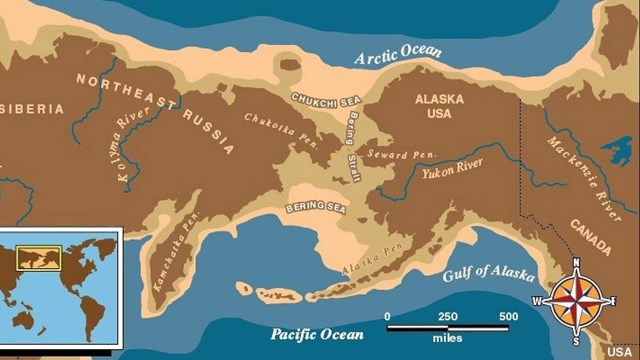
Bering Land Bridge National Preserve - is one of the most remote national park areas, located on the Seward Peninsula in northwest Alaska. The Preserve is a remnant of the land bridge that connected Asia with North America more than 13,000 years ago. The majority of this land bridge, once thousands of miles wide, now lies beneath the waters of the Chukchi and Bering Seas.

Cape Krusenstern National Monument - is a treeless coastal plain dotted with sizable lagoons and backed by gently rolling limestone hills. Cape Krusenstern's bluffs and its series of 114 beach ridges record the changing shorelines of the Chukchi Sea over thousands of years.

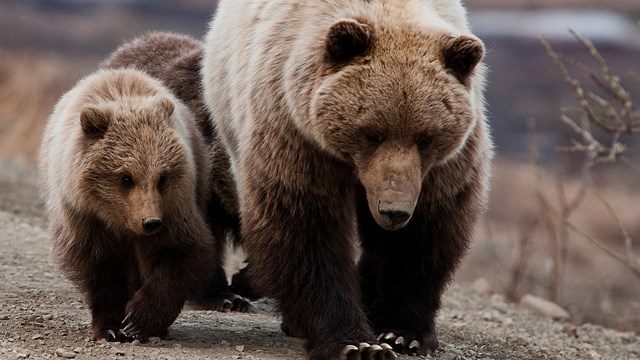
Denali National Park & Preserve - features North America's highest mountain, 20,320-foot tall Mount McKinley. The Alaska Range also includes countless other spectacular mountains and many large glaciers. Denali's more than 6 million acres also encompass a complete sub-arctic ecosystem with large mammals such as grizzly bears, wolves, Dall sheep, and moose.

Gates of the Arctic National Park & Preserve - in Alaska's Brooks Range, is a vast and essentially untouched area of superlative natural beauty and exceptional scientific value with unique opportunities for solitude, wilderness travel, and adventure. It is a maze of glaciated valleys and gaunt, rugged mountains covered with boreal forest and arctic tundra vegetation, cut by wild rivers, and inhabited by far-ranging populations of caribou, Dall sheep, wolves, and bears.

Glacier Bay National Park & Preserve - is a marine wilderness that provides opportunities for adventure, a living laboratory for observing the ebb and flow of glaciers, and a chance to study life as it returns in the wake of retreating ice. Amidst majestic scenery, Glacier Bay offers us now, and for all time, a connection to a powerful and wild landscape.

Katmai National Park & Preserve - is famous for volcanoes, brown bears, fish, and rugged wilderness and is also the site of the Brooks River National Historic Landmark with North America's highest concentration of prehistoric human dwellings (about 900). Katmai National Monument was created to preserve the famed Valley of Ten Thousand Smokes, a spectacular forty square mile, 100 to 700 foot deep, pyroclastic ash flow deposited by Novarupta Volcano.

Kenai Fjords National Park - is a pristine and rugged land located on the southeastern Kenai Peninsula. The mountains are mantled by the 300-square mile Harding Icefield, 35 miles long and 20 miles wide. Land mammals have established themselves on a thin life zone between marine waters and the icefield's frozen edges. Bald eagles and thousands of seabirds inhabit the steep cliffs and rocky shores. Kayakers, fishermen, and visitors on tour boats share the park's waters many types of marine mammals.

Klondike Gold Rush National Historical Park - celebrates the Klondike Gold Rush of 1897-98 through 15 restored buildings within the Skagway Historic District. The park also administers the Chilkoot Trail and a small portion of the White Pass Trail. Included in the park is a portion of the Dyea Townsite at the foot of the Chilkoot Trail.

Kobuk Valley National Park - is encircled by the Baird and Waring mountain ranges. The park provides protection for several important geographic features, including the central portion of the Kobuk River, the 25-square-mile Great Kobuk Sand Dunes, and the Little Kobuk and Hunt River dunes.

Lake Clark National Park & Preserve - stretches from the shores of Cook Inlet, across the Chigmit Mountains, to the tundra covered hills of the western interior. The Chigmits, where the Alaska and Aleutian Ranges meet, are an awesome, jagged array of mountains and glaciers which include two active volcanoes. Lake Clark, 40 miles long, and many other lakes and rivers within the park are critical salmon habitat to the Bristol Bay salmon fishery, one of the largest sockeye salmon fishing grounds in the world.

Noatak National Preserve - is one of North America's largest mountain-ringed river basins with an intact ecosystem, and features some of the Arctic's finest arrays of plants and animals. The Noatak River is classified as a national wild and scenic river, and offers superlative wilderness float-trip opportunities - from deep in the Brooks Range to the tidewater of the Chukchi Sea.

Sitka National Historical Park - was established in 1910 to commemorate the 1804 Battle of Sitka, and is Alaska's oldest federally designated park. Totem poles and a temperate rain forest setting combine to provide spectacular scenery along the park's coastal trail, which also passes the Memorial to the Russian Midshipmen who died in the Battle of Sitka. The Russian Bishop's House is one of three surviving examples of Russian colonial architecture in North America.

Wrangell - St. Elias National Park & Preserve - where the Chugach, Wrangell, and St. Elias mountain ranges converge, is often referred to as the "mountain kingdom of North America." This is the largest unit of the National Park System and includes the continent's largest assemblage of glaciers and the greatest collection of peaks above 16,000 feet. Mount St. Elias, at 18,008 feet, is the second highest peak in the United States. Adjacent to Canada's Kluane National Park, the site is characterized by remote mountains, valleys, wild rivers, and a variety of wildlife.

Yukon-Charley Rivers National Preserve - protects 115 miles of the 1,800-mile Yukon River and the entire Charley River basin. The Charley, a 100-mile long wild river, is considered by many to be the most spectacular river in Alaska. Peregrine falcons nest in the high bluffs while the rolling hills are home to an abundant array of wildlife. Paleontological and archeological sites teach us of the environment thousands of years ago. Rustic cabins and historic sites are reminders of the importance of the Yukon River during the 1898 gold rush.