|
ParkWise
> Students >
Activities> Math
Practice > Converting between meters and feet
Math
Practice:
Converting between meters and feet
Assume 1 meter = 3.3 feet,
or 1 foot = 0.30 meters
- The Novarupta volcano
in Katmai National
Park and Preserve is 4860 feet high. What is it's height in
meters?
- In June of 1912, the
severe earthquakes rocked the area around Katmai
National Park and Preserve for a week before the Novarupta
volcano exploded. For several days volcanic ash, rock and gas
were ejected and darkened the sky over most of the Northern Hemisphere.
When it was over the nearby land lay under 200 meters of volcanic
ash and rock. How deep was this in feet?
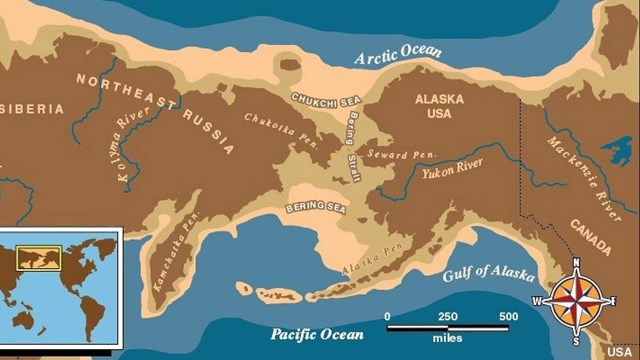
- About 20,000 years
ago, so much of the earth's water supply was locked up in huge
ice masses that the sea level fell 280 to 350 feet below today's
level, exposing vast areas of land formerly under water. The result
was a land bridge between Siberia and Alaska called the Bering
Land Bridge, now part of Bering
Land Bridge National Preserve. Most archaeologists agree that
it was across this land bridge that humans first came from Asia
to populate the Americas. How far did the sea level fall in meters?
- When gold was discovered
in Alaska and the Yukon in the 1890s, tens of thousands of prospectors
headed north. The Chilkoot Trail into Alaska (now preserved with
Klondike Gold
Rush National Historic Park) was treacherous because of the
steep slopes leading to the pass. Prospectors took the ferry up
from Seattle to Dyea. The trailhead at Dyea is at sea level. Prospectors
hike up to Chilkoot Pass at 3600 feet in elevation and down to
Bennett at about 2200 feet. How many meters in elevation did they
gain between Dyea and the Pass? How many meters in elevation did
they lose between the Pass and Bennet? What is the difference
in elevation between Bennet and Dawson, expressed in meters?
- The steepest part
of the Chilkoot Trail runs from Sheep Camp to the Chilkoot Pass.
a) Along this stretch of trail , prospectors climb from an elevation
of approximately 1,000ft to approximately 3700ft. Express the
elevation gain in meters.
b)The horizontal distance from Sheep Camp to the Pass is 7.7 kilometers
(i.e., as measured on a flat map). Do prospectors travel farther
horizontally or vertically?
c) Extra Credit: Using the Pythagorean Theorem, estimate
the length of the trail from Sheep Camp to Chilkoot Pass -- not
the length as measured on a flat map, but as a person would walk
along and up it. Express your answer in both meters and feet.
- Glacier
Bay National Park and Preserve is home to a variety of marine
mammals. Orcas (also known as killer whales) hunt in teams and
have no natural enemies, they are a toothed whale and smaller
than most balleen whales, males average 23 feet long, and females
less. Orcas are thought to be highly intelligent. The North Pacific
population of minke whales is thought to be between one-fourth
and one-third of its pre-whaling numbers. Minkes can be as large
as 33 feet long. Humpback whales are the most acrobatic of whales
and a breaching humpback (heaving itself leaping and turning out
of the water) is an exciting sight to see, but they are currently
considered an endangered species. Humpbacks average 40-50 feet
long, with females larger than males. Express the size of each
of these three whales in meters.
- The Harding Icefield
of Kenai Fjords
National Park is a massive 300 sq mile mass of ice receiving
35 - 65 feet of snow annually. Time and weight of the snow transforms
the underlying snow to ice which flows out in a series of glaciers.
Along the coast eight of these glaciers reach the sea. How many
meters of snow does the Harding Icefield receive annually?
- Lake Clark National
Park and Preserve preserves a rugged landscape. Iliamna (3053m)
and Redoubt (3108m) are active volcanoes within the park. Lake
Clark is a very deep (302m), long (65km) lake. Express these measurements
in feet.
- At 20,320ft, Mount
McKinley is the highest mountain in North America. Rising from
2,000 ft lowlands in Denali
National Park and Preserve, it's veritcal relief (how high
it is above the surrounding land) is approximately 18,000 ft,
greater even that of Mt. Everest. Mt. McKinley's north summit
is North America's second highest peak at 19,470 feet. Express
the peak elevations and vertical relief in meters. Extra Credit:
How many miles high is Mt. McKinley?
- The Tlingit peoples
of southeast Alaska carved elaborate totem poles telling the stories
of their culture. Today replicas of these totems are on display
within Sitka
National Historic Park. For example the K'alyaan Pole pays
tribute to the Kiks.ádi Leader K'alyaan who led his people in
battle against the Russians. It also serves as a memorial to the
Kiks.ádi people who lost their lives during the battle. This pole
is 10.5 meters tall. The name of the pole, Haa leelk'u has Kaa
sta heeni deiyi Pole, roughly translates to "our grandparents
who were the very first people to use the Indian River and the
other people who were here too." This pole is 10.8 meters tall.
How tall are these poles in feet. A young student visiting the
park is 5 feet tall. How much taller than her are these poles?
|