On December 1, 1978, by presidential proclamation under the authority granted in the Antiquities Act of 1906, Wrangell-St. Elias National Monument was created. It encompassed almost 11,000,000 acres of land in south Alaska adjacent to the Canadian border. In 1980, in the Alaska National Interest Lands Conservation Act (ANILCA), the monument was expanded and redesignated as Wrangell-St. Elias National Park and Preserve (WRST). WRST is the largest unit of the National Park Service. In Canada, adjacent to and contiguous with WRST is Kluane National Park. The two parks together form the largest area of protected land in the world and it has been designated as a World Heritage Site.
The implementing language for the 1978 Monument called for preservation of areas with significant geological, ecological, biological, archeological and historic features, among others. The general language of ANILCA echoes the 1978 proclamation. The specific implementing language in ANILCA for Wrangell-St. Elias says that the park and preserve shall be managed to maintain unimpaired the scenic beauty and quality of high mountain peaks, foothills, glacial systems, lakes, and streams, valleys and coastal landscapes in their natural state; to protect habitat for and populations of, fish and wildlife....;and to provide continued opportunities including reasonable access for mountain climbing, mountaineering and other wilderness recreational activities. Subsistence uses by local residents shall be permitted in the park, where such uses are traditional.
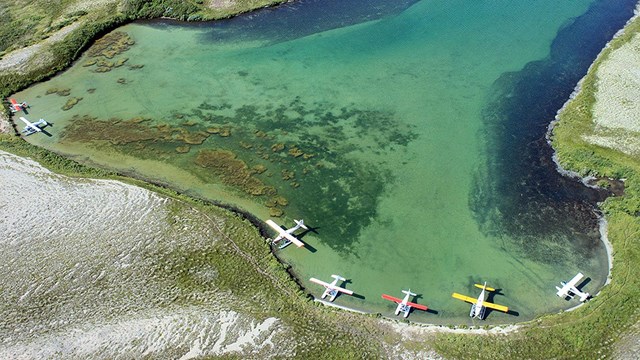
This park and preserve is one of the most accessible in the Alaska Region. The Alaska Highway and the Richardson Highway provide road access to the north and west boundaries of the park while the Glenn Highway provides access from Anchorage. Two rough roads provide access into areas of the park. One, the McCarthy Road (which follows an old railroad bed), runs 60 miles into the southern preserve to the small town of McCarthy and the Kennecott mine and town. The other road, the Nabesna Road, in the northern preserve and 46 miles long, runs to the small village of Nabesna. Access to more remote areas is by small plane, foot and occasionally by pack train. The western boundary roughly follows the Copper River and the eastern boundary is the international border. The far southeastern boundary stretches to the Malaspina Forelands and Yakutat Bay of the Gulf of Alaska.
Land Ownership
Wrangell-St. Elias National Park contains 8,331,000 acres and the Preserve contains 4,856,000 acres (a total of 13.2 million). In both together there are 9,677,000 acres in designated Wilderness status. Even though the percentages of land within the park and preserve that are not within federal ownership or are under application are small compared to the overall acreage, in total the acreage is enormous. There are 709,00 acres in non-federal ownership and an additional 925,000 acres under application for transfer to the State of Alaska and native ownership. A majority of the this land (1,400,000 acres) is held by or applied for by local native corporations. These include Ahtna Regional Corporation, Chugach Alaska Corporation, Gakona Village Corporation, Mentasta Lake Village Corporation, Nabesna Native Group Village Corporation, Tazlina Village Corporation, and the Twin Hills Native Group Village Corporation. Included in these lands are 32,608 acres of cemetery/historical (14(h)1)site applications and 4000 acres of native allotments. There are also about 15,000 acres of mining lands and small tracts. One of the inholdings is the Kennecott copper mine and town, which is a National Historic Landmark. The extent and range of these holdings indicate the presence and value of prehistoric, historic and ethnographic resources in this park.
Environment
The principal features found in the park and preserve that initially led to its inclusion in the National Park Service system are those of the natural environment, and include spectacular mountain ranges, glaciers, active volcanoes, and wildlife. The entire region lies within the Pacific Mountain System, which is a belt of high mountains bordering the Pacific Ocean. The park and preserve contain vast areas of extremely rugged high mountain terrain. Major ranges include the Wrangell, St. Elias, Chugach, Mentasta, and Nuzotin mountains. While separately named, these ranges are not physiographically distinct. In fact, the Mentasta and Nutzotin mountains are actually an extension of the Alaska Range, and they eventually grade into the Kluane Mountains in Canada. The Wrangell and St. Elias mountains form one continuous range running into Canada, and the Chugach Mountains merge with the St. Elias Mountains in the southeastern part of the unit. These mountains together form a rugged chain along the north coast of the Gulf of Alaska. They trap much of the moisture-laden ocean air, which causes heavy precipitation and heavy glaciation. The Wrangell Mountains have a large ice cap that feeds many large valley glaciers, and a group of volcanoes rise abruptly from the Copper River lowlands. Six volcanoes at altitudes from 12,000 to 16,500 feet form the greater part of this range. Recent eruptions include late prehistoric eruptions about 50 AD, 400 AD and an eruption of Mt Wrangell in 1930.As part of the Ring of Fire that encircles the Pacific Ocean, the area is tectonically very active.
WRST has been, and still is, affected by the glaciations of the Pleistocene and Holocene. The Wisconsin glacial cycle began by 37,000 years age and continued to approximately 8000-12,000 years ago. It is important to note that glacial margin habitats not withstanding, even as recently as 8000 years ago most of the park land was glaciated (an exception possibly would have been the coastal areas). By approximately 6000 BP, the glacial ice had receded nearly to present-day distributions, and modern plant and animal communities had colonized the area. Glacial topography and climatic effects are still important factors in this area.
WRST contains three climatic zones - continental, marine. and transitional. North of the Wrangell Mountains the climate is continental, also known as "cold snow forest." As in much of Interior Alaska, this zone is relatively dry, hot in summer and extremely cold in winter. The coastal area is within the marine, or temperate zone, which has moderate extremes of temperature and heavy precipitation. The transitional zone lies along the southern flank of the Wrangell Mountains, encompassing the Chitina to McCarthy area. Extremes of temperature and precipitation fall between those of the continental and marines climatic zones.
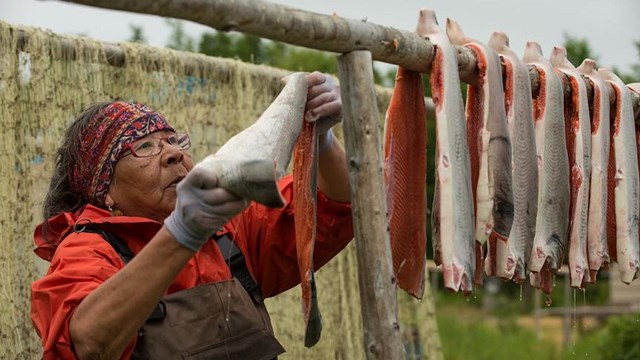
The wide range of elevations, climates, and econiches in the 13.2 million acre park and preserve results in an equally wide range of growing conditions and the resultant vegetation communities and animal populations. The unit contains nearly all of the major vegetation types found in southcentral, southeastern and interior Alaska. Because the area of the park and preserve includes portions of five mountain ranges, much of the surface terrain is composed of steep, rocky slopes, talus and ice. Loamy soils occur on lower slopes, but in many cases these are poorly drained and boggy, or drier and gravelly. Well-developed, loamy, alluvial soils occur along streams or in valleys. With the exception of the coast, permafrost is pervasive throughout the area. In general, four major vegetation communities are present in the park and preserve. Coastal Spruce-Hemlock Forest is present along the shoreline from sea-level to the tree line. Areas of potential logging include the Bremner River area. The Closed Spruce-Hardwood Forest is more widespread and can be subdivided to reflect dominant species. Much of this also fits into the category of boreal forest. In the higher elevations, alpine tundra is common. At lower treeless areas can be found wet or moist tundra which is dominated by sedges and cottongrass. As one of the largest protected ecosystems in North America, WRST supports populations of at least 32 species of mammals, 127 species of birds, 16 species of fish and 1 amphibian. The Copper River and its tributaries support large salmon runs which were and are important subsistence resources for local residents.
Archeological Resources
WRST contains an important grouping of Athabaskan prehistoric and historic archeological sites. The sites include numerous villages, camps, and hunting sites of these people, as well as the remains of other cultural groups such as the Tlingit and Eyak Indians, and the Chugach Eskimos. Important sites include Taral, Cross Creek, Batzulnetas, and the "TLXYK TWGD" camp. In addition to aboriginal sites, the park and preserve also contains historic ruins and structures representing the periods of exploration, mining, transportation, etc. The primary values of the cultural sites in WRST lie in the contribution they can make to our understanding of human interaction with the WRST environs over time, aboriginal culture change and adaptation, the results of culture contact between native and Euroamerican groups, and the development of Alaska after contact. The sites represent a continuum spanning from the prehistoric period to the historic period, including historical times.
Available archeological data, historical and professional accounts attest to the fact that all of the major drainages within and bordering the park and preserve are rich in archeological values, and the site potential of upland areas away from the drainages is also good. In actuality, very little of the unit has seen the type of basic work needed to locate and evaluate archeological resources. Recorded prehistoric and ethnographic sites in WRST now number ten prehistoric sites and forty-three ethnographic sites. Historic sites and structures, mostly associated with mining, which, of course, have associated historical archeological values, number over 100. These sites have been inventoried by the Cultural Resources Mining Inventory and Monitoring Project.
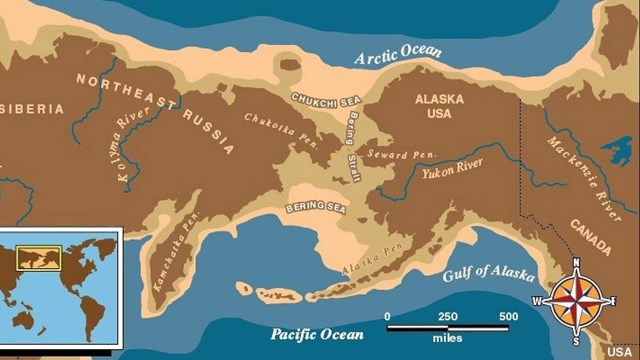
What is known of the cultural chronology in WRST is that it mirrors facets of Western Subarctic, Interior Alaska, and northern Northwest Coast prehistory. Early remains found in Alaska represent occupations by more than one ancient culture for the period 8000-15,000 years ago. Although it is not yet clear which ancestral groups began the lineages that led to the historic Athabaskan and northern Northwest Coast inhabitants, it is likely that these antecedent strands cross-cut and intertwined with each other over the landscape over time.
Early sites in the Interior, including Healy Lake, Dry Creek and Swan Point give us dates of around 11,000 BP. Variously called the Northern Paleoindian tradition, the Nenana Complex, or the Northern Cordilleran tradition, the exact relationship between these archeological components is blurred by the "sands of time." In general, they seem to represent groups of "Amerind" (non-Eskimo) people related to the "fluted point" cultures of Clovis, Folsom, Plano and Agate Basin that flourished in North America south of the great ice sheets about 11,000 BP. A few researchers see the ancestral Athabaskan strand in these cultures.
The next cultural entity that can be clearly distinguished in the archeological records of Alaska is the people of the Paleoarctic tradition. Paleoarctic occupations in Alaska cluster around 10,000 BP time range. Local sites that appear to contain Paleoarctic, or the related Paleomarine, component include Ground Hog Bay on the Gulf of Alaska coast, Hidden Falls on Baranof Island, and Chuck Lake on Heceta Island. Dry Creek in the Nenana Valley and Aishihik Lake in the southwest Yukon also have assemblages attributable to the Paleoarctic. Interestingly enough, microblade technology, a hallmark of the Paleoarctic tradition, persisted in the WRST area longer than in the arctic. Some occurrences of microblades have been dated to as late as 2200 BP on the northern Northwest Coast and in nearby inland areas. Microblade technology remained extant until 2000 years ago in such areas as southwest MacKenzie River in western Canada. This phenomenon, sometimes called the Northwest Microblade tradition, seems to have microblades mixed in an lithic assemblage that also includes lanceolate and side-notched projectile points.
However, to add to the confusion, another widespread archeological tradition appeared across Alaska around 6000 BP. Characterized by side-notched projectile points, large unifacially flaked knives and unifacially flaked endscrapers, the Northern Archaic tradition seems to have its antecedents in the Archaic cultures of the boreal forests south and east of Alaska instead of Siberia, whether by migration or diffusion is not known. Assemblages that contain side-notched points are often found with microblades as well. This has led to some controversy over exactly what and who does the Northern Archaic tradition represent, how it arrived in Alaska, and what eventually happened to the bearers of this tradition. This is a significant issue for WRST because several scholars trace the origins of the Athabaskans to this time period and this archeological tradition.
The definitive development of the Northern Athabaskan culture can be traced back to about 1500 BP. From then to contact with Europeans in southern Alaska was a time when ancestors of historic Athabaskan groups inhabited the region and the final development of their traditional cultures occurred. The lack of definitive sites has made it difficult to push this tradition further back then 1500 BP with the Klo-Kut site, on the middle Porcupine River drainage north of the park and preserve, providing the longest unbroken record of an Athabaskan cultural pattern. Numerous sites representing the later Athabaskan tradition, dating to about 800 BP, have been documented along the western boundary of the park and preserve, One of the earliest sites, from around 700 BP is GUL-077, which consists of cache pits and an associated late winter camp situated along the lower Gulkana River. Excavations at the site yielded artifacts made from native copper, bone and antler, and lithics. Major excavations have been conducted at Dakah De'nin's Village, a site situated along the Copper River near Chitina, dated from the protohistoric period. Directly across the river, at Taral, investigations have revealed an historic period occupation.
A better overall view, perhaps, can be seen by reviewing the archeological cultural sequence for the Aishihik-Kluane area of the southwest Yukon, adjacent to the park and preserve. Like other archeological work in the area, conclusions are based on a small sample which needs much more investigations to prove or disprove. The sequence is divided into four cultural phases:
The major trend identified in the Aishihik-Kluane sequence is the long, ca. 3500 year, persistence of the Little Arm phase that was abruptly replaced by the appearance of Taye Lake technology, which then persisted for thousands of years. Whether the Taye Lake phase represents the advent of Athabaskan cultural antecedents is a major research question for this region.
The Malaspina Forelands and Icy Bay area of the park and preserve falls within the culture area of the northern Northwest Coast. Historically the territory of the Tlingit and Eyak native groups, the prehistory of this area shows distinctive differences from that of the Athabaskan Interior. The oldest archeological complexes, from the Ground Hog Bay site and the Hidden Falls site both of which are just south of the Malaspina Forelands, have been assigned to the Paleomarine tradition. This tradition, dating from around 8000 years ago, is a coastal correlate of the Paleoarctic tradition. Some researchers see a Transitional Period from around 6500-5000 years age during which the technological changes occurred that formed the basis for early Northwest Coast culture, but this hypothesis has not yet been well substantiated.
Davis places the advent of developing Northwest Coast culture at 4600 BP, as it is represented by the Component II materials at Hidden Falls. Davis also defines a Middle Phase with a temporal span of 3000-1300 years ago in which the use of coastal resources continued and intensified. The Late Phase from 1300 BP up to contact time showed changes in the development of larger structures, the introduction of native copper culture tools, the appearance of iron in a few tools, new harpoon forms, and stone bowls and lamps. These remains indicate increased population and complex social organization.
The type of assemblage found in the Late Phase component of Hidden Falls is very consistent with the historic Eyak people who occupied the coast to the west of Icy Bay. Prior to historic contact the Eyak, whose language seems to be related to that of the Haida further south on the Northwest Coast, probably also occupied areas to the south and east, adjacent to the Haida. Sometime between 500-1500 years ago, the Tlingit expanded into this area , wedging between the Haida and the Eyak, displacing them from the Yakutat Bay area.
Historic Aspects
Historic sites with archeological aspects to them are common in WRST. The Copper River, the only water route across the Chugach mountains in southcentral Alaska, has been a major access corridor to the Copper River basin and the Wrangell Mountains since prehistoric times. Coastal and Interior aboriginal groups, apparently engaged in at least limited trade. Copper had served as a Native trade item for at least 1400 years prior to European contact. Copper implements were found along the coast by early explorers beginning with Bering in 1741. An early awareness of the source of the copper was recorded in the English name for the river. History records few penetrations up the Copper River by Russian and American traders and explorers in the first three quarters of the 19th century, although a Russian trader, Klimowski, established a short-lived trading post near present-day Chitina about 1819. In 1885, Lieutenant Henry Allen ascended the river and explored the upper Copper River area before crossing the Alaska Range to the Tanana River drainage. He produced the first published map of the Copper River basin and named Mount Drum, Mount Sanford, and Mount Blackburn. Allen also explored up the Chitina River and named the Chitistone River.
As a result of the 1898 Gold Rush to the Yukon, exploration up the Copper River and its tributaries began in 1898 with a large influx of prospectors and the Ambercrombie expedition of 1899. By 1900 the major copper deposits of Kennecott had been located. By 1911, railroad tracks of the Copper River and Northwestern had reached from Cordova to the mines above McCarthy. The richest copper lode in the world was mined until 1938 when the ore was pretty much gone. By then, the access provided by the railroad (and the railroad bed after the tracks were salvaged) had opened up the area to gold ming, homesteading, fur trapping and hunting activities. Over 725 mining claims or abandoned mining areas exist in WRST today. Most of these areas have archeological potential as historical sites.
Ethnographic Aspects
Approximately 115 Athabaskan sites have been ethnographically documented through oral histories within the park and preserve. These sites include winter villages, hunting and fishing camps, trails, house sites, food caches, caribou fences, and cemetery/historic sites. Settlements have been investigated archeologically at Bazulnetas, just south of the Nabesna road, and at Taral, on the east bank of the Copper River. De Laguna has done major ethnographic and archeological investigations in the Tlingit area around Yakutat Bay.
Prior to, and into, the 20th century three major cultural groups lived in the area of Wrangell-St. Elias National Park and Preserve. Tlingit Indians, occupying the coast from the mouth of the Alsek River northwest to Yakataga, including Yakutat Bay and Icy Bay, were probably the most numerous. Rich marine and coastal resources allowed development of a complex ranked social organization and art style, part of the Northwest Coast cultural area. Eyak Indians occupied the area around the Copper River delta. It is quite probable that they had been pushed off the land around Yakutat Bay and Icy Bay in the late prehistoric time period by the Tlingit.
The interior areas of the park and preserve were occupied by Athabaskan Indians, so grouped because their languages were part of that large language family. The largest group was the Ahtna Indians, represented in the present day by the Ahtna Corporation. They occupied an inland territory that extended from the headwaters of the Susitna and Matanuska rivers eastward to the present-day Alaska-Canada border. The larger group can be divided into five regional bands based on linguistic differences and further split into local bands by geographic locations. Another Athabaskan group, the Tanana, traditionally occupied the area to the north of the Ahtna territory, roughly corresponding to the area of the Tanana River drainage. Only the southeastern part of the traditional Tanana territory lies within WRST. Several bands used this area, including the Nabesna (Northway), Tetlin, and Scottie Creek bands.
Neighboring groups included the Southern Tutchone, an Athabaskan group that lived in the Kluane Lake area north and east of the park and preserve. The White River would have been a travel route to and from the park and preserve area for these and other people. North and west, in the Cordova area, lived several groups of Chugach Eskimos. This group of Pacific Eskimos were also expanding in late prehistoric and protohistoric times. With the Copper River as a major highway to the interior and for trade, there was probably contact between all these groups, with the Eyak and the Ahtna as the middlemen of the trade network. Since there was also conflict between these groups, the extent of trade and cultural exchange between them is difficult to gauge - thus the need for ethnographic and archeological research.
Discussion
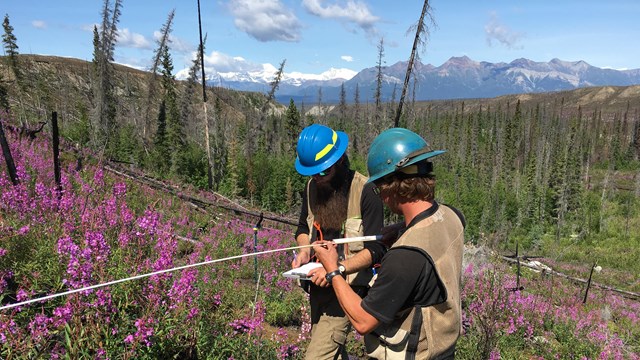
WRST remains the largest unit of the National Park Service and one of the least known archeologically. What is known indicates that there is good potential for the occurrence of prehistoric, historic, and ethnographic sites. The unit has road access and a large number of inholdings which will lead to possible impacts on whatever sites that do exist. The need for a long-term inventory and evaluation program is obvious and should be addressed. Environmental stratification would eliminate millions of acres from consideration for survey due to topographic factors, leaving a relatively possible target of several million acres. By dividing the park and preserve into segments and programming the inventory along those lines and setting reasonable goals for each stage of the program, a long-term program would be affordable and logistically possible.
This area presents numerous opportunities for cooperative research. Kluane National Park, in and native and state land are all adjacent to the park and preserve.
BIBLIOGRAPHY
Questions, Comments, and Suggestions - please send email to: ken_schoenberg@nps.gov