Lake Clark National Park and Preserve


Lake Clark National Park and Preserve (LACL), was created in 1980 under the Alaska National Interest Lands Conservation Act (ANILCA). This act states that it is to be managed "to protect the watershed necessary for the perpetuation of the red salmon fishery in Bristol Bay; to maintain unimpaired the scenic beauty and quality of portions of the Alaska Range and the Aleutian Range, including volcanoes, glaciers, wild rivers, lakes, waterfalls, and alpine meadows in their natural state; and to protect habitats for and populations of fish and wildlife, including, but not limited to caribou, Dall sheep, brown/grizzly bears, bald eagles, and peregrine falcons." Though not specifically mentioned in the implementing language, cultural resources are part of the NPS mandate under the Organic Act and numerous other laws and regulations. In addition, in order to properly manage and interpret the natural environment, animal populations, and plant communities of these units it is necessary to develop a diachronic perspective. Humans have been part of this environment and interactive with it for at least 8000 years. Park and preserve resources continue to be so used by the local rural population, mostly inland Dena'ina, who reside in or adjacent to LACL. The General Management Plan (1984) states that one of the major resources management issues for the park and preserve is the "management and protection of cultural and archeological resources and the opportunity for subsistence lifestyles by local rural residents." The GMP goes on to state that "Past and present uses of the park and preserve will be identified, evaluated and interpreted, and management programs will be developed and implemented to protect cultural values." In addition, "A cultural sites inventory and cultural resources base map will be prepared and maintained ..."

The northern boundary of LACL lies approximately 100 miles southwest of Anchorage, accessible only by air or on foot, through formidable, glaciated passes. The park includes almost all of the rugged Chigmit Mountains, which are located at the convergence of the Alaska and Aleutian mountain ranges. This terrain effectively had isolated this area from the more intensive effects of the early Euroamerican contact that had occurred on the coast. The preserve adjoins the park to the south and west and comprises an area of foothills, rivers and lakes, and tundra plains. The southeast boundary is formed by the coast of Cook Inlet, from Chinitna Bay to Tuxedni Bay. The southwestern boundary runs approximately 30 miles north of Lake Iliamna.

Land Ownership

Lake Clark National Park and Preserve encompasses approximately 4,050,000 acres. The national park contains 2,637,000 acres and the preserve 1,400,00 acres. Of the total, 2,275,000 acres have been classified as Wilderness. The Federal government has title to 3,352,000 acres. About 507,000 acres are under application under the Alaska Native Claims Settlement Act and the Alaska Statehood Act. There are also about 185,000 acres that are non-Federally owned. Of these acres, the state of Alaska has title to 95,000 acres; the rest are divided between Cook Inlet Regional Corporation, Nondalton Village Corporation, Iliamna Village Corporation, Pedro Bay Village Corporation, and Tanalian Inc. Native Group. Ten thousand acres of small tract holdings include Native Allotments (76), homesites and a farm, 9 patented mining claims, and 10 14h(1) cemetery and historical sites.

Environment

The area can be divided into four distinct physiographic realms: the Cook Inlet coastal region, the Alaska-Aleutian mountain ranges, the foothill and lake region, and the tundra plains region. The coastal region, from Tuxedni Bay south to Chinitna Bay, is formed where the mountains plunge almost directly into the Inlet. The precipitous coast is deeply incised with U-shaped glacial valleys and fjord-like coves. The heads of the coves along here are generally choked with sediment washed down from the uplands. The Alaska Range joins the Aleutian Range at the north of the park to form the dominant feature of the park - the Chigmit Mountains. These are rugged mountains carved by glaciers and frost action with deep river canyons between them. There are three active volcanoes in or near the park - Mt Spurr (11,070 ft) to the north, Mt Redoubt (10,197 ft) and Mt Iliamna (10,016 ft) in the park.

The volcanic history of this area has certainly had great influence on its cultural and ecological history. West of the mountains is a region of foothills and terminal moraines. Behind this band of moraines lies a series of lakes, smaller in the north of the park and culminating with the 110-square-mile Lake Clark. These lakes, and the rivers leading from them have very high potential for cultural resource occurrence. The foothills region gives way on the west to the tundra plains. Rivers through this area become meandering and slow, and much of the surface water is trapped in a myriad of poorly-drained ponds and small lakes. This area supports moist tundra, sparse stands of black spruce, and large populations of caribou, moose, birds, and fish.

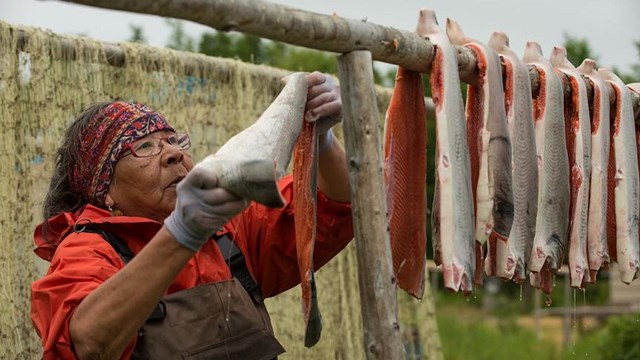
There are major river systems running through and from the park. The most important of these river systems is the Kvichak River, which hosts one of the largest sockeye salmon runs in the world. Prehistorically and historically this, and other, salmon runs formed the subsistence and economic backbone for the residents of this region.

Archeological Resources

There has been a limited amount of archeological work done within LACL. The earliest work was the excavation of the Kijik Village site on the north shore of Lake Clark. This site is now on the National Register of Historic Places and its nomination as a National Historic Landmark is in the final review process. Several brief, reconnaissance surveys and compliance clearances have been done in the last 20 years. These indicate that the full range of archeological resources, from early prehistoric to late prehistoric and historic, can be expected to occur in the park and preserve.

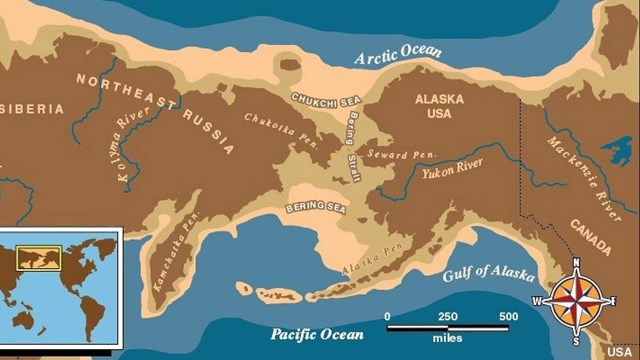
A brief discussion of the cultural history of this and surrounding areas provides a basic framework for assessing the resources and needs of LACL. The prehistory of Bristol Bay and Cook Inlet are both relevant to this park. Bristol Bay is relevant because most of the drainages in the park and preserve flow into the Bering Sea at Bristol Bay, and a great deal of cultural influence was felt from that region. Cook Inlet, although on the east side of the Alaska and Aleutian ranges, is important because it has been demonstrated historically to have a connection with Lake Clark and there is no reason to believe that this relationship did not extend into prehistoric times as well. The discussion will focus on Alaska/Pacific Eskimo cultures because little work has been done in this area on Dena'ina prehistory (A major ethnography by Ellanna and Balluta has recently been completed). Indeed this is one of the main areas of concern for LACL. Historically, the occupants of LACL were and are Inland Dena'ina Athabaskans. The Kijik village site represents Dena'ina utilization of the area.

The earliest archeological tradition found in the Bristol Bay region is the American Paleoarctic tradition. It dates from 10000 to 7500 BP. The nearest well-documented sites of this tradition are from the Ugashik Narrows in the Katmai area, Graveyard Point at the Naknek River, and Igiugig at the outlet of Iliamna Lake. A possible Paleoarctic site was found at XLC-034 which is on a high hill overlooking the southwest shore of Telaquana Lake. However, this temporal placement appears to conflict with the glacial chronology of this area.

The next cultural tradition, also found across Alaska, is known as the Northern Archaic tradition of about 6000 to 4000 BP. This tradition seems to represent an influence from the south and east - the boreal forest Archaic cultures there. This is interesting because it marks a cultural development that cannot be traced directly to Siberia and northeast Asia. Nearby, major sites of this tradition have been found at Ugashik Narrows and Graveyard Point, as well as at Kagati Lake and Security Cove. Two sites representing this tradition have been found in LACL; one near the outlet of Twin Lake (XLC-042) and one on a hill just west of Snipe Lake (XLC-044). If this cultural attribution is correct, it would be significant because this area of the park was still glacier-covered until about 6000 BP.

As in other areas, following this tradition came a series of affiliated traditions that most scholars believe lead directly and indirectly to historic Eskimo cultures. The Arctic Small Tool (AST), Norton and Thule provide a fairly continuous evolution of Eskimo technology. They mark a strong flow of migration and diffusion from the Bering Sea region to the north. The bearers of the distinctive Arctic Small Tool technology seem to have persisted in Alaska from about 5000 BP to 3000 BP. Indeed, these people seem to have been the first truly successful colonizers of the High Arctic, spreading as far east as the Canadian Arctic and Hudson's Bay. They combined a maritime hunting culture with exploitation of inland resources. The major site for this group in the area is at Brooks River in Katmai National Park. The later (2200 - 1000 BP) Norton tradition seems to have been more of a coastal culture. Well represented in the Bristol Bay region, major sites are at Brooks River and at Ugashik Lake. A possible Norton-style projectile point was found at XLC-033 on Telaquana Lake in the park.

The final part of this prehistoric triad is the Thule tradition. Depending on the area, this tradition began as early as the beginning of the Christian era and continued until European contact. There is evidence for a Thule expansion into the Pacific basin and ultimately to Kodiak Island and the southcentral coast of Alaska, where they influenced the Pacific Eskimo cultures.

The early prehistory of Cook Inlet, which forms the eastern boundary of the park, is not very well known. The main cultural sequence is the Kachemak Bay sequence (I-IV), which runs from 4000 BP to late prehistoric times. Kachemak settlements were located along rugged coastlines with deep water offshore and mountains inland, especially in the southern portion of the Inlet. Apparently, the Kachemak Bay people were a Pacific Eskimo culture that spread as far south as Kodiak island and as far east as Prince William Sound.

Ethnographic Aspects

The third cultural element of the prehistory of Lake Clark National Park and Preserve, the Dena'ina, is the least well known archeologically. Inland Dena'ina, the late prehistoric and historic inhabitants of the Lake clark area, are a branch of the much larger Athabaskan people. The origins of the Athabaskan groups can almost certainly be traced back to northeast Asia and Siberia but these early migrants have not been pinpointed at any archeological sites in Alaska. However, linguistic research has shed some light on the prehistory of the Athabaskans, despite the difficulty of correlating linguistic and archeological data, especially as it relates to group and ethnic identity.

The ancestral language was, apparently, the Na-Dene family of languages (containing Athabaskan - Eyak - Tlingit), which according to current linguistic theories, arrived in Alaska 6000-7000 years ago. Proto-Athabaskan diverged from the others about 3500 years ago and as recently as 2500 years ago was still undifferentiated and also showed no significant Eskimo language influence, suggesting the physicalseparation of the proto-Athabaskans from the ancestral Eskimo and Aleut peoples. Krauss has argued that eastern interior Alaska and adjacent west central Canada were probably the Athabaskan linguistic "homeland." By minimally 1500 years ago, this language family had differentiated into three main branches - Apachean, Pacific, and Northern, of which the contemporary Athabaskan languages of Alaska and Canada are a part. Dena'ina is a dialect of the northern Athabaskan family.

There is linguistic and oral historic evidence to conjecture that the Dena'ina were expanding their territory prior to and at the time of Euroamerican contact, including movement into the coastal of Cook Inlet. Linguistic interpretations strongly support the contention that the Dena'ina were originally an interior oriented people who inhabited the high, inland plateau west of the Alaska Range, rather than a coastal population who moved across the mountains to escape the oppression of Russian contact. Unfortunately, there has not been enough archeological research undertaken in the area to allow interpretive consensus between linguistic, oral historic and archeological data. The residents of Nondalton, who were the historic inhabitants of the Lake Clark area, speak a dialect of Dena'ina called Inland Dena'ina. This dialect is related to dialects that were spoken on the Kenai Peninsula and at Old Iliamna, but shows enough distinctiveness to indicate some degree of cultural isolation.

The Kijik Village site, on the northwest shore of Lake Clark, is the most investigated and significant archeological site in the park. It represents an Inland Dena'ina occupation at least 200 years ago and probably much longer. Its last occupants left in the early twentieth century and moved to Nondalton. The site is still incompletely mapped or excavated, and remains a site with significant research potential. Cultural remains have been reported along the Kijik River all the way to Kijik Lake, where the Kijik fish camp site has been located. Additional sites have been found from the Lake Clark shore up to the slopes of Kijik Mountain. All the sites have been included in the Kijik Archeological District which is on the National Register of Historic Places. The excavations that have been done at Kijik have revealed large amounts of Russian and American trade goods and a declining use of the aboriginal material culture. It seems that by this time that the relative isolation of the Lake Clark area from outside influence had been breached.

Historical Aspects

Following Captain Cook's 1778 explorations of Cook Inlet, Euroamerican contacts steadily increased. Navigators visited and traded with the coastal Dena'ina toward the close of the eighteenth century, and the Russians established settlements and trading posts along the Kenai Peninsula as part of the fur trading activities. Some evidence suggests that the Russian Bocharov may have reached Iliamna Lake in 1791 and perhaps established a small and temporary trading station in that area. This period was marked by unfair dealings and mismanagement by the Russians.

The Lake Clark people were in contact with their Cook Inlet relatives (and possibly with their Yupik neighbors to the west on Bristol Bay). During the period of Russian hegemony in Alaska, missionary activity by the Russian Orthodox Church was widespread. Kijik shows evidence of this activity since the remains of a Russian Orthodox church has been documented.

Van Stone and Townsend estimate that between 1875 and 1890 that there was a population of from 150 to 175 at Kijik. Other Dena'ina settlements during the nineteenth century were at Telaquana lake, and on the Mulchatna and Stony rivers. In the 1890's American traders penetrated into the Lake Clark area. Lake Clark was named for John W. Clark, "chief of the Nushagak trading post in 1891..." By this time, epidemic diseases were making significant inroads in aboriginal population, including a major measles epidemic in 1902. By the early 1900's almost all of the Inland Dena'ina in the general area were concentrated at the north end of Iliamna Lake and at Nondalton. Important factors in this move were increased access to Bristol Bay and its salmon fishing and canning industry and the closeness to the trading posts which had become established there. Trapping for furs remained a major economic activity among the local people. In addition, the resources of the Lake Clark region continued to be heavily used by the Inland Dena'ina, as has continued to the present day. Van Stone and Townsend have concluded:
Representing as it does the peripheries of Tanaina Indian expansion inland... the Iliamna-Lake Clark area is an extremely important one from the stand point of ...understanding Eskimo-Athabascan boundaries and the problems of contact between the two groups. More specific than this, however, is the importance of the Lake Clark region itself for an understanding of nineteenth century Tanaina expansion... and affords the ideal location for the study of the regionally specialized contact Tanaina culture.

Discussion

The Archeological Overview and Assessment of LACL has been programmed and funded. It should be completed within a year. At that point, a comprehensive, long-term inventory and evaluation program should be instituted as soon as possible. LACL is one of the largest Alaska parks and is probably the least known from the standpoint of archeological resources. As a major park near Alaska's largest city, its resources will come under increasing pressure. With at least one National Historic Landmark, a viable and ongoing Native community and subsistence lifestyle, and an archeologically interesting location, this park and preserve has great archeological potential.

BIBLIOGRAPHY


Return to the Prehistory of Alaska Homepage


More general information on this National Park and Preserve is available at

LACL


Questions, Comments, and Suggestions - please send email to: ken_schoenberg@nps.gov