Cultural Resources of Kobuk Valley National Park


Kobuk Valley National Park (KOVA), was created in 1980 under the Alaska National Interest Lands Conservation Act (ANILCA). This act states that KOVA is to be managed "for the following purposes, among others: To maintain the environmental integrity of the natural features of the Kobuk River Valley, including the Kobuk, Salmon, and other rivers, the boreal forest, and the Great Kobuk Sand Dunes, in an undeveloped state; to protect and interpret, in cooperation with Native Alaskans, archeological sites associated with Native cultures; to protect migration routes for the Arctic caribou herd; to protect habitat for, and populations of, fish and wildlife including but not limited to caribou, moose, black and grizzly bears, wolves, and waterfowl; and to protect the viability of subsistence resources." Archeological and ethnographic resources are specifically discussed in the enabling language for the park and it is very rich in both. Prehistoric resources within the park are extensive and of national and international significance.

The park is located in Northwest Alaska. It consists of the valley of the Kobuk River, running along the southern edge of the western end of the Brooks Range. The boundary of KOVA runs along the ridgetops of a set of mountains (the Baird Mountains to the north and the Waring Mountains to the south) that essentially forms a circle, defining and enclosing the Kobuk Valley. The middle two-thirds of the Kobuk River, from just above Kiana to just below Ambler, is included in the park, as are several major tributaries (Salmon, Hunt and other rivers).

Land Ownership

KOVA has a gross area of about 1,750,700 acres, of which 1,660,000 acres is in federal ownership. Within the park there are 182,767 acres of designated Wilderness lands. About 81,000 acres of non-federal lands lie within the park. The state of Alaska claims about 9,500 acres (mostly submerged lands), with the rest divided among several Native Alaskan interests, including NANA Regional Corporation, Ambler Village Corporation and Kiana Corporation. These include 61 Native allotments, and 94 acres in 14h1 cemetery and historical sites.

Environment

The Kobuk River begins in the central Brooks Range. The river's midsection, as it passes through the Kobuk Valley, is wide, slow-moving and clear, and its banks and bottom are sandy. Rushing clearwater tributaries to the Kobuk have their headwaters in the Baird Mountains. These are the Akillik, Hunt, Kaliguricheark, Tutuksuk, Salmon, and Kallarichuk rivers. Only slow moving creeks enter the Kobuk from the south.

Trees approach their northern limit in the Kobuk Valley, where boreal forest and arctic tundra meet. Large expanses of tundra cover the valley in some locations, while forests cover the better-drained portions. In some places sparse stands of spruce, birch, and poplar grow above a thick ground cover of lichens (reindeer moss). Sand created by the grinding action of glaciers (mostly during the Pleistocene) has been carried to the valley by wind and water. Large sand dunes lie on the south side of the Kobuk River. These are the Great Kobuk Sand Dunes, the Little Kobuk Sand Dunes, and the Hunt River Sand Dunes. Older, vegetated dunes cover much of the southern portion of the valley.

Three general landscape types exist within Kobuk Valley National Park: the Baird Mountains, the Waring Mountains, and the Kobuk Valley (floodplains and terraces). The Baird Mountains, north and east of the river, are the western extension of the Brooks Range and separate the Kobuk and Noatak rivers. They range in height from 2500 to 4760 feet. On the south side of the Kobuk River lie the Waring Mountains, which are broadly folded, northeast-trending mountains that are generally less than 2000 feet high. The Kobuk River runs through the lowland between these two sets of mountains. This area is largely covered by glacial drift and alluvial deposits, including clayey till, outwash gravel, sand, and silt.

Although there are currently no glaciers within the park, at least five major Pleistocene glaciations have left effects in the area. Especially noteworthy are the large dune fields that were the result of the strong easterly winds that moved glacio-fluvial deposits of sand and silt during interglacial periods. These dune fields cover approximately 200,000 acres, mostly vegetated by tundra and forest. There are presently three active dune fields: the Great Kobuk Sand Dunes lie less than two miles south of the Kobuk River and immediately east of Kavet Creek (a major archeological site, Ahteut, is located there also); the Little Kobuk Sand Dunes lie about five miles south of the river in the southeastern part of the park; and the Hunt River Sand Dunes are located on the south bank of the Kobuk River across from the mouth of the Hunt River.

The Kobuk River is one of the major rivers of northwestern Alaska. It drains an area of 11,980 square miles and is about 350 miles long. Its course is characterized by meanders, oxbow bends, and sloughs. The floodplain varies from one to eight miles wide with most flooding occurring during spring breakup, usually due to ice jams. There are six major tributaries of the Kobuk. All have their headwaters in the Baird Mountains and all are entirely undeveloped. One of them, the Salmon, has been designated a Wild and Scenic River in that national system. There are numerous small lakes and ponds scattered throughout the park, some due to the permafrost and some due to detached meanders or oxbows of the rivers.

The Kobuk Valley is partially forested and is typical of the broad transition zone between forest and tundra. The vegetation of this park is of particular scientific interest because of tree line phenomena, the relationship of vegetation to the sand dunes, the proximity to the eastern end of the Bering land Bridge, and the relationship of vegetation to human use of the Kobuk Valley for thousands of years. Forests occur on the better-drained areas along stream courses and on higher ground. There is an alternating tundra and forest pattern that forms a mosaic across the valley. Spruce and balsam poplar grow in the lower and middle reaches of the river valleys that extend into the Baird and Waring mountains. Willow and alder thickets and isolated cottonwood grow up to the headwaters of the rivers and streams. Alpine tundra covers the higher slopes and ridges. Tussock tundra and low, heath-type vegetation covers most of the flat floor of the valley. Of note is that lightning and human-caused fires have greatly affected the vegetation processes over much of the Kobuk Valley as willow, alder and fireweed have invaded or become dominant in many burned areas.

The fish and wildlife of KOVA are typical arctic and subarctic fauna. The major economic species are caribou, moose, salmon, sheefish, and other fish species. Caribou of the Western Arctic Caribou herd range over the entire region. The 1986 herd size was approximately 225,000. The herd migrates through the park twice a year - southward in August from their summer range north of the Brooks Range and the DeLong Mountains and northward from their winter range in the Selawik Hills-Buckland River area in March. Onion Portage, in KOVA, is a major crossing point of the herd, and has served as a hunting stand for at least 10,000 years. Moose were scarce in the region 50 years ago but the population has steadily increased in recent years and now numbers several thousand. There is some indication that moose populations have been high in the past and have fluctuated along with climatic shifts.

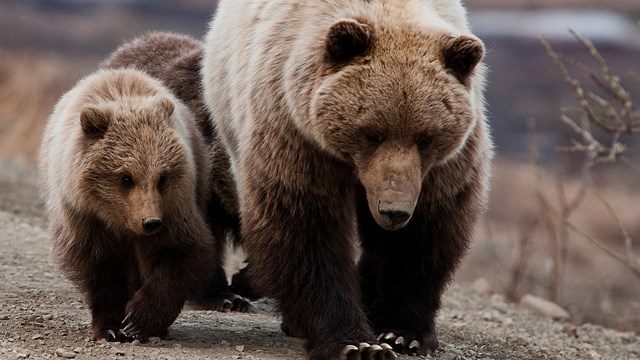
Dall sheep are present in the higher elevations of the Brooks Range. Bears, both grizzly and black, are found throughout the region, as are wolves, coyotes, and foxes. Other fur bearers are also locally and seasonally abundant. Birds are seasonally abundant, especially waterfowl which use the area for summer breeding. So far, 83 species of birds have been identified within KOVA.

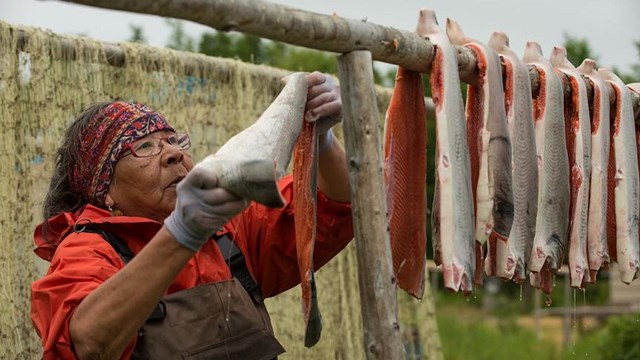
Twenty-five species of fish are found within the Kobuk River drainage. Although all five species of Pacific salmon occur in the waters of the region, only chum, king, and pink salmon occur within the park. Chum salmon is the most abundant and supports commercial and subsistence harvests. The Salmon and Tutuksuk rivers are major spawning and production tributaries of the Kobuk River for chum salmon. Within the Kobuk River in the park, sheefish, or inconnu, are found and harvested. Arctic char and arctic grayling are more widely distributed throughout the park. Other species, such as northern pike, whitefish, burbot, sculpins, and least ciscos inhabit rivers and lakes in the region and park.

Archeological Resources

The Onion Portage site, on the Kobuk River in the eastern side of the park, is one of the most important archeological sites in arctic America. It has more than 70 distinct stratified cultural layers that documant a progression of human camps spanning about 12,500 years. Onion Portage is still in use as a major caribou hunting site as it has been for over 100 centuries. Large portions of the site remain unexcavated. Onion Portage has been designated a National Historic Landmark and placed, as a district, on the National Register of Historic Places. It is not, however, owned by the park, but remains an inholding of the NANA Regional Corporation.

The Kobuk valley has been lived in and used for at least 12,500 years. People of all the major cultural groups that have lived in northwest Alaska have left evidence of their presence at numerous sites in the park. The known sites are concentrated along the Kobuk river and its tributaries. Detailed archeological investigations in five sites in the park were made by J.L. Giddings in the 1940's, including Ahteut, Ekseavik, and Ambler Island. He also did dendrochronological research there. Extensive excavations, begun by Giddings and completed by Anderson, were done in the 1960's at Onion Portage. Since the termination of work at Onion Portage, very little archeological work has been done in KOVA. Hickey excavated several sites within and near the park. Stanford and Dixon conducted a reconnaissance survey of portions of the Great Sand Dunes and located several sites, some of which may be very early.

Apparently, only the highlights of the park's prehistory have been revealed. This is because most of the known archeological sites in KOVA are winter settlements which were concentrated along the rivers. Other aspects of the the lifeways of the prehistoric inhabitants of the valley, especially those activities that took place away from the Kobuk River, are still basically unknown and remain to be investigated. Enough is known of the cultural chronology of the park (based mainly on the findings from Onion Portage), however, to outline the sequence.

The earliest inhabitants of the valley lived in a treeless environment around 12000 years ago. These people of the Paleoarctic cultural tradition are represented by the Akmak and Kobuk levels at Onion Portage and seem to have been mostly hunters of caribou. Evidence of the Paleoarctic culture ended at Onion Portage about 8000 years BP.

After a gap of almost 2,000 years, during which no people appear to have occupied the Onion Portage area, a different cultural group, the Northern Archaic tradition or the Palisades and Portage cultures occupied the Onion Portage area. Their traditions were derived from the spruce-forest or boreal forest regions to the south and east, and they could well have been Indian from the interior regions. Their camps show some evidence of fishing as a major subsistence activity. The diagnostic artifact of this tradition is the side-notched projectile point. It is sometimes found with the microblades and cores that are the hallmark of the Paleoarctic and the Arctic Small Tool traditions. However, this was not the case at Onion Portage (Anderson 1968), leaving the theoretical and chronological issues that are inherent in this contradiction to be further investigated (Schoenberg 1995).

About 4,000 years ago, arctic-oriented peoples of the Arctic Small-Tool tradition again moved into the Kobuk Valley. They had developed lifeways that enabled this culture to spread over most of the Arctic, from Norton Sound to Greenland. While coastally oriented, regional and local specializations were also present. The people in the Kobuk Valley undoubtedly used local resources such as caribou and fish. They also maintained strong ties to the coast and its marine resources. They probably made seasonal journeys downriver to the coast for trading and marine mammal hunting . From about 1,500 to 2,000 years ago, this coastal orientation becomes even more evident in the archeological record as the Norton tradition becomes identifiable.

From about 1,000 to 1,500 years ago (A.D. 500 to 1000), the middle and upper portions of the Kobuk River were generally unoccupied, perhaps because of a decline in the caribou population (Anderson 1977). During this interval, native peoples of Indian descent (possibly Koyukon) used Onion Portage intermittently for caribou hunting.

By about 800 years ago (A.D. 1200), arctic-oriented people once again occupied the valley. About 25 miles downriver from Onion Portage, Ahteut, a major archeological site with an extensive series of housepits, provides the definitive data and description for the Arctic Woodland culture (Giddings 1952). This culture appears to have been unique to the Kobuk River region and shows the adaptation of coastal Eskimos to the forested and riverine environments of the Kobuk Valley. By A.D. 1400 the Arctic Woodland culture had developed a wide range of fishing techniques and had begun to practice a seasonal round that was basically the same as that seen in late prehistoric times. Settlements appeared in the middle reaches of the valley. The earliest of the sites was located where both winter caribou hunting and summer salmon fishing were possible. Sites such as Ahteut, Onion Portage, and the confluences of the Salmon River, the Hunt River and the Ambler River all had winter houses located on or near sand bars along river bends where seining for salmon was productive. The site at Ambler Island, dated at A.D. 1750, shows the long continuity of the lifestyle of the Arctic Woodland Culture.

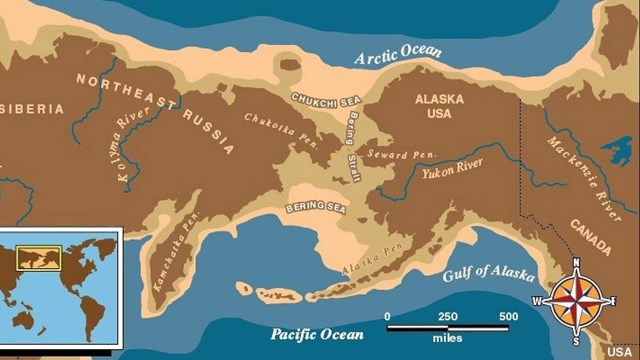
The middle Kobuk Valley seems to have remained fairly stable during the early 19th century. Sometime after 1850, the caribou population declined (as happened periodically) and subsistence efforts shifted more to the seacoast. By then, the influences of western civilization were being strongly felt. Actual exploration of the Kobuk River by Euroamericans, however, had been preceeded by at least 150 years of trade and contacts along the coasts of northwest Alaska. Russian trade goods reached people of the Kobuk region through extensive trade ties across the Bering Strait (as had existed for centuries) between the Native peoples of eastern Siberia and western Alaska.

Ethnographic Aspects

In the 19th century, two Inupiat societies, the Akunirmiut and the Kuuvaum Kangianirmiut, occupied the area now included in the park. Descendants of these people, referred to collectively as "Kuuvangmiit" still use the park and now live in the villages of Kiana, Ambler, Kobuk and Shungnak. The first U.S. Census of the region was conducted in 1900. At that time, the second largest village encountered along the Kobuk River was at the mouth of the Hunt River (now within the park). This village was near Camp Penelope. Grinnel, one of the Kobuk stampeders living at Camp Penelope, provides some accounts of the first substantial contact with Euroamericans. Coordinated ethnographic, historical, and archaeological study of the village and Camp Penelope can open exciting and unique interpretive, historical and methodological vistas.

The site of Stonewall Jackson's (Oolyak) cabin and camp (XBM-046), at the Kallarichuk ranger station, is being eroded by the Kobuk River. Oolyak, interviewed by Giddings, was one of the last Kobuk Inupiat to reach adulthood prior to sustained Euroamerican contact. Archaeological investigation of the site and interviews with his descendants could provide a powerful illustration of Inupiat acculturation.

Much data have been generated by the CRPP-funded Ethnographic Identification Study for Kobuk Valley National Park. Major research efforts were undertaken at the villages of Kiana and Ambler. The placename data generated by this study will form the basis of an Ethnographic Resource Inventory.

Historical Aspects

While there is much potential for locating historical sites in the park, almost no historical research or surveys have been completed. The remains of Cantwell's encampments and Stoney's winter camp, Fort Cosmos, dating to the mid 1880s, may be located through systematic fieldwork. Local residents have stories, potential leads, about the location of Fort Cosmos. E.S. Hall, Jr. attempted to locate Fort Cosmos from the air but failed. Camp Penelope and thirty-two other gold stampeders' camps established during the winter of 1899-1900 should also be locatable if they have not been claimed by river erosion. As most of the camps were occupied for a single season only, they can provide valuable "snapshot" images of Kobuk miners' lives at the turn of the century. In 1992 NPS rangers found a log structure that may have been the church built by the Long Beach Mining and Trading company at Camp Penelope. Shungnak villagers report finds of boilers, propellers and other old ship parts from along the river that may have been used and left by the Kobuk Stampeders or by later miners and traders.

Kiana, outside the western park boundary and established in 1908 or 1909 as "Squirrel City," supported the miners at Kleary Creek and grew up adjacent to the Inupiat village of Kutyak. Originally known as "Long Beach," the village of Kobuk, outside the eastern park boundary, supplied miners working the upper river and had established regular winter mail service (by dog team) by 1905. In the early days, trading companies at Kianna and Kobuk issued "tokens" and credits in lieu of U.S. currency. The history of trade and traders' records and inventories will have significant bearing on the interpretation of historic sites and artifacts located on park lands.

Discussion

The archeological resources in KOVA are major components of the resources base in the park, as discussed in the implementing legislation. An archeological resources base map of the park has not been created and much of the land within the park has not been inventoried. An Archeological Overview and Assessment of the park has not been done as yet. There is an immediate need for ethnoarcheological research as well, as the local population ages and sources of oral history about the park and its resources disappear. In addition, many sites are vulnerable to erosion, development, and ongoing use of the park.

BIBLIOGRAPHY

Return to the Prehistory of Alaska Homepage


More general information on this National Park is available at

KOVA


Questions, Comments, and Suggestions - please send email to: ken_schoenberg@nps.gov