Gates of the Arctic National Park and Preserve (GAAR) was created in 1980 under the Alaska National Interest Lands Conservation Act (ANILCA). The implementing language states that the park and preserve "shall be managed for the following purposes, among others: To maintain the wild and undeveloped character of the area, including opportunities for visitors to experience solitude, and the natural environmental integrity and scenic beauty of the mountains, forelands, rivers, lakes, and other natural features; to provide continued opportunities, including reasonable access, for mountain climbing, mountaineering, and other wilderness recreational activities; and to protect habitat for and the populations of, fish and wildlife, including, but not limited to, caribou, grizzly bears, Dall sheep, moose, wolves, and raptorial birds. Subsistence uses by local residents shall be permitted in the park, where such uses are traditional..." Though not specifically mentioned in the implementing language for GAAR, Section 101(a) and (b) of ANILCA specifically states that (a) "In order to preserve for the benefit, use, education, and inspiration of present and future generations certain lands and waters in the State of Alaska that contain nationally significant natural, scenic, historic, archeological, geological, scientific, wilderness, cultural, recreational, and wildlife values, the units described in the following titles are hereby established." (b) "It is the intent of Congress in this Act to ... protect the resources related to subsistence needs; to protect and preserve historic and archeological sites, rivers and lands, ..."
GAAR is known as the "Wilderness park" and many managers and visitors think of it as untouched by humans. However, in order to properly manage and interpret the natural environment with its animal populations and plant communities it is necessary to develop a diachronic perspective. It is only through the study of the cultural resources in GAAR that we can gain an understanding of the effect that human interaction has had over the millenia. Humans have been part of this environment and interactive with it for at least the last 12,000 years. It is quite possible that some of the earliest migrants to the New World lived in this area. Park and preserve resources continue to be used by the local rural population in and around GAAR. Both the GMP and RMP (1993) state that one of the objectives of park management to "identify, evaluate, and provide appropriate treatment for historic and prehistoric sites and structures.
Land Ownership
The park and preserve contain about 8,470,000 acres (13,240 square miles) all of which lies north of the Arctic Circle. It is approximately bisected by the central Brooks Range running east-west. Significant parts of GAAR extend north and south of the Continental Divide. Gates of the Arctic National Park and Preserve contains 7,524,000 in the park and 950,000 acres in the preserve. About 259,000 acres are not in Federal ownership. Of those acres, 16, 540 are under application by the State of Alaska, Doyon Limited Regional Corporation, Arctic Slope Regional Corporation, and Anaktuvuk Pass Village Corporation. There are a number of native allotments, lode and placer mining claims. A major land management factor in GAAR is that about 7,263,000 acres are in Wilderness status.
Environment
GAAR is a rough rectangle straddling the east and central Brooks Range. It is bounded on the east by the Middle Fork of the Koyukuk River and the oil pipeline and the Haul Road, which provides access to the area of the park. It is bounded on the north by the Arctic Foothills, including the discontinuous Castle Mountain unit, and the North Slope of Alaska. The eastern boundary is roughly at the Baird Mountains and Noatak National Preserve. The southern boundary is uneven, extending south of the upper Kobuk River in the east and just of Wild Lake in the west.
Four major physiographic zones run horizontally across the park and preserve. Northernmost is the southern section of the Arctic Foothills, which is characterized by east-west trending linear ridges and irregular buttes with interspersed tundra plains. These ridges have been regular travel routes in aboriginal times. Interestingly, a major part of the zone was unglaciated during the late Pleistocene. The largest physiographic zone of the park and preserve is the central Brooks Range. The mountains in the Brooks Range are east-west trending and rise to heights of 7000-8000 feet in the north and 4000-6000 feet in the south. Obviously, these rugged mountains, which have been subject to several glacial episodes in the Pleistocene and Holocene, have been a significant barrier to animal and plant, and human movement. The third physiographic region, the Ambler-Chandalar Ridge and Lowlands crosses the southern preserve. Large lakes such as Selby, Narvak, and Nutuvukti are located in this zone. The last region, the Kobuk-Selawik Lowlands zone encompasses the southern most portion of the southern preserve of GAAR. The headwaters and upper Kobuk river are located in it.
There are basically two major climate and environmental zones in GAAR. South of 68 degrees of latitude is a mixed Boreal forest containing spruce, birch, and poplar while north of 68 degrees is treeless tundra. The north side of the Brooks Range has an arctic climate. The influences of the Arctic Ocean and "north slope" weather patterns are dominant. Very little precipitation occurs and this has been called an "arctic desert." South of the Brooks Range, in the lower elevations, the climate is subarctic or Continental and is generally considered "milder" than the arctic. Both zones of the park and preserve share long, bitterly cold winters where temperatures may reach -70 degrees F and short, brilliant (midnight sun) summers where temperatures may peak at 90 degrees F (but rarely). Frost can occur at any time and winds can be strong and variable.
The glacial history of this area has formed the Holocene and modern landscape of GAAR. Glaciation of the Brooks Range began before the Pleistocene and continued into the Holocene. From our point of view, only the later glacial episodes are relevant. The last major glacial period in this region was the Itkillik glaciation. The last pulse of ice advance, often called the Walker Lake advance, began around 24,000 BP and lasted, in some locations, until about 12,000 years ago. There were also several ice pulses in the Holocene during 3500-2000 BP and 1500-1200 BP (mostly in the mountains). Numerous topographical features in the park and preserve are remnants of glacial activity. These features tend to be well-drained and often offer excellent vantage points or travel routes. Archeological sites tend to be associated with these glacial features as well as with the well-drained alluvial terraces and beach deposits surrounding many of the glacially-formed lakes. [Sites are also found associated with other topographical features such as ridges and portages].
The fauna and vegetation of GAAR show great variation, due to the large area of the unit, variation in elevation and topography, and from a diachronic perspective. Broadly speaking, at present there is both an arctic and a subarctic ecological zone. The major contrast in vegetation is between the forested boreal areas and the tundra zones. Over the last 10,000 years, the tree line has shifted to the north and then retreated several times. With the disappearance of the Pleistocene megafauna, the major species for subsistence became the caribou, sheep, bear and moose of modern times. Interestingly, salmon does not appear to have been a major subsistence item in the GAAR area. Of course, salmon and sea mammal products were sought and obtained on a regular basis through trade networks and relationships.
Archeological Resources
GAAR lies within the Arctic and the Interior cultural zones of the NPS Alaska region. The Brooks Range has been occupied and traversed by people for at least 12,500 years, yet the land bears relatively little visible evidence of their presence. People moved within and through the mountains and valleys, rivers and lakes following the seasonal rhythms of their lives. Later, miners, trappers and guides left the most visible remnants of their presence, but these are thinly scattered over the landscape. Given the purposes for which this park and preserve was created and its overall character, the GMP states that the overall objective for the management of cultural resources is to understand the long-term human use of the area, recognizing the importance of both physical remains and intangible associations in GAAR.
Though some areas of the park have been the subject of archeological research, overall the park is not well known archeologically. Enough work has been conducted in the park and preserve (Solecki 1951; Campbell 1956; Irving 1964; Alexander 1969; Binford 1978, 1980; Kunz 1982, 1991; Schoenberg 1985), to provide an overall view of the cultural history of the area. It should be noted that this "standard" chronology is still evolving as recent developments at the Mesa Site, Nenana Valley and Broken Mammoth Site have led to revisions and new ideas in this chronology.
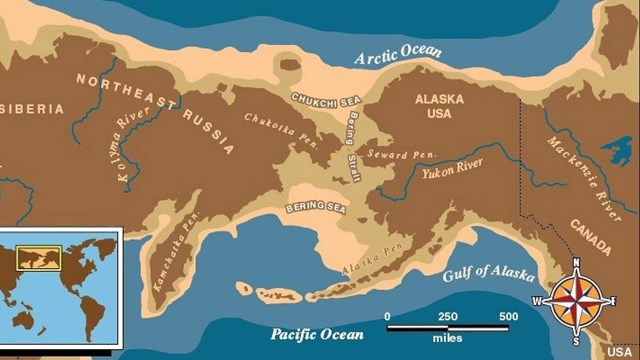
It is generally accepted that the New World was settled by immigrants from Siberia and Northeast Asia at least 13,000 years ago and that the majority of these people arrived across the Bering Land Bridge. In late Pleistocene times the indigenous population was probably not large, even by Arctic standards. Clear evidence of their presence shows up as lithic sites of the Paleoarctic Tradition dating to about 11,500 to 8000 years ago. This widespread cultural tradition was characterized by a core and blade industry, especially microblades and burins. Certainly while Paleoarctic people were in the area, remnant glacial ice was still present in some of the valleys and vegetation was herbaceous or grassy with some areas of balsam poplar. In this area of Alaska, the concept of this tradition reflects the presence of an environmental adaptation with an economy focused on land-based hunting, small and mobile groups whose sites seem to represent small camps and/or lookouts.
Recently, Kunz and Reanier (1994) have redated and reinterpreted the data from the Mesa Site, which lies at Iteriak Creek just north of the park boundary. The site, now dated at between 10.300 and 11,500 BP, contains a lithic assemblage characterized by lanceolate points and lacking the Paleoarctic core and blade complex. This has led researchers to postulate that this site represents a different group of people, a cultural group named the Northern Paleoindian tradition, which is related to the Nenana Complex of Interior Alaska and possibly the Clovis tradition and other Big Game hunters of mid-continent North America. Since the antecedents of these fluted point groups has not yet been traced, these new findings and hypotheses are exciting and significant areas for future research. GAAR is geographically central to this research.
In many areas, the end of the Paleoarctic period is marked by what appears to be the arrival of an intrusive group around 6000 BP, characterized by lithic assemblages containing asymmetric side-notched projectile points, large unifacially-chipped knives and notched pebbles or net sinkers. As originally proposed, these complexes represent migration or diffusion from the boreal forests to the south and east of the arctic. The type site for this complex, Onion Portage on the Kobuk River, shows no microblades present with this Northern Archaic material while the major Northern Archaic sites in GAAR, Tuktu and Kurupa Lake do have them present. Varying explanations have been proposed by researchers in the area, ranging from site taphonomy (postdepositional mixture of components) to adoption of Archaic traits by Paleoarctic-type peoples. Presently, this issue is unresolved and remains a potentially fruitful area for future research.
Around 4500 BP, the most distinctive of all the lithic assemblages in the Arctic archeological record appeared. These are the tools of the Arctic small Tool tradition (ASTt). The finely made and apparently miniature tools appear, fully developed, and occuring throughout the coastline from Bristol Bay around the Alaska coastline northward, and then eastward through the Canadian Arctic to Greenland. This coastline is characterized by an ice-locked winter season and a treeless hinterland. The ability of this cultural group to exploit the arctic coastal resources such as sea mammals as well as the resources of the tundra such as caribou enabled them to spread rapidly throughout the arctic areas of North America, including GAAR. The tradition has a number of phases identified within its span of time (up to 1000 BP). There are several differing interpretations of this series of phases. Some researchers see the ASTt people as ancestral to the modern Eskimo and include them in an Eskimo Continuum. Others see the phases (Denbigh, Choris, Norton, and Ipiutak), as more distinctive and treat them separately. In any case, the adaptations developed by these groups show the basic resource exploitation strategies that did lead to the identifiable Eskimo groups that inhabited the area at contact and have continued to do so. In the park and preserve, archeological sites exhibiting the classic Denbigh complex type tools are widespread and distinctive. This complex marks the last appearance of microblades in northern Alaska. The Denbigh folk appear to have been equally oriented to the use of tundra resources as those of the coast and are thus the most widespread. Later phases increasingly emphasized coastal resources and their tool complex changed over time, even though the lithic continuity remained evident. The only other phase of the Arctic Small Tool tradition that has been positively identified in GAAR is an interior facies of the Ipiutak phase. This phase (2000 - 950 BP) has been identified and investigated at the Bateman Site at Itkillik Lake in the northeast part of the preserve. Since the coastal sites of this phase show strong Asian or Scythian influence in spectacular art objects, its appearance at Itkillik Lake and other lake sites beyond the North Slope is intriguing.
The identifiable antecedent cultures of the Inupiat Eskimos appear around 800 BP on the arctic coast of Alaska in the form of the Western Thule people. Dumond (1977) has conceptualized this period the Thule tradition which " as a whole includes all the midden-building, polished slate-making, lamp-burning, kayak and umiak-paddling Eskimos of later times, who extended from Kodiak to Greenland." They appeared or evolved around the Bering Strait sometime in the first millennium AD. Others see this period as the Northern Maritime tradition, descending from the Birnirk culture. However viewed, these people spread over the North American arctic in much the same way that the earlier Arctic Small Tool tradition groups did in earlier times. The spread and adaptation to varying environments of these late prehistoric cultures is of prime importance for a GAAR research agenda. As they moved and adapted over the centuries, groups of these people developed specialized versions of the Eskimo culture pattern. On the Kobuk River, an adaption of the coastal culture that emphasized use of riverine and boreal resources has been named the Arctic Woodland Culture. Another group, based in the Brooks Range and named the Arctic Tundra culture, was similar to the modern Nunamiut. Archeological sites of the Nunamiut are important resources that need immediate attention since, as the most recent sites, they would show more of the ephemeral details of arctic life that have been lost in sites of older cultures. [Tent rings and sod houses with faunal remains are good examples].
Also present in the GAAR area over the last 1000 years or so, were groups of Athabaskan Indian people. The prehistoric lithic culture that seems to represent them has been called Kavik. Such groups as the Kutchin (Athabaskan) which were present in historic times in the Brooks Range, now occupy the area of GAAR south of the mountains.
Overall, over 800 archeological sites have been identified in GAAR. While this seems a high number for an Alaskan park, it actually represents only a small proportion of the sites actually present in this 8,000,000 acre park. Many of the known sites have been inadequately recorded and those records that do exist need to be better managed, collated, correlated and analyzed. As yet, no archeological sites have been nominated to the National Register of Historic Places, even though several sites or districts certainly are eligible. Approximately 125,000 acres in this park have had some sort of archeological survey, mostly at reconnaissance levels.
Historic Aspects
The Gates of the Arctic National Park and Preserve area remained relatively unknown and unexplored by Euroamericans until the late nineteenth century. Because of this, the marks of western civilization remain fairly rare in the park, mostly those of miners, trappers and hunting guides. Historic archeological sites do exist in the park. A possible campsite of the Howard exploration party, which crossed the Brooks Range in the winter 1885/86 has been found at Walker Lake. Another possible campsite of an exploration party, that of Smith and Mertie of the USGS from 1911, has been identified at Kurupa Lake. Remnants of the gold rush, which washed over the northern Koyukuk River area from 1901 to 1910, are still extant in the park. Small mining operations have been ongoing in the park area since that time and have been surveyed by the NPS Cultural Resources Mining Inventory and Monitoring project.
Ethnographic Aspects
This park and preserve contains a rich ethnographic record and ongoing use of its resources. The Inupiat village of Anaktuvuk Pass is entirely surrounded by GAAR lands. The residents of this village continue to use park resources as their ancestors did. Several excellent ethnographic studies have been done about the inhabitants of this region. Ethnoarcheological research such as Binford's (1978, 1980) has had significant influence on archeological and hunter-gatherer studies as a whole. Studies of northern Athabaskans also have provided important data for interpreting the archeological record. Urgently needed oral histories from the elders in this area could provide even more significant data. This research would provide comparative data for interpreting the archeological record as well as information on more recent uses of and relationships with the landscape of GAAR.
Discussion
At the present time, there are more archeological sites recorded in GAAR than in any other park in Alaska. There have been no archeological sites placed on the National Register of Historic Places in GAAR, even though there are many that are eligible. In addition, much of the park and preserve remains unsurveyed or only surveyed superficially. This park and preserve would benefit greatly from a continuing inventory and evaluation program. This is especially the case for late prehistoric and protohistoric sites, which should be linked to an ethnohistoric research program. From an overall viewpoint, the recent reevaluation of the Mesa Site, just north of the GAAR boundary, points up how generalized and hypothetical is the current cultural chronology of this area, as well as the area's potential to contribute much more to the understanding of that chronology.
BIBLIOGRAPHY
Questions, Comments, and Suggestions - please send email to: ken_schoenberg@nps.gov