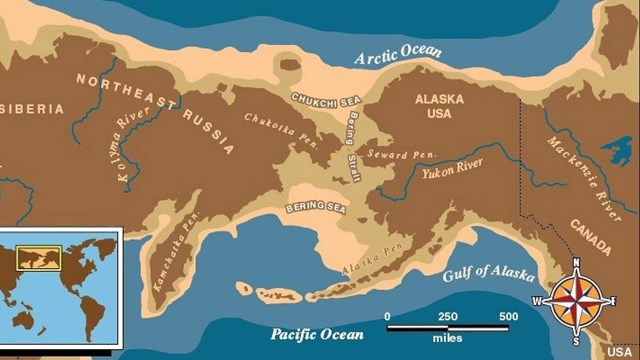
President Jimmy Carter issued a Presidential Proclamation establishing the Cape Krusenstern National Monument in 1978. The monument was created in order to protect a series of beach ridges located by J.L. Giddings in the 1940's along the southern coast of Cape Krusenstern. The beach ridges, built up over a series of thousands of years, contained evidence of prehistoric populations. The older archaeological sites were located on the back beach ridges, farthest from the shoreline, while the progressively younger sites were located closer and closer to the present day shoreline. The monument was established to protect these cultural remains and to provide an area where human migration and population processes could be studied; in this case the process of moving from the Asian continent to the American continent via the Bering Land Bridge. Further, the monument was established to provide protection for seal, other marine mammal, bird and other wildlife habitats, to protect fish resources, and to protect the viability of subsistence resources. The entire monument lies within the Cape Krusenstern National Historic Landmark boundaries. These landmark boundaries were defined in 1973 with the placement of Cape Krusenstern on the National Register of Historic Places as an Archaeological District.
Cape Krusenstern encompasses 659,807 acres along the northwestern coast of Alaska. Kotzebue Sound makes up its southern shore, while the Chukchi Sea makes up its western shore. The Noatak River, emptying southward along its eastern border into Noatak Inlet, separates Cape Krusenstern National Monument from the Noatak National Preserve. The monument is made up of two sets of low, rolling hills that reach a maximum height of 2,000 feet above sea level. The Mulgrave Hills to the north, and the Igichuk Hills to the south (which extend eastward into the Noatak National Preserve) are separated by a broad plain of coastal lowlands. This area exhibits classic thermokarst topography, with thaw lakes and ponds, ice wedge polygons, pingos and the like. To the south, the cape from which the monument takes its name consists of a series of relict beach ridges and intervening swales with numerous ponds and lakes. The entire shoreline is made up of barrier bars, lagoons and spits.
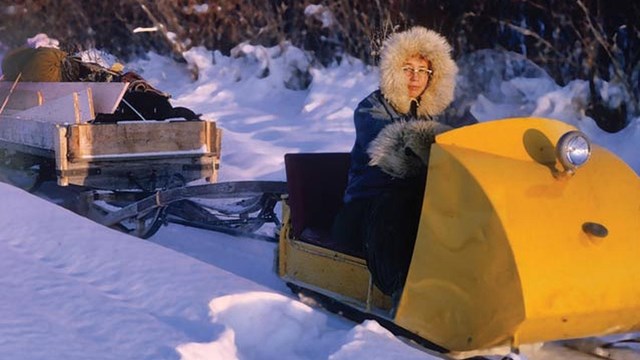
The monument is accessible in any number of ways. Generally snowmachine, boat, all-terrain vehicles, and dogsleds are used to enter the park. Air access is possible, but helicopter use is restricted and permitted only with the written permission of the superintendent. CAKR, along with KOVA and NOAT, is administered from Kotzebue, Alaska under the aegis of the Northwest Alaska Areas Office (NWAK).
Of the 659,807 acres within the monument 534,347 acres are federally owned. Non-federal lands make up 19% of the monument and are comprised of a variety of Native allotments under application, easements, areas selected by the Nana Regional Corporation and other village corporations, and State of Alaska navigable waters and submerged lands in Kotzebue Sound.
During the summer months, a maritime climate influences the monument. Cloudy skies coupled with frequent fogs and westerly winds are normal. Temperatures are fairly uniform, ranging from 43 F to 53 F. In the fall, after the offshore waters have froze, a more continental climate occurs, with decreased temperatures that fluctuate more drastically, from -40 F to 0 F. Precipitation is sparse, with nine inches being recorded annually. Most of this falls between July and September.
Limestone, dolomite, chert and phyllite of Precambrian to Devonian age make up the majority of bedrock materials in the inland portion of the monument. The southern end of the Mulgrave hills also contains a collection of marine sediments: dolomite, sandstone, shale, and limestone from the Devovian to Mississippian periods.
While the area of Cape Krusenstern was affected by glacial advances during the Illinoian Glaciation of the Pleistocene epoch, and boasts a unique 100,000 year old esker in the central lowlying area between the Mulgrave and Igichuk hills, it was not glaciated during the late Pleistocene's Wisconsin glaciation, the last major glaciation of the area that ended approximately 10,000 years ago.
Another unique feature of Cape Krusenstern is a beach plain with a series of successively younger beach ridges that have been deposited by longshore currents over thousands of years. The 114 ridges that have been identified record the post-glacial rise in sea level during warm spells as well as give evidence for the movement of human populations into the area, presumably from Asia, for the last 6,000 years. This beach ridge complex was of primary importance in the establishment of the monument; its purpose being to allow the study of this ridge system and the archaeological remains associated with them.
Moist tundra community, characterized by cottongrass tussocks interspersed with mosses and lichens, covers most of the monument. Species include willow, dwarf birch, Labrador tea, Lapland rosebay, mountain alder, and saxifrages. Wet tundra occupies the southern boundary of the monument, with characteristic grasses and sedges making up the community. Alpine tundra, consisting of willow and heather, and lichens and saxifrages is located in drier areas, and barren ground is found sporadically in the upland areas (National Park Service 1988). Isolated patches of white spruce trees occur in the southeastern portion of the monument. Along the southern coast, in the beach ridge/swale configuration of Cape Krusenstern proper, a variety of brackish and freshwater planktons and algal forms are found. Eelgrass is found in marine waters and pendant grass and mare's tail grasses are found closer to freshwater sources.
A variety of mammals inhabit the area within the monument boundaries. These include caribou, moose, bears, musk-ox, wolves and sheep. Populations of red and arctic fox, snowshoe and arctic hares, porcupines, weasel, mink, lynx, river otter, ground squirrel, and muskrat also occur as do very small populations of wolverine. Marine mammals in waters within and directly adjacent to the monument include several species of seals (bearded, ringed, spotted and ribbon) and several species of whales (beluga, bowhead, gray and finback). The ringed seal in particular is a mainstay of subsistence hunters in the region. Beluga are taken from ice free leads during the sealing season, but most often are taken after the ice has left the shoreline in the spring. Other species of whales are not usually taken. Walrus are not common, but are taken if and when they do appear.
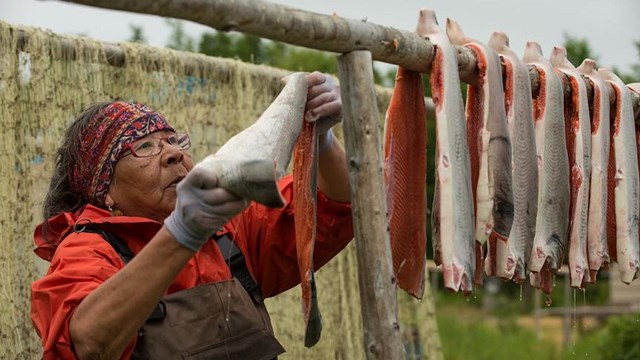
Whitefish is the most important fish for subsistence users and is abundant within the monument. Species include humpback whitefish, least cisco, Bering cisco, and broad whitefish. Arctic char is also important, as are grayling. All five salmon species are located within the monument, as are northern pike, burbot, dolly varden, herring, and sheefish.
Bird species are numerous, primarily due to the summer migration and nesting habits of many of them. A variety of ducks, geese, grebes and loons nest in the monument including the mallard duck, green-winged teal, common eider, black scoter, red-breasted merganser, Canada and snow goose, horned and red-necked grebes, and the common, yellow-billed and arctic loons. Whistling swans and sandhill cranes are the largest birds to nest in the monument. Seabird colonies house the long-tailed jaeger, common murre, arctic tern and glaucous gull. Willow and rock ptarmigan, goshawks, snowy owls and the threatened Arctic peregrine falcon are generally found inland.
After World War II, Arctic researchers were still focused upon revealing the 'origins' of Eskimo peoples and culture. Taking his cue from Collings' observations on the chronological array of archaeological cultures at Gambell on St. Lawrence Island and relying on aerial photographs obtained during the war, Giddings investigated sets of successively formed beach ridges at Cape Espenberg, Choris Peninsula, and at Cape Krusenstern. His reasoning was straight-forward: sea-oriented (i.e. Eskimo) peoples would utilize the seaward-most beach ridges of their day; thus archaeological settlements located on older beach ridges would predate settlements on younger beachridges. Giddings theorized that if he could locate and investigate settlements that could be chronologically arranged according to their relative positions on the beach ridges, he could outline the development of Eskimo culture in that vicinity. By comparing the archaeological sequences of one vicinity to another, he could reconstruct cultural interaction spheres. At Cape Krusenstern Giddings "hit the jackpot", finding settlements and campsites arrayed over more than 114 beach ridges, the earliest of which started to form before 4,000 years ago (Giddings and Anderson 1986). On the mainland behind the Cape Krusenstern beach ridges and lagoon, Giddings also located sites that he believed pre-dated the formation of the earliest beachridge, i.e. older than 4,000 year BP.
With the advent of locating the beach ridges of Cape Krusenstern and the subsequent analysis of archaeological materials recovered during this course of investigation, Giddings and Anderson (1986) were able to establish a cultural chronology for Cape Krusenstern spanning a 10,000 year period with a series of cultural traditions, as described below.
Older sites representing the Paleoarctic tradition and dating between 10,000 and 7,000 BP have been located within the monument as well as in the surrounding area of Kotzebue Sound. Battle Rock, the Lower Bench and Rabbit Mountain sites in the preserve all contain materials that, while not conclusively dated using radiocarbon methods, can be reliably assigned to the Paleoarctic tradition based on comparable materials discovered in the Kotzebue region proper. Giddings and Anderson (1986:311) describe the artifact types as "regular, broad, oval-platformed microblade core, often evidenced by remnants of core tablets" and a "narrow, wedge-shaped microblade core" that was collected from the Battle Rock site. These materials are similar to artifacts recovered in the low levels of Trail Creek caves to the south (on the Seward Peninsula in the Bering Land Bridge National Park and Preserve). Early microblade and core sites possibly associated with the early Paleoarctic tradition are generally thought to date between 10,000 and 7000 BP in the Kotzebue Sound area. The deposits at Trail Creek Caves containing Paleoarctic tradition remains are dated to 9000 BP and even deeper and earlier human occupation was postulated on the basis of modified animal bones (the famous calcaneous) that were interpreted as reflecting human activities, dating to approximately 13,000 BP. This interpretation, while not disproved, is presently considered tentative. The Paleoarctic tradition typical assemblage, containing microblades, microcores (often wedge-shaped), flake burins and large bifaces, shows definite affinities with archeological assemblages in northeast Asia, such as the Dyuktai culture of Siberia.
Remains representing the Northern Archaic tradition were found at the Palisades site at Cape Krusenstern and at Onion Portage on the Kobuk River. It is generally considered a culture of the interior, a result of expansion of the northern boreal forests, related to a climatic warming period, and a concomitant expansion of people and/or cultures from the boreal forests and Archaic cultures south and east of Alaska, in the Southwest Yukon (Giddings and Anderson 1986). The Palisades collection contained "corner-notched points, regular-edged unifaces, and the end scrapers" as well as "crude cobble and core tools...and a single shouldered point" and was ultimately assigned a 6,000 BP date.
The Arctic Small Tool Tradition (ASTt) was first recognized in the Denbigh Flint Complex of the Iyatayet site on Cape Denbigh, along the southeastern margins of the Seward Peninsula. ASTt has been defined as the early development of an economy that exploited sea mammals and resources of the hinterland. People of this tradition spread across the arctic, as far east as Hudson's Bay and as far south as the Alaska Peninsula, as a recognizable technology. The origins of this technology are somewhat obscure but certainly developed around the Bering Strait. Some artifact types appear in the eastern Siberian Belkachi culture but the manufacture and use of burin spall artifacts seems to be unique to the North American Arctic. ASTt first developed about 4200 BP and continued through a series of related cultures, ending with the Ipiutak culture around 1000 BP. Other complexes generally included Choris, Norton, near Ipiutak, and Ipiutak. Some scholars see the Norton tradition as a separate line of development instead of as part of this continuum.
The Northern Maritime tradition, which includes Birnirk, Western Thule, and Kotzebue Period cultures, dates from approximately AD 600 to the early 19th century. This tradition is considered the prehistoric expression of the modern historic Eskimo culture of the North American Arctic. Birnirk, the initial expression of the Alaskan Northern Maritime tradition occurred on the eastern side of Bering Strait at a time when Punuk culture was developing on Siberian shores and the St. Lawrence Islands. The Alaska developments are generally held to be ultimately northeast Asian in origin. However, Birnirk and Ipiutak coexisted for several hundred years on the eastern side of Bering Strait. Thus, the relationship between Northern Maritime (and modern Eskimo) and the preceding Arctic Small Tool tradition cultures remains an important and interesting research domain. Birnirk sites have been found at Cape Krusenstern, Cape Prince of Wales and Cape Nome, on all sides of the preserve.
The succeeding Western Thule culture is dated between AD 950 and 1400. It is a continuation of a mixed sea and land mammal based economy but with a major emphasis on bowhead whale hunting. Western Thule culture followed ASTt cultures in spreading across the arctic. Western Thule settlements were large coastal villages, usually near whale migration routes. Use of thick, grit-tempered curvilinear-stamped pottery continued. Ground slate butchering implements and weapon insets replace the flaked stone implements used in the preceding Birnirk period. By this time, the seal oil lamp, toggling harpoons, umiak, and dogs were present and in full use. The Kotzebue culture period, between AD 1400 and 1850, is seen as a direct outgrowth of the Western Thule culture and links the prehistoric and early historic Inupiat cultures. Kotzebue period sites and remains are more numerous than those of any preceding culture and have been documented around the full extent of Kotzebue Sound. Sites dating to this time period have been found at Wales and the southern Seward Peninsula, indicating an increasing population. Extensive trading networks and communications were maintained over northwest Alaska, the Seward Peninsula, and across the Bering Strait into Siberia.
The "Iqatngut" or trade fair took place traditionally in the Kotzebue region. This trade fair attracted Native peoples from the surrounding area until the establishment of Nome at the beginning of the 20th century and was an important social activity for the peoples of the area. The 1900's brought the introduction of reindeer herding to the local population. Herding was eventually established as a 'traditional' lifestyle and allowed a more stable lifestyle than was previously possible. Yankee whalers frequented the area during the hey-day of whaling area and the last battle of the Civil War (CSS Shenandoah took Yankee whaling vessels off East Cape on June 28, 1865) was fought here. The Alaska Road Commission also figures prominently in the history of the area. The road commission cabin at Anigaaq and four other historic structures have been documented and are currently under study for inclusion on the List of Classified Structures (LCS).
During the 1890's the gold rush that originated in southern Alaska spread to the Seward Peninsula and then north to the Kotzebue area. Another historically significant event highlights a turning point in the relationship of the United States government to the public with regard to disclosure of its activities, their costs and consequences. "Project Chariot", the creation of a deep-water port by underground nuclear detonations, was proposed for Cape Thompson, located about fifty miles northwest of CAKR, in the late 1950's. The controversy over "Project Chariot" had national effects (the National Environmental Policy Act) and seasoned many of the region's current leaders. Large-scale Euroamerican settlement and enterprise largely bypassed northwestern Alaska. The NANA Region remains ~90% Inupiat today. Thus the historical resources of the region relate primarily to regional Inupiat history rather than to the more traditional themes of Euroamerican expansion and exploitation. Historical resources, with a few exceptions, cannot be separated from ethnographic resources.
Despite drastic population reductions and dislocations beginning in the latter half of the 19th century, the descendants of the early 19th century populace remain in northwestern Alaska. These descendants still derive a significant portion of their sustenance and identity from the land and its resources. The life experiences, oral traditions, traditional knowledge and current endeavors of the Inupiat of northwestern Alaska are rooted in the landscape and its resources. Archaeological, ethnographic, historic and contemporary perspectives perforce overlap and become blurred. Many current practices are discernable transformations of traditional activities. For example, the timing and kinds of activities held at Thanksgiving ad Christmas and at the NANA Regional Corporation's annual meeting identify these gatherings as modern counterparts of the fall "kivgiq" or messenger feasts and the "katirut" or annual gathering of the members of each of the early 19th century societies. Seasonal settlements of the 19th century Kivallinirmiut, Napaaqturmiut, Nuataarmiut and Qikiqtarungmiut Inupiat groups were located within the monument or on sea ice immediately offshore. Some members of every one of the 19th century Inupiat societies of northwestern Alaska annually visited the "qatngut" or trade fair at Sisualik, within the monument, or at nearby Kotzebue. The traditional "qatngut" or trade fair, drawing visitors from as far away as Uelen in Chukotka was held at Sisualik or Kotzebue in early July throughout the 19th century. In all probability, all groups (e.g. Point Hopers, Diomeders, northeast Asian Chukchi) that visited the qatngut received, in trade, products and resources derived from lands now designated parklands.
Visitors from Little Diomede Island continued their trading visits through the 1950s. This traditional meeting of neighbors, partners and kin is now incorporated into the American Fourth of July celebration. Although modern equipment is used, caribou are still killed while crossing the river in the vicinity of Onion Portage, just as they have been for millennia.
The Inupiat residents and neighbors of CAKR, KOVA and NOAT are park resources in several real senses. ANILCA-guaranteed subsistence use of parkland resources highlights an ecosystem continuum that includes man. Using the "direct historical method" or "upstreaming", anthropological researches can link the Inupiat to the archaeological manifestation known as the "Arctic Woodland Culture" which began about 1250 A.D. Some researchers have extended more tenuous ethnic linkages far back as "Denbigh Flint complex" times, about 4,000 years ago.
Thirty years ago anthropologists had the opportunity to work with Elders whose grandparents', and in some cases parents', memories of customs and life prior to sustained Euroamerican contacts were clear. According to Burch, who began his research in the region in the 1960s, comprehensive and integrated views of the 19th century no longer may be obtained from single persons, but must be painstakingly reconstructed from bits and patches of information obtained from many persons.
Rich data pertaining to the last ninety years is available. For example, several families within the region have four living generations of same-gender adults; comparative generational life histories of families can provide powerful insights into changing values, customs and into changing relations with polities and economies outside the region. Written records of reindeer herding are available from the turn of the century through the 1950s and can be supplemented by personal accounts of living persons who once herded deer. Many people can fully describe the rigors of a subsistence lifestyle before outboard motors, snowmachines, scheduled air traffic, radio and television and jet-delivered groceries, hardware and drygoods.
Two studies that are in preparation should provide excellent ethnoarcheological data as well as baseline data for archeological interpretation. In the early 1980s, NANA commissioned Ernest S. Burch, Jr. to prepare a ten volume encyclopedia for the region. Burch has conducted research on the region for more than thirty years and his unpublished notes and command of the anthropological literature is unequaled. Volume II, Geology, and Volume V, The Inupiaq Nations of Northwest Alaska, have been published. Proposed Volumes VI - X will cover ethnographic topics from the early 19th century to the present.
Another potentially productive source for ethnographic data pertaining to parklands in northwestern Alaska is "Inupiat Ilitqusiat", occasionally referred to as "the Spirit Movement." The purpose of Inupiat Ilitqusiat is cultural revitalization, the celebration of Inupiat Heritage.
At present, human occupation of northwestern Alaska spanning more than 8,500 and perhaps has much as 14,000 years can be posited. However, beyond 4,000 years ago our vision is very murky and the culture historical models now premised on very limited data are likely to be over-turned by any, perhaps every, new data set derived from competent and comprehensive excavations in northwestern Alaska.
In order to identify and evaluate any ethnographic resources within the park units, the Service must work cooperatively with the Inupiat. Place-names, gravesites and old villages acquire meaning and significance through Inupiat traditional knowledge and lore. The function and social context of items of material culture no longer in use may only be understood through the memories of Inupiat Elders. ANILCA recognizes the resource value of local communities to the parks and other conservation units and contain provisions for local hire.
Five essentially contiguous parklands (BELA, CAKR, NOAT, KOVA, and GAAR) include 19 million of the most promising acres for investigating the peopling of Alaska and the Western Hemisphere. Unlike other historic parks whose resources pertain to one or very few cultural groups and time periods, these five northwest Alaskan parks are potentially significant to all aboriginal groups in the hemisphere. Undiscovered and under-investigated archaeological resources in National parklands in northwestern Alaska will prove keystones to our understanding of late Pleistocene and early Holocene cultural development in Alaska and of the initial peopling of the Western Hemisphere.
BIBLIOGRAPHY
Questions, Comments, and Suggestions - please send email to: ken_schoenberg@nps.gov