Bering Land Bridge National Preserve


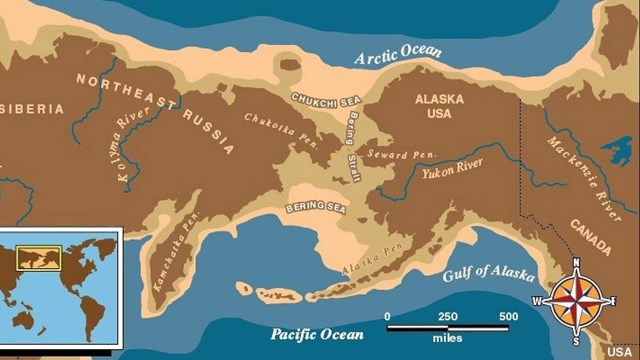
Bering Land Bridge National Preserve (BELA) occupies the northern third of the Seward Peninsula, which is about 500 miles northwest of Anchorage. The peninsula is approximately 200 miles east to west, and the greatest north to south distance is 150 miles. The peninsula is the divide between the Arctic and Pacific oceans, With Norton Sound and the Bering Sea to the south and Kotzebue Sound and the Chukchi Sea to the north. The northernmost point of the peninsula, Cape Espenberg, extends just north of the Arctic Circle, and the westernmost point, Cape Prince of Wales, is only 55 miles from East Cape of Chukotka, Siberia. Separating them is Bering Strait, with the Little Diomede and Big Diomede islands in the middle. The north coast lands of the preserve lie along the Arctic Circle, bordered by the Bering Strait on the west, the Chukchi Sea on the north, and Kotzebue Sound along the eastern coast. The preserve lands in the interior of the peninsula are bounded on the south by the Bendeleben Mountains, a low range reaching 3400 feet above sea level. The Kugruk River flowing north to Kotzebue Sound defines the southern boundary of BELA.

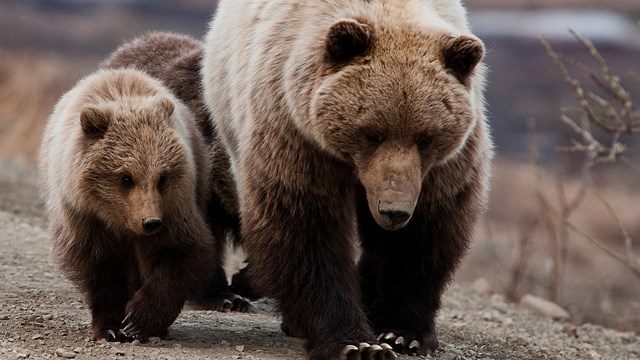
In 1980, Congress passed the Alaska National Interest Lands Conservation Act. This law redesignated the original national monument as Bering Land Bridge National Monument. The foremost purposes of the preserve are: "to protect and interpret examples of arctic plant communities, volcanic lava flows, ash explosions, coastal formations, and other geologic processes; to protect habitat for internationally significant populations of migratory birds; to provide for archeological and paleontological study, in cooperation with Native Alaskans, of the process of plant and animal migration, including man, between North America and the Asian Continent; to protect habitat for, and populations of, fish, and wildlife including, but not limited to, brown/grizzly bears, moose, and wolves; ...to continue reindeer grazing use...; to protect the viability of subsistence resources; ..."

As the name of the preserve indicates, a major focus of this unit is the Bering Land Bridge between Asia and North America. Archeological resources are a central facet of any endeavor to understand the flow of plants, animals, humans and their cultures in both directions across the Bering Strait. This flow has been going on since 15,000 years ago (at least) and continuing into the present. As part of this emphasis, BELA has been designated as a core area for the proposed Beringian Heritage International Park. This proposed park will involve cooperative research, interpretation and other activities with park areas in the Russian Far East. Several research programs, both in natural and cultural resources are already underway.

Land Ownership

Bering Land Bridge National Monument encompasses 2,700,000 acres. Of this acreage, 2,509,000 acres are in federal ownership. There are 95,000 acres of non-federal land within the boundaries, as well as 180,000 acres selected by Native groups to fill their land entitlement under ANCSA. This means selected but still federally owned and managed (with appropriate consultation). There are over 165 native allotments, approved or applied for, in the preserve. There are also over 26,000 acres in cemetery/historical (14h1) site applications in the preserve, which demonstrates high level of the rich cultural resources present. Other land holders or applicants are the NANA Regional Corporation, the Inalik (Little Diomede) Corporation, and the Kikiktagruk Inupiat Corporation (Kotzebue). There are also 79 unpatented mining claims within BELA. The local villages of Shishmaref (entirely surrounded by the preserve), Deering and Wales near or adjacent to the preserve boundaries.

Environment

Western Alaska has been joined to Eastern Siberia by "land bridges" several times in the past when glacial stages have resulted in lowered sea levels. During those times when the bridge was exposed, BELA was part of the subcontinent named Beringia. Important remnants of the Beringian paleoenvironment have been preserved in BELA, as well as a record of the changes that have taken place there since the last submergence of the bridge around 10,000 BP. The modern-day physiographic zones in BELA categorize the terrain as: Northern Coastal Plain, Rolling Stream-dissected Uplands, Imuruk Lava Plateau, Kuzitrin Flats, and the Bendeleben Mountains. Prominent features of the northwestern coast are barrier bar/lagoon systems extending from Wales to Kividlo, which includes Lopp Lagoon and Arctic Lagoon. Noteworthy are the series of relict beach ridges that dominate the landscape at Cape Espenberg and contain significant archeological sites. Although BELA was mostly unglaciated during Wisconsin times, substantial deposits of glacial loess, gravels, silts, and a few moraines within the preserve boundary reflect the effects of glacial advances and retreats in surrounding areas. Aeolian deposits in the area, dating to Pleistocene times, include dunes as well as blanket deposits up to several meters thick.

These thick deposits are found mostly on the Northern Coastal Plain, which is of low relief, only up to 60 meters above sea level. Major drainages across the plain are the Nugnugaluktuk River, flowing east to Kotzebue Sound, and the Serpentine River flowing west to Shishmaref Inlet. A major physiographic subdivision within the coastal plain is an area of vulcanism which includes Devil Mountain and five large maar lakes. These maars are rimless craters formed by explosive eruptions which occurred during a period extending from 180,000 years age to Holocene times. The coastal plain is also covered by thaw lakes and basins. The northwestern edge of the coastal plain is a 1.6 kilometer-wide strip of land characterized by sea coast beaches, salt water lagoons, and fresh water estuaries, as well as a dynamic barrier bar system. The Rolling Stream-dissected Uplands lie south of the coastal plain. They include such areas as Serpentine Hot Springs about 880 meters above sea level (asl), and in the eastern portion of the preserve, Trail Creek Caves at 560 meters asl. These higher elevation areas are limestone, marble, quartz, and slate exposures and are conducive to cave formation.

The Imuruk Lava Plateau is in the southeastern portion of the preserve, north of the Bendeleben Mountains. It is composed of at least five different lava flows ranging in age from 5 million years to the 2000 year old Lost Jim Flow. Imuruk Lake, Cloud Lake, and Lava Lake are prominent features in the Plateau. The terrain is generally gently rolling with isolated broad-domed summits of ancient volcanic cones. The Kuzutrin Flats border the north flank of the Bendeleben Mountains and south of the lava plateau. Kuzutrin Lake, in the Flats, is bordered by relict lacustrine beach terraces. Last but not least, the foothills of the Bendeleben Mountains form the southern boundary of the preserve.

The modern climate of the Seward Peninsula includes aspects of both maritime and continental influences. The presence of marine waters on three sides of the peninsula has an ameliorating effect during the winter season, and the inland area is drier with greater temperature extremes than the coast. The present day distribution of plants can be characterized as treeless (except willow and alder shrub thickets in alluvial and flood zones) tundra. These included shrub tundra, tussock tundra, and alpine tundra. There are also wet and dry meadows with vegetation consisting primarily of grasses.

A generalized arctic fauna is also present on the peninsula. Historically, caribou and musk oxen ranged across the Seward Peninsula. Musk oxen were eliminated by the early 1900's and reintroduced in 1970. Numerous historic accounts document that caribou were very abundant on the peninsula prior to 1874. The peninsula probably has been an overflow area during times of high population of the arctic caribou herd. Siberian reindeer were brought to the peninsula in 1892 and population levels reached about 600,000 in the early 1930's. The present level is about 4000 animals and much of their grazing takes place in the preserve.

Archeological Resources

The cultural sequence model proposed by Giddings and Anderson (1986) is directly relevant to the preserve, as is the most recent one by Harritt (1994). The conceptual framework for much of the early research in the region of northwest Alaska focussed on the search for the origins of the historic Eskimo culture. These explanations can be lumped into two categories, one arguing development out of indigenous cultures somewhere in the central Arctic, and the other seeing the origins in northeast Asia. The more recent interpretations of the origins of Eskimo culture, indeed of most Arctic cultures, use the concept of the existence of broad co-traditions in the Bering Strait region. The ebb and flow of people, ideas and technology from east and west and in situ development and adaptation forms the basis for looking at the cultural chronology and prehistory of this region.

BELA falls within the Tundra & Arctic zone of the NPS Alaska region. As such, the cultural sequence in the area generally follows that of northwest Alaska and the Bering Sea. Early microblade and core sites possibly associated with the early Paleoarctic tradition are generally thought to date in the Kotzebue Sound area between 10,000 and 7000 BP. The known occupation of the Seward Peninsula by bearers of this tradition is presently restricted to Trail Creek Caves in the southeastern preserve. The deposits containing Paleoarctic tradition remains are dated to 9000 BP and even deeper and earlier human occupation was postulated on the basis of modified animal bones (the famous calcaneous) that were interpreted a reflecting human activities, dating to approximately 13,000 BP. This interpretation, while not disproved, is presently considered tentative. The Paleoarctic tradition typical assemblage, containing microblades, microcores (often wedge-shaped), flake burins and large bifaces, shows definite affinities with archeological assemblages in northeast Asia, such as the Dyuktai culture of Siberia.

Although not yet documented on the Seward Peninsula, remains representing the Northern Archaic tradition were found at the Palisades site at Cape Krusenstern and at Onion Portage on the Kobuk River. It is generally considered a culture of the interior, a result of expansion of the northern boreal forests, related to a climatic warming period, and a concomitant expansion of people and/or cultural from the boreal forests and Archaic cultures south and east of Alaska. It is likely that evidence of this culture will be found on the Seward Peninsula. The best stratigraphic sequence in the preserve, at Trail Creek Caves, suggests a hiatus in occupation of that area during Northern Archaic times.

The Arctic Small Tool tradition (ASTt), has been defined as the early development of an economy that exploited sea mammals and resources of the hinterland. People of this tradition spread across the arctic, as far east as Hudson's Bay and as far south as the Alaska Peninsula, as a recognizable technology. The origins of this technology are somewhat obscure but it certainly developed around the Bering Strait. Some artifact types appear in the eastern Siberian Belkachi culture but the manufacture and use of burin spall artifacts seems to be unique to the North American Arctic. ASTt was first recognized in the classic Denbigh Flint complex, about 4200 BP and continued through a series of related cultures, ending with the Ipiutak culture around 1000 BP. Other complexes generally included Choris, Norton, near Ipiutak, and Ipiutak. Some scholars see the Norton tradition as a separate line of development instead of as part of this continuum.

Denbigh remains have been found on the Seward Peninsula at Cape Espenberg, Kuzitrin Lake, Trail Creek Caves, and Agulaak Island in Lopp Lagoon. Choris culture in Bering Strait, marked by the first appearance of pottery (an Asian import), and a shift towards slate grinding to produce stone tools (imported from southern Alaska), was first found and identified on the Choris Peninsula east of the preserve. Choris sites in the preserve occur at Cape Espenberg, Trail Creek Caves, and Lopp Lagoon. While human occupation of the Seward Peninsula in the period 2550-2000 BP is poorly understood, in general there seems to have been regional variations on the theme of Norton-Near Ipiutak. These variations reflected differing emphases in subsistence pursuit (or just that our ability to distinguish variations in the archeological record improve as the time differential from the present decreases). Norton-Near Ipiutak sites have been located in the preserve at Kugzruk Island in Lopp Lagoon (where the presence of net-sinkers seems to indicate a focus on fishing), Ikpek, Cape Espenberg, and a trace at Trail Creek Caves. The final phase of the Arctic Small Tool tradition is represented by the Ipiutak culture, appearing about 1900 BP and continuing until about 1000 BP. The culture is best recognized by a unique and elaborate art style that shows Siberian (Okvik and Old Bering Sea), and northeast Asian (possibly Scythian) influences in addition to a continuation of the manufacture of Denbigh-like end and sideblade insets. Ipiutak remains at some locations are substantial, consisting of hundreds of houses at Point Hope and almost 100 at Cape Krusenstern. Present data indicates that Ipiutak occupations were confined no northwest Alaska. Site locations in the preserve include Trail Creek Caves and Cape Espenberg, as well as at Deering just outside of the preserve.

Following the ASTt, comes the Northern Maritime tradition, which includes Birnirk, Western Thule, and Kotzebue Period cultures, dating from approximately AD 600 to the early 19th century. This tradition is considered as being the prehistoric expression of the modern historic Eskimo culture on the North American Arctic. Birnirk, the initial expression of the Alaskan Northern Maritime tradition occurred on the eastern side of Bering Strait at a time when Punuk culture was developing on Siberian shores and the St. Lawrence Islands. The Alaska developments are generally held to be ultimately northeast Asian in origin. However, Birnirk and Ipiutak coexisted for several hundred years on the eastern side of Bering Strait. Thus, the relationship between Northern Maritime (and modern Eskimo) and the preceding Arctic Small Tool tradition cultures remains an important and interesting research domain. Birnirk sites have been found at Cape Krusenstern, Cape Prince of Wales and Cape Nome, on all sides of the preserve.

The succeeding Western Thule culture is dated between AD 950 and 1400. It is a continuation of a mixed sea and land mammal based economy but with a major emphasis on bowhead whale hunting. Western Thule culture followed ASTt cultures in spreading across the arctic. Western Thule settlements are large coastal villages, usually near whale migration routes. Use of thick, grit-tempered curvilinear-stamped pottery continued. Ground slate butchering implements and weapon insets replace the flaked stone implements used in the preceding Birnirk period. By this time, the seal oil lamp, toggling harpoons, umiak, and dogs were present and in full use. The Kotzebue culture period, between AD 1400 and 1850, is seen as a direct outgrowth of the Western Thule culture and links the prehistoric and early historic Inupiat cultures. Kotzebue period sites and remains are more numerous than those of any preceding culture and have been documented around the full extent of Kotzebue Sound. Sites dating to this time period have been found at Wales and the southern Seward Peninsula, indicating an increasing population. Extensive trading networks and communications were maintained over northwest Alaska, the Seward Peninsula, and across the Bering Strait into Siberia.

Historical Aspects

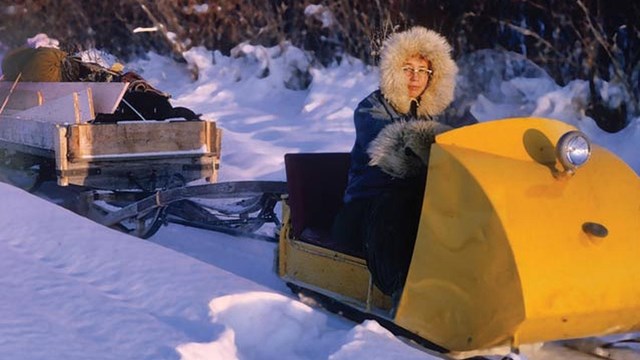
European exploration and development began in the 1700s when Russian and then English explorers mapped the Bering Strait and the land to the north. The traditional lifestyles of the Inupiaq remained fairly stable until the mid-19th century. Although Russian trade goods had reached northwest Alaska during the 1700s through trade with Siberian peoples, it did not seem to significantly affect local people. The first direct European contact with natives of the Seward Peninsula occurred in 1816, when Kotzebue touched at several points on the northern coast. The situation changed rapidly after 1850, with the arrival of whalers and others. Fur trade expanded in economic importance, missionary activity increased, and the use of sophisticated dogsledding methods became common. In the late 1890s the gold rush in the southern portion of the peninsula attracted thousands of miners, who quickly spread over the peninsula to search for gold. Mining camps were set up at Deering, Taylor, and Serpentine Hot Springs, among other sites. The Alaska Road Commission marked cross-peninsula trails, and remnants of shelter cabins built along these trails still exist within the preserve. Mining continued at a high level on the peninsula until the 1920s. Evidence of mining activity within the preserve includes the Fairhaven Ditch, which was constructed in 1906 to divert water from Imuruk Lake for hydraulic mining operations in the Pinnel River. During World War II, the peninsula became an important base of operations and there was another major influx of nonnatives into the area. The war, post-war military construction, recent oil and gas operations, and the opening up of the Russian Far East have all affected the Seward Peninsula.

Ethnographic Aspects

Historic Inupiaq culture was characterized by post-contact influences and epidemics. It lasted until the early twentieth century. Winter settlements were small and dispersed, located mainly along the coast but occasionally inland. The semi-subterranean houses were single-roomed with tunnel entries and storm sheds. Subsistence was focused on seal, caribou, fish, birds, with some beluga hunting. Reindeer herding grew in importance, peaking in 1932. BELA includes portions of the territories of five late nineteenth century Inupiaq bands: the Tapqaqmiut (Shishmaref area), Kingikmiut (Wales area), Kauweramiut (Kuzitrin River area), Kuiyugmiut (Koyuk River area), and the Piitarmiut (Cape Espenberg - Imuruk Lake area). The seasonal round followed by these groups was generally similar.

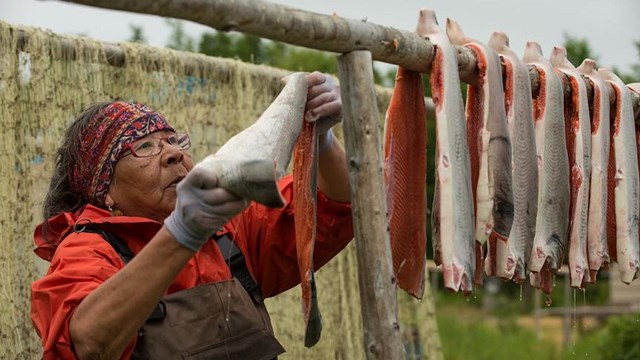
At break-up in spring, families gathered on the coast in larger communities to hunt beluga, bearded seal (and other seal species), walrus, and to gather greens. During summer, some families dispersed inland along rivers and lakes to fish, snare small mammals and ptarmigan, gather plants and eggs, and hunt waterfowl. Other families stayed along the coast to net beluga. In late summer and fall, berry gathering, caribou hunting (sometimes in large, organized drives), squirrel snaring and fishing were important. At freeze-up, people returned to winter villages where they could net seal, ice fish, snare ptarmigan and small mammals, and occasionally hunt caribou. Winter was also the time for traveling and gathering for feasts and dances. This pattern is thought to be a continuation of that of the late Kotzebue Period archeological culture.

By 1900, larger, more stable villages were established as schools, trading posts and post offices were set up. Reindeer herding became an important activity and continues to be part of life on the Seward Peninsula. Subsistence activity is still a major focus of the people living all around the preserve. Traditional cultural life is still strong on the Seward Peninsula, and sacred sites and landscapes are still recognized. For instance, in the preserve, the Serpentine Hot Springs area has long been recognized by natives for its spiritual and medicinal values. The Serpentine River valley has traditionally been used as a training ground for shamans in northwest Alaska, and the Hot Springs were known as the site where the area's most powerful shaman spirits lived. Oral history and ethnographic archeology is as ongoing program at BELA under the auspices of the Beringian Heritage program.

Discussion

Although there has been one major inventory project, a major excavation and evaluation project, and an ongoing ethnohistoric project for the preserve, less than 15 % of the preserve has been surveyed. The rich cultural and geological resources of this unit, its relationship to Beringia and its implementing language all point up the need for a continuing inventory, evaluation and research program.
BIBLIOGRAPHY


Return to the Prehistory of Alaska Homepage


More general information on this National Preserve is available at

BELA


Questions, Comments, and Suggestions - please send email to: ken_schoenberg@nps.gov