National Park Service Alaska Regional Director Announces Retirement

After a lifetime in national parks -- first as the child of a park ranger, then in his own 35-year career -- Alaska Regional Director Robert Arnberger recently announced his retirement from the National Park Service. "I have tremendous respect for the people of Alaska, as well as the talents of all of our park employees who work so hard as stewards of these magnificent treasures," said Arnberger. "I have been so impressed by Alaskans and their commitment to preserve the cultures of this land in consonance with the preservation of the land."

In his three years as Regional Director, Arnberger held both resource protection and education as high priorities for national parks in Alaska. He implemented the "Natural Resource Challenge," a major effort to substantially expand the natural resources research, inventory and monitoring work in our national parks. He oversaw the launch of the journal "Alaska Park Science." This publication connects and informs the public about the types of research taking place in our national parks. More importantly, it addresses what these studies are finding out about the state of our invaluable natural and cultural resources.

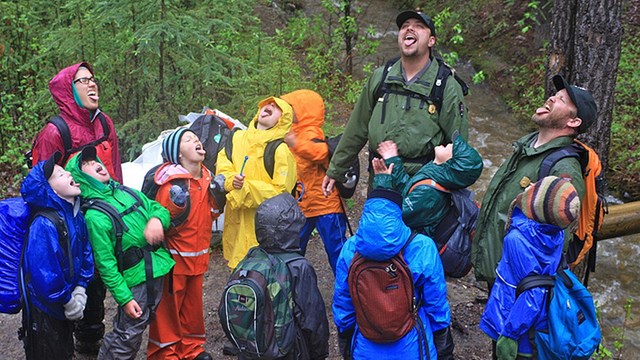
In education he saw that our national parks represent the broadest sweep of American history and sciences, and are thus natural classrooms. "We formed several key partnerships to make significant advances in distance education, bringing the park experience to students through web-based curriculum, park ranger visits, cable television programs and other media projects," he said.

Improving the visitor experience was also a high priority for Arnberger. His direction led to several major visitor facility improvements and construction at parks across the State. "I was proud to cut the ribbon last summer at the opening of the new visitor center in Wrangell-St. Elias National Park," stated Arnberger. "In addition we have been able to see major construction underway at Denali National Park in the frontcountry area. This will be a major improvement to the visitor experience at those parks." This spring the NPS, in partnership with other agencies, will open another new visitor center in Coldfoot.

Arnberger was born June 17, 1947, at Grand Canyon National Park, Arizona and is a second-generation park service employee. Director Arnberger graduated from the University of New Mexico with a Bachelor of Arts Degree in History/Biology in 1969. For a short period of time, he taught school in Albuquerque, New Mexico. He started his career as a seasonal park ranger at Gila Cliff Dwellings National Monument in New Mexico in 1969. In addition to being regional director for Alaska since 2000, Arnberger has served at 10 parks across the nation, serving as a park ranger at 5 of them and as a superintendent or deputy at the other 5. "I am most proud that I worked as a field ranger in my early years performing visitor education, law enforcement, search and rescue and emergency medical services," said Arnberger. His years as a senior national park manager were carried out at Palo Alto Battlefield National Park, Everglades National Park, Saguaro National Monument (now a national park), Big Bend National Park and Grand Canyon National Park. "My fondest superintendent memories were at Grand Canyon where I was able to be superintendent at the very place I was born," recalled Arnberger.

Arnberger is married to Elvira (Vera), originally of Midland, Texas. His oldest son, Jeffrey, works for the Bureau of Land Management, as an assistant fire management officer in Elko, Nevada. His daughter Kristi Campbell is married, and is an admissions counselor at Tiffen University in Tiffen, Ohio. Youngest son, Samuel is presently a park ranger at Glen Canyon National Recreation Area in Arizona. This summer Arnberger and his wife will move to Tucson, where they have maintained a home for several years.

"I'm proud to end my career in Alaska. The park areas in Alaska represent the most important wild landscapes left in the United States -- and maybe the world," said Arnberger. "To have been able to work with so many good people dedicated to preserving these areas, and the cultures that depend upon them, has been exciting."

--END--