|
ParkWise
> Teachers >
Treasures
> Footprints into the Past and the Future
Footprints
into the Past and Future of
Bering Land Bridge National Preserve:
Background
Introduction:
Bering
Land Bridge National Preserve is as much a part of America's cultural
heritage as Yellowstone, Yosemite or the Everglades, if not more
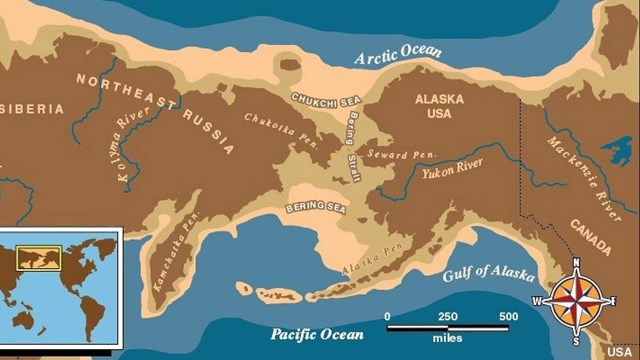
so. The distance across Bering Strait from Siberia to Alaska's Seward
peninsula is approximately 55 miles. For several periods during
the Pleistocene Ice Age, humans, plants and animals could have dispersed
from Asia to North America entirely by land.
During
the late Wisonsinian glacial episode, so much of the earth's water
was locked up in huge ice masses that sea levels fell to 350 ft
below today's, exposing vast areas of land that had previously
been submerged. Most archaeologists agree that it was across this
Bering Land Bridge, also called Beringia, that humans first passed
from Asia to populate the Americas.
Bering
Land Bridge National Preserve commemorates the prehistoric peopling
of a continent some 10,000 years or more ago. It also preserves
important future clues in this great detective story regarding human
presence in the Americas.
The
descendants of those original wanderers continue to depend upon
the land in Beringia. From villages near the Preserve, subsistence
fishers, hunters and gatherers come to obtain their nutritional
needs and to share in traditions that go back generations.
While
there are relatively few threats facing the Preserve and its resources
at this time, the greatest hope for the future of Bering Land Bridge
is our children. As resource users and future decision-makers, the
fate of the Preserve lies in their hands.
Recognizing
the need to teach children more about the Beringia region and about
issues concerning the Bering Land Bridge ecosystem, the park requested
Parks as Classrooms grant monies to produce this interdisciplinary
curriculum kit for elementary school children and teachers.
Objectives
of this curriculum unit:
- Acquaint students with the Bering Land Bridge ecosystem and
purpose through hands-on activities.
- Develop within students an understanding of the value of resource
conservation and the value of Bering Land Bridge to the state
of Alaska and ultimately to the world.
- Develop within students an appreciation of national park areas
with special emphasis on Bering Land Bridge National Preserve
- Direct students toward active participation in resource conservation
in their area.
Acknowledgments:
- Coordinators:
- Jeanette Cross (Bering
Land Bridge National Preserve)
- Greg Dudgeon, Chief
Ranger (Bering Land Bridge National Preserve)
- Sponsors
- National Park Foundation,
Parks as Classrooms
- Development Team
- Educator/Editor/Primary
Author: Jennifer Allen (Bering Land Bridge)
- Editor/Secondary
Author: Jeanette Cross
- Reviewers: Greg
Dudgeon, Sue Goodglick (Bering Land Bridge), selected teachers
from the Seward Peninsula
- Illustrator/Layout:
Martha Craft (Nome, AK)
- Contributors:
- Wendy Davis (Alaska
System Support Office), Richard Harris (Bering Land Bridge),
Greg Dudgeon, Ken Adkisson (Bering Land Bridge), selected teachers
- Goods and Services
contributed:
- Bering Land Bridge
National Preserve, Alaska System Support Office
>
Unit Outline >
|