National Park Service arrowhead logo National Park Service, US Department of Interior
Visit ParkWise!Home for ParkWiseTeacher Resources Student Resources

Overview

Background

Unit Outline
Final Activity
Final Activity Assessment
Instructional Resources
National Standards

ParkWise > Teachers > Treasures > Footprints into the Past and the Future

Activity 1:
Locating Bering Land Bridge
National Preserve

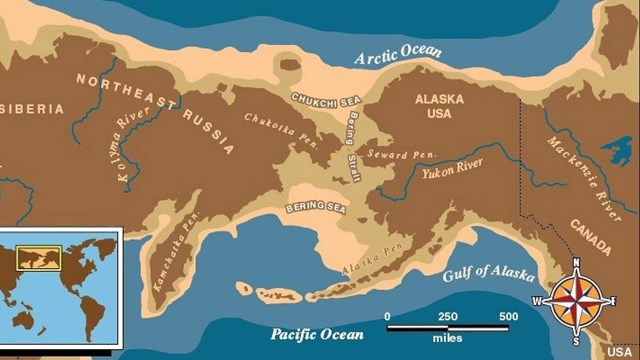
Students use maps to locate Bering Land Bridge National Preserve and the points of interest, towns and landmarks, in and around the Preserve.

Unit: Footprints into the Past and the Future
Guiding Question: What is the Bering Land Bridge National Preserve?

Critical Content:
Students will know what the Preserve is, where it is, and some resources preserved within it.
Grades: 4

Duration: 1/2 - 1 class period

Group size: entire class, and individual

Setting: classroom

Materials: blackline masters of North America and Alaska, Seward Peninsula map (color or black and white), classroom wall map of continental United States or North America, map of Seward Peninsula
.

Objectives:

1) Locate the Preserve as related to:
a) the Continental United States,
b) State of Alaska,
c) Seward Peninsula
 
2) Locate significant land marks in the Preserve:
a) Serpentine Hot Springs,
b) Trail Creek Caves,
c) the Maar Lakes,
d) Cape Espenberg,
e) Lost Jim Lava Flow,
f) Nome,
g) Shishmaref,
h) Deering,
i) Wales

Before You Begin: Review What is Bering Land Bridge National Preserve?

Procedures:

  1. Introduce students to the location of Bering Land Bridge National Preserve using classroom wall map of continental United States or North America.

  2. Introduce students to location of Bering Land Bridge National Preserve using blackline masters of Alaska and the Seward Peninsula.

  3. Point out the location of Bering Land Bridge on Alaska blackline map and on the Seward Peninsula laminated map from the brochure.

  4. Point out significant landmarks and why they are significant in the Preserve using the Seward Peninsula laminated map from the brochure.

  5. Distribute a copy of each blackline master to every student. Students will label Bering Land Bridge National Preserve, Nome, Shishmaref, Deering, and Wales, the significant landmarks mentioned above and major bodies of water like the Bering and Chukchi Seas.

Discussion Questions:

  1. How far north is Bering Land Bridge?

  2. What type of climate do you think it might have? Would it be a warm or cold place in summer? In winter? Would it be light or dark in the summer? What about in the winter?

Extensions: Have students label their home city, and find the national parks closest to their home.