|
ParkWise
> Teachers >
Treasures
> Footprints
into the Past and the Future
Activity
2:
Riddle Me This
Students
learn about Bering Land Bridge National Preserve by answering riddles.
|
Unit:
Footprints into
the Past and the Future
Guiding Question: What
is the Bering Land Bridge National Preserve?
Critical Content: Students
will know what the Preserve is, where it is, and some resources
preserved within it.
Grades: 4
Duration: 1 class
period
Group size: entire
class, and individual
Setting: classroom,
playground or gymnasium
Materials: Riddle
cards (riddles,
bonus riddles),
pictures of objects from Bering Land Bridge.
|
Objectives:
- Students will become familiar with the purpose of the Preserve.
- Student will be able to name 4 resources in the Preserve.
- Students will become familiar with the role of the National
Park Service.
- This activity will reinforce the concepts learned in Activities
A and B
Before You Begin: Review
What
is Bering Land Bridge National Preserve?
Review the information
below. Refer to the glossary or other area in the curriculum for
more background information.
Lava rock
is from Lost Jim's Lava Flow that erupted 1-2,000 years ago. The
Lost Jim Lava Flow is one of the major geological resources in the
Preserve.
Kiviut
represents the musk ox, a true arctic animal. The musk ox is an
example one of the many different types of wildlife found the Preserve.
Plant pressings
show plant dispersal across the land bridge as well as arctic adaptations
plants utilize to survive in the harsh environment.
Junior Ranger Badges
represent the people that work in the Preserve.
The Baby Mammoth
Molar represents the prehistoric animals that migrated across
the land bridge. It also represents paleontological resources in
the Preserve.
A spear point
was a common tool of the early people who crossed over the land
bridge. It symbolizes archaeological resources in the Preserve.
The site bulletin of
Serpentine Hot Springs represents one of the main
use areas in the Preserve and a geological resource.
The picture of the subsistence
hunters depicts the importance of subsistence to the people
of the Seward Peninsula.
Lichen
represents reindeer grazing in the Preserve and symbolizes how fragile
the arctic environment is.
Answers to Bonus Questions:
Beringia
is the other name for the Bering Land Bridge that existed 10,000
years ago.
The preserve contains
2.7 million acres.
Villages that border
the preserve are: Nome, Deering, Shishmaref, and
Wales.
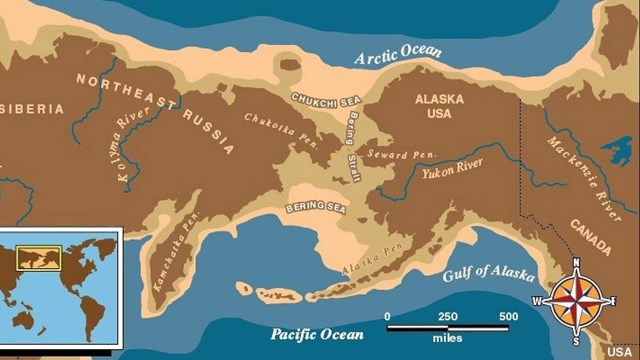
Two bodies of water separate
Siberia and Alaska: the Bering Sea and the Chukchi
Sea. The Bering Strait covers what was once the land bridge.
Procedures:
- Introduce students to the location of Bering Land Bridge National
Preserve using classroom wall map of continental United States
or North America.
- Review the purpose of the Preserve and its significant resources.
- Place objects lined up in the middle of the room.
- Divide the students into 2 groups.
- Number off students in Team One (from 1 to the number of students
in the group).
- Number off students in Team Two (from 1 to the number of students
in the group).
- Line the students up on opposite sides of the object (see diagram).
| Team
One |
|
Team
Two |
| Student
1 |
picture |
Student
1 |
| Student
2 |
picture |
Student
2 |
| Student
3 |
picture |
Student
3 |
| Student
4 |
picture |
Student
4 |
| Student
5 |
picture |
Student
5 |
| etc. |
etc. |
etc. |
- Read a riddle card:
- Call out a student number or number that has been assigned.
- Two students race to the object they think is correct.
- The team member that gets the correct object first earns their
team a point.
- Read a bonus question for one extra point for the team.
- The team with the most points wins!
Discussion
Questions:
- What of these objects might you find where you live?
- What kinds of objects would you choose to create a riddle game
for a national park near your school?
- What kinds of objects would you choose to create a riddle game
for your town or state?
|