|
ParkWise
> Teachers >
Treasures
> Footprints into the Past and the
Future
Activity
6:
Plant Adaptations
Students
learn about adapting to the arctic environment.
|
Unit:
Footprints into
the Past and the Future
Guiding Question: How
do plants and animals adapt to the arctic conditions of Bering
Land Bridge National Preserve?
Critical Content: Students
will know about plant and animal adaptations to the arctic
environment of Bering Land Bridge National Preserve.
Grades: 4
Duration: 1
class periods
Group size: entire
class
Setting: classroom
and outside in winter if possible
Materials: dark-colored
winter clothing (hat, polar fleece, wind breaker), plant pictures
|
Objectives:
- Students will identify two tundra plants.
- Students will list three adaptations that plants use to survive
in the arctic tundra.
- Students will explain one way that people can help the survival
of tundra plants
Before You Begin: Review
Arctic
Adaptations, and Canada's
Polar Life site
Many plant and animal
species develop adaptations for the areas that they live. Desert
plants like the cactus, require very little water to survive. Plants
of the arctic have also developed unique strategies to survive in
the harsh arctic environment. Many of the plants are small, growing
close to the ground and very close together to avoid the wind and
conserve heat. Some possess a light, fuzzy covering to insulate
the buds so they can grow. Many are dark colors of blue and purple
to absorb the heat from the sunlight even during the winter months.
Because of the cold and short growing seasons, arctic plants grow
very slowly. Some grow for ten years before they produce any buds
for reproduction.
Procedures:
- Set the atmosphere for the arctic by playing a game of charades
for cold and windy weather. Emphasize the harsh conditions in
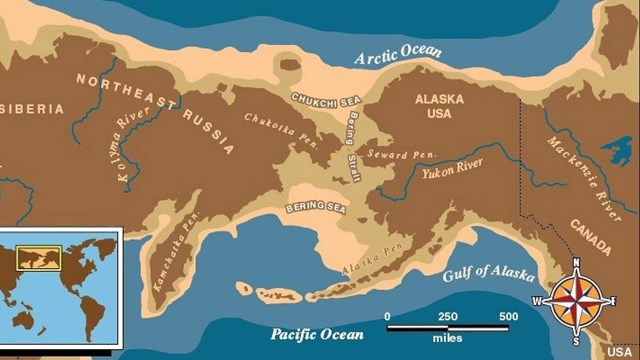
the arctic and show the students on the map the imaginary line,
the Arctic Circle.
- Ask the students to picture themselves on top of a high ice-covered
peak. Ask them: "How would you protect yourself from the cold
and wind? How would you act and what would you wear?"
- Brainstorm and make a list on the board of the students' responses.
- Discuss the fact that just like humans, plants that live in
cold conditions also do special things to stay warm.
- Tell them that many arctic plants grow in tight clumps close
to the ground. This creates a tiny hill with an uneven, spongy
surface. They use other rocks and plants to create a wind block
which enables them to better conserve the heat radiating from
the ground.
- Take the students outside if it is cold.
- Have students get in groups of four and crouch together as
tightly as they can. If you're really ambitious, try splitting
the class in half and do the same thing. If they stay together
long enough, they will feel the heat being trapped in the mass
of bodies.
- Tell them that some plants grow a fuzzy material for insulation.
Compare it to the polar fleece that humans wear to keep warm when
the air is cold.
- Conduct a scientific experiment on insulation:
- Break the class into 4 groups. Give each group a bottle
of water that has been stored at room temperature.
- Have each group record the temperature of the water in their
bottle. Each bottle should have a similar temperature.
- Have each group select a different insulation, such as paper
(flat or crumpled), a wool scarf, a polar fleece jacket, etc.
If it is cold enough outside, place the bottles outside for
one hour. Otherwise place the bottles in the freezer for 30
minutes.
- Discuss with the class their hypotheses of what will happen
to the water temperature in the bottles. Discuss with the
class which insulation they think will work the best.
- At the end of the cooling period, record the temperature
of each bottle and compare the effectiveness of the different
insulations.
- Show them an example (plant pressing and photograph) of the
woolly lousewort and its insulation.
- Ask the students what they would wear on their feet.
- Explain that the plants in the tundra have very shallow root
systems since they cannot grow downward into the permafrost. Their
roots are very close to the surface and easily damaged.
- Stress to the students that arctic plants are very fragile
and take a long time to grow. Compare lichen to grass. If grass
is stepped on the ground will protect its roots. It will most
likely grow back later on in the year or by the next season. If
lichen is stepped on they are easily damaged. It may take decades
to recover or not recover at all.
- Since the tundra is the home to many important members of the
food chain we need to care for and preserve it. 'People and animals
need the tundra to survive. We need to not drive on or trample
it unnecessarily. Even pollution in the air can kill the fragile
plants of the tundra.
- Preserving the tundra is everyone' s job.
Discussion
Questions:
- Why is the tundra important to protect?
- What kinds of activities can harm the tundra?
- What should the role of National Parks be in preserving tundra?
|