National Park Service arrowhead logo National Park Service, US Department of Interior
Visit ParkWise!Home for ParkWiseTeacher Resources Student Resources

Overview

Background

Unit Outline
Final Activity
Final Activity Assessment
Instructional Resources
National Standards

ParkWise > Teachers > Treasures > Footprints into the Past and the Future

Activity 3:
Beringian Math
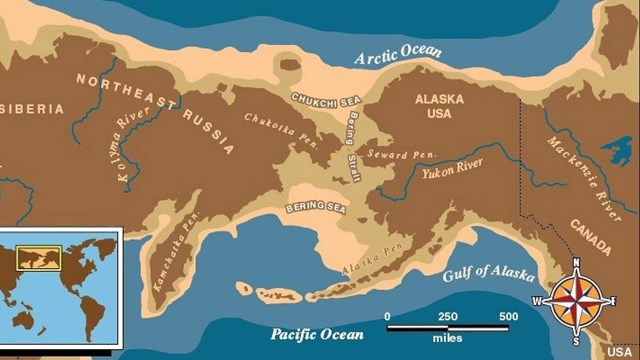
graphic of Beringia

Students calculate rates of migration for different species across the Bering Land Bridge.

Unit: Footprints into the Past and the Future
Guiding Question:
What is Beringia, or the Bering Land Bridge?
Critical Content:
Students will know about the Bering Land Bridge and migrations across it.
Grades: 4

Duration: 1/2 class period

Group size: students work individually

Setting: classroom

Materials: paper, pencils, map of Beringia (color or B&W), map of Seward Peninsula
.

Objectives:

  1. Students will use the formula T=D/S to calculate the time it may have taken for early travelers to move from Asia to North America. T = time, D = distance, and S = speed.
  2. Students will understand what, where and when Beringia or the land bridge was, and its significance to Bering Land Bridge National Preserve.

Before You Begin: Review The Lost Continent of Beringia

We can get a clearer picture of the how long it took the prehistoric animals and hunters to travel across the land bridge when their distance traveled and moving speed are taken into consideration. Remember, scientists don't think the animals and hunters intended on crossing to another continent. They believe that hunters followed the animals and preyed on them.

The formula to calculate the time it takes to travel a certain distance is T=D/S. That is the time (T) it takes to travel a certain distance (D) equals the distance traveled divided by the speed (S) of travel. For this exercise we have taken average speeds of migrating animals as well as a constant distance. Use the migration times below to get a better idea of the time it might take an animal or a human to travel the distance between the continents.

The distance traveled in all of our equations is 350 miles (this can be modified at the discretion of the instructor).

The estimated average animal migration speeds are as follows:

Muskox 2 miles per day
Caribou 15 miles per day
Woolly Mammoth 7 miles per day
Saber-toothed tiger 12 miles per day
Arctic tern 200 miles per day
Bear 20 miles per day
People 8 miles per day


Procedures:

  1. Reinforce to the students that it took many years to populate North America.

  2. Show them the color map of Beringia. Restate the purpose of the Preserve and distribute blackline maps to the class.

  3. Have your students label Beringia, Alaska and Siberia.

  4. Introduce the formula: T=D/S. Provide an example to do with the class explaining how the formula works. Use numbers that divide evenly to ease the concept of the equation. Use a student walking time from their home to school to put it into another perspective if necessary.

  5. Use the estimated migration times the provided to reinforce the formula.

  6. When comfortable with the students' performance, provide the remaining equations for independent practice.

Discussion Questions:

  1. How do you think you could walk each day?

  2. How long do you think it would take plants to cross Beringia?

  3. Do you think small animals like mice and voles or insects crossed Beringia?

  4. What kinds of plants and animals do you think might have been able to cross between the continents even if there had been no land bridge?

Extensions:
For students with more advanced mathematical skills, use the following:

  • Give the students the time and distance - and have them figure out the speed.

  • Give the time and speed and have them figure the distance.

  • Research migrations of other animals and find out how long - it takes or how many miles the animal travels in a day. Some animals that migrate are whales, seals, and migratory birds.

  • The students may pick one animal and a starting place for the animal in Siberia and show how far that animal migrated into Alaska by using the blackline maps.