National Park Service arrowhead logo National Park Service, US Department of Interior
Visit ParkWise!Home for ParkWiseTeacher Resources Student Resources

Overview

Background

Unit Outline
Final Activity
Final Activity Assessment
Instructional Resources
National Standards

ParkWise > Teachers > Treasures > Footprints into the Past and the Future

Activity 5:
The Archaeology Puzzle

Students learn archaeology and artifacts.

Unit: Footprints into the Past and the Future
Guiding Question:
What are the resources of the arctic ecosystem in Bering Land Bridge National Preserve?
Critical Content:
Students will know about the archaeological studies of Bering Land Bridge National Preserve.
Grades: 4
Duration:
1 class period
Group size: entire class
Setting: classroom
Materials: Blackline map of the Preserve. Pit-house puzzle pieces. For pieces that fit on 8.5 X 11 paper: 1, 2, 3, 4, 5, 6, 7, 8, 9, 10, 11, 12, 13, or puzzle.zip (700K). For larger pieces to print on 11X17 paper: 1, 2, 3, 4, 5, 6, 7, 8, 9, 10, 11, 12, 13, or puzzle_big.zip (9MB).

***NB: be sure when printing puzzle pieces that you set the properties so that your printer does not fit to page, or have other scaling that differs between pieces.

Objectives:

  1. Students will be able to define "archaeology", "artifact", "feature", "site", and "context".

  2. Students will give one reason why archaeology is important.

  3. Students should be able to tell why looting/pot-hunting is bad.

  4. Students will be able to name an archaeological site in the Preserve and know that archaeological sites are protected by the Archaeological Resources Protection Act.

Before You Begin: Review It's All About Resources and Archaeology in Bering Land Bridge National Preserve

Procedures:

  1. Ask your class if someone can tell you what archaeology is. Then add whatever information that needs to be added to their answer. If no one answers explain to them what archaeology is. Maybe write the definition on the board.

  2. Ask your class why archaeology is important, (i.e. Why do archaeology? Why is it important to know about past cultures? etc.) You may want to write down some reasons on the board.

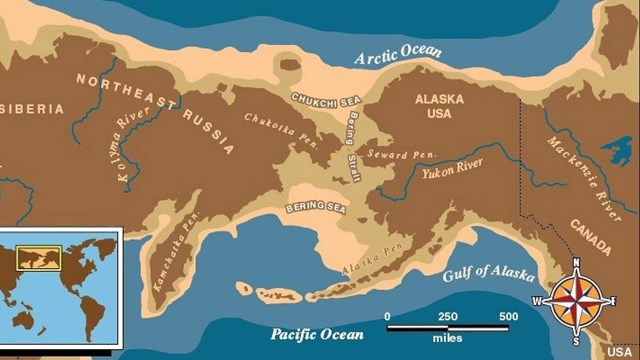
  3. Explain to them that there are hundreds of archaeological sites in the Preserve. Point out a few sites on the map and give some details about each place:

    a) Cape Espenberg: There are hundreds of semi-subterranean pit houses at Cape Espenberg ranging from a few hundred years old to up to 4,000 years old

    b) Ublasaun: Ublasaun was a traditional sea mammal hunting area and summer reindeer herding camp used up until the 1950's. Today, Cape Espenberg and Ublasaun are areas were local people still pursue their subsistence lifestyle by hunting, fishing, and gathering.

    c) Trail Creek Caves: One of the oldest sites in Alaska. Human use is dated back 9,500 years.

    d) Twin Calderas: The cairns, used for various hunting purposes, associated with the Lost Jim Lava Flow have human use dated back 300 years.

  4. If you would like, have your students take out black line maps from the exercise, "Where is the Preserve?" and mark the four sites on it.

  5. Explain to your class that archaeology is like putting together the pieces of a puzzle. The archaeologists looks for clues, like a detective.

  6. Explain that clues include:

    a) artifacts: objects made or altered by humans (portable objects)

    b) features: larger man made objects like houses, gardens, hearts, roads, etc.

    c) context: the relationship between things - how things relate to each other. For example, finding toys in the sleeping area would suggest a child playing with toys in- bed or cooking pots by a hearth indicates cooking indoors, etc.

  7. Bring out the puzzle pieces; lay them face down. Have your students gather around in a tight circle around the puzzle pieces. Have the students put the pieces, together.

  8. Once the puzzle is put together tell the students that they're going to be archaeologists and that they're looking at a floor plan of a semi-subterranean house (partially underground home) or pit house.

  9. Tell your students that as archaeologists they have just excavated (uncovered) this house. Now they are looking for clues on how people lived in this house.

  10. Ask them:

    a) What artifacts or features do they see?

    b) What are they made of?

    c) What was their purpose? What different areas are there in the house (sleeping area, men's work area, woman's work area, cooking area, clothing area)?

    d) What activities went on in each area and who did these activities?

    e) How many people lived in the house?

    f) Where there children living in the house?

    g) Did these people live in a cold climate or warm climate?

    h) Did they hunt?

    Ask your students any other questions that pop into your mind while looking at the puzzle with them.

  11. Ask your students how they know all of these things just by looking at the site. Tell them that they are making inferences based on what they know about their lives and objects they use today.

  12. What happens when pieces of the puzzle are missing? Take away a piece of the puzzle. Ask your students: What information will be lost? For example, if you take away the piece with the children's toys, how will an archaeologist know that there were children in the house?

  13. Take away more pieces. Ask your students what other information is lost.

  14. Ask your students why pieces of the puzzle would be missing. Causes of disturbance might be: looters/pot hunters, erosion by wind and water, earthquakes, freezing and thawing, animals, bulldozers and urban development like sewer and water.

  15. Ask your class why is it important not to loot a site? Why is it important to keep artifacts in context? Explain to them that it's important not to loot a site just for the artifacts because a lot of information about the site gets lost. Information is gained only by looking at the whole picture, and how things relate to each other in context. It is also against the law under the Archaeological Resources Protection Act (ARPA).

  16. Review why archaeology is important and why sites should not be looted. What is the role of government agencies such as the National Park Service in protecting archaeological sites?

  17. Ask your students what they should do if they find an archaeological site or artifact?

    a) Do not dig up the site or artifact.

    b) Write down where they found it.

    c) Tell a responsible adult so that the adult can report it.