|
ParkWise
> Teachers >
Treasures
> Footprints into the Past and the
Future
Activity
8:
Alaskan Natives
Students
research the different Native groups of Alaska and how they live.
|
Unit:
Footprints into
the Past and the Future
Guiding Question: Why
did people migrate across Beringia and how did they live?
Critical Content: Students
will know about Native cultures and subsistence near Bering
Land Bridge National Preserve.
Grades: 4
Duration: minimum
1 class period (depends on level of detail)
Group size: small
groups (5 groups per class)
Setting: classroom
Materials: Blackline
map "Native Alaskans", books on Native American
and other independent sources.
|
Objectives:
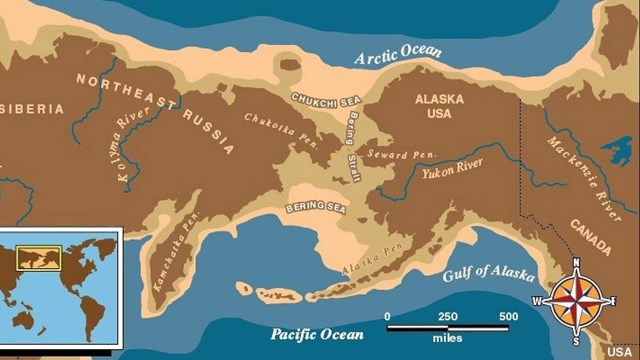
- Students will learn about the five major Native groups in Alaska
and find their geographic location on a map of the state.
- Students will learn facts relating to the lifestyle of the five
groups: what they subsist on (animals and plants), traditional
modes of transportation and house structures, and how their lives
are different today.
Before You Begin: Review
People
on the Land in Bering Land Bridge National Preserve and Alaska
Although these indigenous
people speak different languages and live in different geographic
regions, they share a common link. Scientists believe that they
are descendants of the early travelers of the land bridge when it
was last open. All the groups carry on subsistence lifestyles.
Procedures:
- Discuss the background information about the Natives of Alaska
and distribute copies of the blackline map.
- Break the students into five small groups, and assign to each
one of the Native cultures of Alaska. Students are to research
that culture and show how it helps their people to survive in
the arctic ecosystem in which they live. Research information
should include location, a description of the local environment,
their means of subsistence, transportation, houses, traditions,
their families and community, and how their lives are different
today.
- The students work together in the small groups using at least
three resources to find the information. This information can
come from picture books, encyclopedias, computer programs, or
interviews with experts.
- Teachers should make sure that duties are equally distributed
and all students take part.
- The group writes a short summary about the culture including
the information that is required in the objectives.
- Each student will draw a picture of something about the culture
that was interesting to him or her.
- Each group will now be an expert in their culture and will
teach the rest of the class what they have learned about the subject.
Each will give a short presentation highlighting the key information
in the objectives and use their pictures as visual aids.
Discussion
Questions:
- How has the environment of Alaska shaped the Native cultures
there?
- What are the resources (animals, plants, wood, water) that the
different cultures have to use?
- How are the different Native cultures of Alaska similar to and
different from each other?
- How are the Native cultures of Alaska similar to and different
from other cultures around the world?
- What part of their culture seems the most interesting to you?
Why?
Extensions:
- Have students create a poster out of their research, including
text, photos and drawings.
- Have students create a model of something used by the Native
culture they are researching, such as clothing, tools, boat, or
a house.
|