Procedure:
Work with the class
to phrase a question about population size that can be answered
through scientific investigation. The question should be along
the lines of How many objects of a certain type are there in an
area of known size? Discuss with the class types of questions
can be answered through scientific investigation and what types
of questions are more difficult to answer.
Take the students outside
to a big area or field.
Look around and decide
on an object whose population you will measure. It may be rocks,
plants (all plants or a specific type), sticks, etc. Sample areas
won’t be large, so don’t select full-sized trees.
Discuss with the students
how they might design and conduct an investigation answering their
population size question. If an area is too large to count every
object, how might they estimate the population anyway? Scientists
use a method known as field sampling. They carefully count all
the objects in a small, manageable area or a series of areas and
then make an estimate from those sampling areas to the entire
area.
As a class decide the
extent that you would like your population estimate to cover.
For instance, a soccer field, a playground, the parking lot, etc.
Sometimes science requires
only simple tools and instruments. In this investigation, use
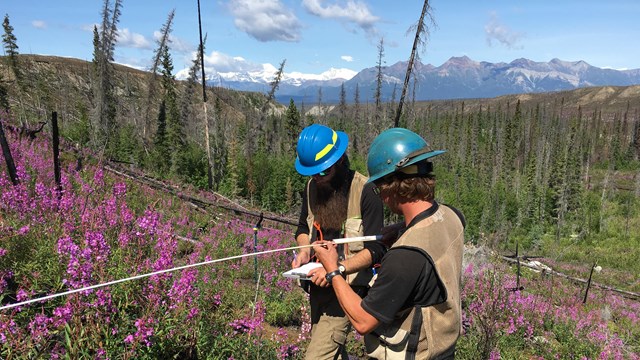
a tape measure to mark off at least five different sampling areas
that are a meter square. Select sampling areas that represent
the variety within your larger area.
You may split your
class into five groups and have each group count all of the specified
objects in that sampling square. If the object is numerous or
difficult to see, you can have each member of the group count
separately, and see if they arrive at the same number, and use
the mean as the number of individuals.
Record the number of
individual objects within each of the one-meter squares.
Determine the average
(mean) number of individuals per square meter by using the information
collected from each of the sample areas. Use the following as
an example for the calculations.
| Area |
Number of
Individuals |
| Area 1 |
1
|
| Area 2 |
14
|
| Area 3 |
0
|
| Area 4 |
5
|
| Area 5 |
21
|
| Total Number
of Individuals |
41
|

The class now has a
measure of the average number of individuals per square meter.
This number is known as a population density.
To determine the total
population, calculate the area of your complete population extent,
e.g., the field or playground. (For younger students, remind them
how to calculate area by measuring the long side and short side
of a rectangle and multiplying.)
Multiply the density
per square meter times the total area in square meters to determine
the total population estimate.
Scientists review each
others' work by asking questions about how they did their research,
and what conclusions they draw from their research. Have the students
brainstorm a list of questions to ask each other about their techniques
and conclusions. You can do this as a class, and have the students
answer them together as a class, or students can brainstorm in
their small groups and then ask them of another group which must
answer the questions.
Scientists make their
results public. Have the students make a presentation of their
research methodology and results for the public. They can do this
as individuals or in their small groups. Create a small poster
that describes the question to be answered, the methodology used,
the data, the results, and the conclusions they can draw from
those results. These can be presented to the class or put on display
in the hall.
Discussion Questions:
- Is the total population estimate the true number of individuals
in the area?
- If you sampled another square meter area, would you get the
same population density?
- If the objects you were counting were very much larger (trees)
or smaller (grains of sands) how would you need to adapt your
research design?
- Was it difficult to know which objects to count? Were some
objects similar but not to be included? (For instance, if you
are counting pebbles, when is an object a pebble and when is
it sand or rock? If you are counting leaves how small can a
leaf fragment be before it is no longer considered a leaf?)
- How might wildlife researchers counting populations in a large
habitat area decide where and when to sample?
Extensions:
- Students can discuss
the various habitat needs for each population and then draw
their needs on the mural. For example, squirrels need trees
for food and shelter so the students would draw or cut out pictures
of trees for their squirrel population.
- Students could collect
various materials from the local area and glue them to the mural
(i.e. tundra, grass, rocks, needles).
Suggested Assessment:
Ask the students if
a population can include two or more different kinds of animals
(Answer: no).
Give the students a
worksheet with pictures or drawings of animals. Ask them to state
the size of each population.
Credit:
Adapted from Population
Posters, Wildlife for the Future - Alaska Wildlife Curriculum,
Teacher’s Guide K-8. Alaska Department of Fish and Game.