|
ParkWise
> Teachers >
Culture > People
and Land
> Unit Outline
Activity
1:
On the Move
Students
will travel about to collect their needs in order to survive. Students
will plot seasonal camps on a map. Optional card game version.
|
Unit:
Denali People and
the Land
Guiding Questions:
Why did Alaska
Natives in the Denali area move about? How does geography
affect the movement of people?
Critical Content: Reasons
for native moment in the Denali area. The affects of geography
on travel routes.
Grades: 5-6
Duration: Three
part activity. Half-hour
preparation, and 1
hour and 15 minutes for all three parts and discussions.
Group size: Entire
class
Setting: classroom
(can be adapted
for outdoors)
Materials: Four
different colors of construction paper. Enough of each color
to make one 3x3 inch square for each student in your class.
(If this is an activity that you will repeat in the future,
you may want to laminate your paper or use poker chips or
colored tongue depressors in place of the paper squares.)
Masking tape and marker.
|
Before
you begin:
For Round
One:
- Obtain colored paper
to represent each basic need. Example: blue - water, green - food,
brown - shelter, and red - clothing. Cut into 3"x3" squares. One
square of each color for each student.
- Make three piles
of each color of square, e.g., three piles of the blue squares,
three piles of the green squares, etc.
- Randomly place the
piles around your classroom, being sure to spread out the various
"needs" so that students must travel a bit to get each item.
- Set up activity rules
for student movement around the room. (e.g., no running, no pushing,
etc.) You may want to make it more challenging by having students
crawl or hop around the room to travel.
For Round
Two:
- Repeat above activity
with the addition of "geography". You will create geography by
placing small strips of tape on the floor in various areas, making
sure to place tape in at least one well traveled area. Label the
tape with delays and detours, such as those listed below. Close
off some areas completely so students will need to find another
route to get to their piles.
Ideas for
tape labels: Cross a river: Wait 10 seconds. Cross a mountain
pass: wait 15 seconds. Through thick vegetation: 20 jumping jacks
or wait 20 seconds. Avalanche: area closed. Find another route.
Moose blocking trail: wait 5 seconds. River flooded: find another
route.
For Concluding
Activity:
Procedures:
- Brainstorm with your class to identify the basic physical needs
for human survival (food, water, shelter, clothing). Are these
the same everywhere? How do we get our basic needs met where we
live?
Round One:
- Each color of paper represents a basic physical need that humans
must have to survive. Students will need to collect items (colored
squares) for survival. They are allowed to pick up only 1 item
from each pile. They must obtain each physical need to survive.
- Optional: Teacher will time how long it takes for everyone
in the class to get what they need. Write time on board.
Round Two:
- Put in place the strips of tape representing geography. Repeat
procedure from Round One above. Optional: Teacher times how long
it takes the entire class to class and writes it on the board.
- Discuss how students traveled throughout the room. What avenues
did they tend to use the most? Why? What were some of the challenges?
- You may want to repeat this round again and discuss with students
if it was easier to collect their needs. Why? What did they do
differently from the last round? Did they change their travel
routes? What did they base their new routes on?
Round Three:
- Repeat above round, but this time, students are allowed to pick
up to 3 items from each pile (ex. 3 blue for water). Emphasize
that they must end up with only one of each need at the end of
the round. Allow the students to figure out how they will do this.
This will represent the concept of bartering (trade) to get your
needs met. Optional: Time the class.
- You may want to repeat this round, but give students a few
minutes to strategize how they might complete this round more
quickly.
Concluding Activity:
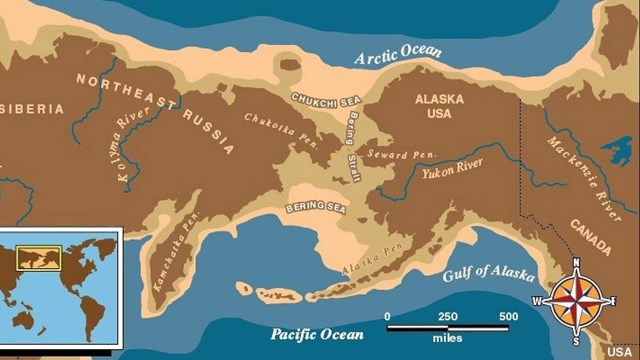
- Have students study the subsistence maps of the Denali area.
Plot areas which would be good seasonal camps. Students must support
their plots with reasons for choosing these areas.
Adaptations: To make the activity
non-movement oriented: Begin activity with the same opening discussion
about what humans must have for survival. Divide students into groups
of 4. (If you have a group larger than four, you will need to add
at least one more of each of the following cards to the group's
card set: Food, Water, Shelter, Clothing.) Print out On
the Move Game Cards(pdf), copy, cut them out, and give each
group a set of the cards.
To play:
The
object of the game is for the students to get one card of each
survival need (Food, water, shelter, clothing) to win.
The dealer deals out five cards to each student and then places
the remainder of the cards face down in a pile in the center of
the group. Students must have five cards in their hands at all
times until they are ready to go out of the game.
The student to the dealer's right begins the round by discarding
one card face up in a second pile and drawing from the face down
pile. Players may choose to draw from the face up pile or the
face down pile, but must always draw one card and discard one
card for every turn.
Players may receive cards that have "skip your turn" on it. They
discard the "skip your turn" card into the face up pile and pass
the play onto the next player. "Take another turn"
cards may NOT be picked up from the
face up pile after a player discards them.
To win, student must collect one card of each need (food, water,
shelter, clothing) and will discard their 5th and final card to
the face up pile. Teacher may choose to mark this as the ending
of the game OR the game can continue until all participants have
their needs met.
Extensions:
- Limit the
number of each color of squares available and repeat the game.
After the round, discuss what happens when resources run out or
aren't enough to support the population. How do humans respond?
Make a prediction of what the natives in the Denali area did.
- Have
students break into small groups of four or five students. Each
group must come up with an addition to the game that will include
an item of trade found in their area.
|