National Park Service arrowhead logo National Park Service, US Department of Interior
Visit ParkWise!Home for ParkWiseTeacher Resources Student Resources
Activities
Data
Reference Library
Park Facts
Links
Maps
Photo Gallery

ParkWise > Students > Documents

Dall Sheep
What's in a Name?

If you are an Inupiat native living in northwest Alaska, then the name for Dall sheep is easy. Around the Northwest Arctic, there are two Inupiat dialects. The coastal Inupiat dialect refer to Dall sheep as Imnaiq. The Kobuk dialect calls the Ipnaiq.

Dall sheep also have a scientific name: Ovis dalli dalli. The scientific name provides information about the physical and genetic relationship a plant or animal has to all other plants and animals.

Taxonomy is the science of classifying plants and animals into groups with similar features. The classification system we use today was developed by Linneaus and is a hierarchical system with organisms are placed into large groups, and then each large group is split into smaller groups, and those are split again until the group has only one type of animal a species or subspecies.

Dall sheep have been classified as follows:

Kingdom: Animalia
Phylum: Chordata (Subphylum: Vertebrata)
Class: Mammalia
Order: Artiodactyla
Family: Bovidae
Genus: Ovis
Species: dalli
Subspecies: dalli

The phylogenetic tree, above, gives us a lot of information about Dall sheep.

The Kingdom Animalia distinguishes a sheep from a plant, virus, protozoa, fungus, and one-celled bacteria. Dall sheep are animals.

Phylum Chordata means that the Dall sheep has a spinal cord. Because it is in the subphylum Vertebrata, it is specifically grouped with fish, amphibians, reptiles, birds, and other mammals that all have a spine of bone or cartilage.

Dall sheep are in a special class called Mammalia. Like all mammals, this means they have mammary glands, sweat glands, hair, a four-chambered heart, a muscular diaphragm, two functional ovaries, aParaxonic feet diagramnd specialized teeth.

The order Artiodactyla is represented by hoofed animals (also called "ungulates") that have paraxonic feet. These animals have an even number of toes and the plane of symmetry passes between digits three and four. Having two hooves on each foot (plus 2 regressed digits) is a characteristic of Artiodactyla.

The family Bovidae, tells us that the Dall sheep is specialized and has horns like musk oxen and goats and not antlers like moose and deer. Bovid horns are unbranched and curving horns.

Genus Ovis means that Dall sheep are a type of sheep. Wild sheep fall into two groups, thinhorn and bighorn. Dall sheep are one of the two subspecies in the thinhorn group. The other subspecies, Stone sheep, look similar to Dall sheep but occur in a small area of the Yukon and northern British Columbia. At present, Dall sheep are found throughout the mountain ranges of Alaska as well as the Yukon, Northwest Territories, northwestern British Columbia (see map below). Very specific traits like a short tail, no "beard" on the chin, and horns that are larger than 6 inches at the base are characteristic of animals in the genus Ovis.

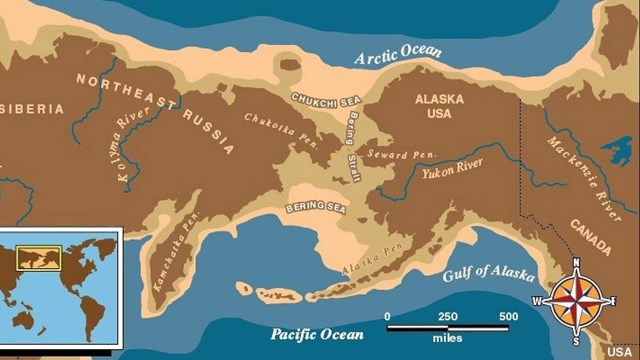
Dall sheep are the only subspecies of North American wild sheep found in northwestern Alaska. Wild sheep descended from mammals that evolved during the Pleistocene Epoch. It is thought that they arrived in North America by crossing the Bering Land Bridge about 100,000 years ago.

Both the Species and Subspecies portion dalli dalli, refer to William Healey Dall (1845 - 1927), an American naturalist who studied these sheep. Often the scientific name refers to a person that observed or first identified the unique animal. Species classification further identifies our Dall sheep as a unique animal based on its habitat, genetics and special characteristics.

Map of sheep ranges in North America