|
ParkWise
> Students >
Documents
Fossils
in Alaska National
Parks
What types of
fossils have been found in Alaska?
More than a dozen dinosaur
species have been found in Alaska, most from the time just before
the massive extinction of dinosaurs at the end of the Cretaceous
Period. The first dinosaur fossils found in Alaska were on the
North Slope during the mid-1980s. The North Slope refers to the
northern side of the Brooks Range, the most northern mountain range
in Alaska. The fossils were of an Edmontosaurus, a
duck-billed dinosaur of the hadrosaur family. Edmontosaurus
was a large plant eater, about 10 feet tall and 40 feet long. It
weighed about 3 tons. More recent fossils of other hadrosaurs, the
Troodon and the Dromaeosaurus have been found along
the Colville River of the North Slope. These dinosaurs were smaller
than the Edmontosaurus and were carnivores.
Dinosaur footprints from the
Jurassic Period have been found near Black Lake on the Alaska
Peninsula. The tracks date back more than 140 million years, the
oldest fossil evidence in Alaska, but scientists are not certain on
the species of dinosaur that left them. In the Talkeetna Mountains
of southcentral Alaska, the skull of an Edmontonia was
found. Edmontonia was a four-legged herbivore with leathery
and bony armor plates along its back. A hadrosaur skeleton, all but
the skull, was found dating back to 90 million years ago. This is
the oldest hadrosaur known in Alaska.
The bulk of the paleontology
has been done on the North Slope. At least seven plant-eating
dinosaurs have been found there. Hadrosaurs were large herbivores
that walked on their back two legs and had a duck-like bill. Three
different hadrosaur fossils have been found, including the
Edmontosaurus, the Kritosaurus, and the Lambeosaurid.
The Pachyrinosaurus and the Anchiceratops were both
ceratopsians -- dinosaurs that walked on four legs, had large horns
and horny plates on their heads. Hypsilophodontids were smaller
herbivores that ran on two legs of which only Thescelosaurus
has been found so far.
In
addition, six different species of Theropods have been found on
the North Slope. Theropods were mostly carnivorous.
They ran quickly on their back legs to catch their prey, and killed
them with sharp, serrated teeth. Tyrannosaurus and
Albertosaurus were huge hunters 10 to 15 feet tall and equally
long. The Troodon was smaller, only 6 feet tall, but
had a larger brain and large eyes which may have been for hunting
at twilight. Although only 4 feet high, Dromaeosaurus
and Saurornitholestes may have been among the fastest and
fiercest of the predators. Pachycephalosaurus was
only 7 feet tall, it was an herbivore with a thick, domed skull.
One theory for their thickened skulls is that they, like rams today,
butted their heads in ritual combat.
Source Bureau of Land Management, Alaska Region:
http://www.ak.blm.gov/ak930/akdino.html
Fossils
in the National Parks of Alaska
Although there are only 16
national parks in Alaska (and several affiliated areas), they
contain upwards of one-third of all the land in the national park
system. They also include some of the more remote areas in the
United States. Only a few of the parks have roads that lead to
them. Only a tiny fraction of the park lands have established
trails to use. The only tourist access to much of this land is by
small airplane. Parks such as Denali, Kenai Fjords and Wrangell –
St. Elias are along the road system. The parks of southeast Alaska,
Klondike Gold Rush, Sitka and Glacier Bay are usually visited by
boat – either by the Alaska ferry or the many cruise ships that tour
that coast. Not only are they hard to get to, but they are
extremely large.

The shear size and
remoteness of these parks, makes paleontology research more than a
little challenging. Think of looking for a fossil somewhere in a
park the size of a small state, like Massachusetts or Vermont, that
is very, very far away, and has no roads or and no trails. Don’t
forget, you can only do your field work during the few months of
summer (not including spring or fall), because the rest of the year
it is cold, dark, and mostly covered with snow. Despite all of
this, paleontologists have found interesting fossils in the Alaska
national parks. It is clear that there is much more to be learned
than we already know. The process of discovery will be long and
slow but exciting. There will still be plenty to discover when the
students of today are the scientists of tomorrow!
Aniakchak
National Monument
Present day Aniakchak
National Monument, lies within a string of volcanic islands known as
the Aleutian Islands. The area is known for extreme weather, stormy
and cold, it has been little used by Native American or by European
peoples. The land is rocky and only small plants live there. Much
of the area cannot support trees, the soil is too shallow and the
winds too strong. Most of the wildlife lives along the shores
feeding on the plants and animals of the ocean rather than the
land.
Rocks dating from the Late
Jurassic period to the Eocene epoch (some x to y millions of years
ago) can be found in Aniakchak. Researchers examining a section of
late Cretaceous rock known as the Chignik Formation have found
dinosaur footprints: the first evidence of dinosaurs in southeast
Alaska. The Chignik Formation includes fossils from shallow marine
environments in one section and fossils of life on land in another
section. These fossils date from 77 to 68 million years ago,
approximately the same time as dinosaur fossils found in northern
Alaska.
Although parts of Alaska
have moved through time, it is believed that these rocks and fossils
were formed at the same latitude that the area is at now. In
addition to the hadrosaur hand and footprints, researchers have also
found fossil leaf litter and a standing forest. All of these
together will help paleontologists reconstruct a picture of what the
environment was like in Alaska some 70 million years ago. A
forested environment with enough food to sustain dinosaurs weighing
many tons that must have been quite different from that of today.
Bering Land Bridge
National Preserve
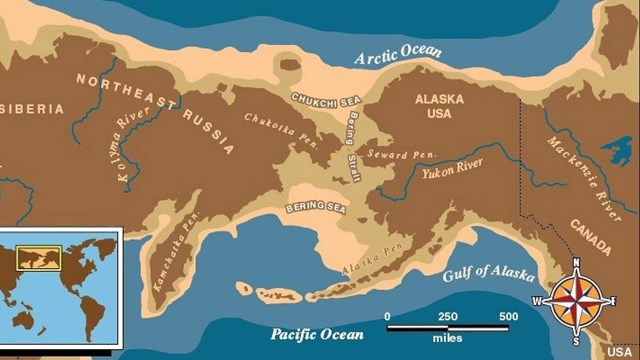
The Bering Land Bridge was a
stretch of land that connected North America to Asia, more than 13,
000 years ago. During the last ice age, much more of the earth’s
waters were frozen as ice, and there was less water in the oceans.
The sea level dropped and exposed the land between the continents.
The land bridge was a migration route for plants and animals between
the two continents, and the national preserve is an important source
of information about the ice age.
At Bering Land Bridge
National Preserve, researchers have found fossils from the
Quaternary Period of the Cenozoic Era. The last great ice age was
during this period. Scientists have found woolly mammoths,
including their teeth and tusks and bone, and the remains of other
animals such as ancient horses, bisons and even a prehistoric beaver
dam. Fossils of ancient trees, beetles and marine life have also
been found.
Another type of fossil
record is buried pollen. Each year, the pollen from plants falls to
the ground. If it falls in an area where sediment layers are
forming, they are preserved within the sediments, whether they are
soil or sedimentary rock. Scientists take “cores” by putting a long
hollow pipe straight down into the ground and pulling up a long,
skinny plug of dirt or rock. By examining the pollen in the core,
they can learn about the plants and therefore the environment and
climate back through time. At Imuruk Lake in the preserve,
researchers have been able to collect pollen cores dating back
100,000 years.
Katmai
National Park
Although Katmai National Park is one of the most active volcanic
areas in the world, with at least 14 active volcanoes, it is
best known for its large population of brown bears which come to its
rivers to feed on salmon. Katmai is less well known for its
fossils, including a site along the shores of Naknek
Lake. The site contains many remains of flowering plants, which
first appeared sometime during the Cretaceous period. These plants
did not diversify until after the dinosaurs had gone extinct. This
site is likely to be only 50 millions years old, allowing
researchers to examine yet another chapter in the changing
paleoenvironment of Alaska.
Gates of the
Arctic National Park and Preserve
Today, Gates of the Arctic
is a maze of rugged mountains, glaciated valleys, and arctic
tundra. It is inhabited by caribou, Dall sheep, wolves, and bears.
Fossil deposits of its past, however, range from tiny invertebrates
of the Devonian Period of the Paleozoic Era, some 400 mya, to
Pleistocene remains of bison and mammoth less than 5 million years
ago.
Fossils from the Paleozoic
Era include marine invertebrates like coral, and variety of other
small marine life have been found such as brachiopods and
trilobites. From later in the Paleozoic, during the Permian period,
scientists have found teeth from shark who once swam its waters.
Many other marine fossils from the Triassic and Cretaceous periods
of the Mesozoic Era have been preserved in limestone. Although the
area has many high mountains today, it was obviously under the sea
during the Paleozoic and Cenozoic eras. During the more recent past
of the Pleistocene, however, the area was already above water and
home to bison and mammoth and other mammals that roamed the northern
reaches.
Yukon – Charley Rivers National
Preserve
Yukon-Charley’s rich history
is filled with warm, shallow seas, cold ocean bottoms, turbulent
continental shelves, volcanic activities and continental collisions.
The unusual and remarkable depositional history continues to baffle
geologists. The rocks north of the Yukon River and overlying the
Tintina Fault record, in almost unbroken succession, the history of
the area from about 800 million years ago to the Cenozoic Era -
about 40 million years ago - an incredible and perhaps unparalleled
760 million years.
The
earliest animals were tiny, soft creatures from the Precambrian
Era. Some were single-celled, you might not see them without a
microscope. Later animals evolved bones and hard shells, which are
more easily preserved as fossils. Finding the earliest organisms is
difficult and exceedingly rare. In 1976, scientists discovered tiny
one-celled organisms, and some multicellular jellyfish and flatworms
in Yukon – Charley. The one-celled organisms are less than
one-hundredth of an inch long and make the flatworms and jellyfish,
about one-fiftieth of an inch long seem big in comparison. Not only
that, they were found to be about 700 million years old. Making
them some of the oldest fossils ever found.
The flatworm is particularly
interesting because it looks to be an ancient ancestor to the group
of microscopic animals that still live today, and are believed to be
the type of animals that formed that line of animals which
eventually evolved into the terrestrial animals – reptiles,
amphibians, birds, and mammals.
Throughout the rest of the
park, scientists have discovered other fossil beds that stretch all
the way to the Pleistocene. These other fossils include marine
invertebrates and shell fragments. The greatest amount of fossils
are of plants, including pollen, fruit, seeds and wood. Because of
its great size and remoteness, much still remains to be learned from
the Yukon-Charley fossil deposits.
What is
the next step for paleontology of national parks in Alaska?
Researchers will
continue to visit the Alaska National Parks to determine what other
fossil treasures there might be. By looking at sites around the
state, it may be possible to develop a more complete picture of the
environment, and its flora and fauna. Hadrosaurs as well as other
herbivorous and carnivorous dinosaurs have been found in northern
Alaska from the same time period. These finds show that the
dinosaurs were year-round residents of these northern latitudes.
Denali National Park and Yukon-Charley Rivers National Preserve both
have sedimentary rocks from the same general time. By studying
these and other parks in Alaska, scientists will continue to learn
more about the earth, its environment and the species that lived
here during those ancient times.
|