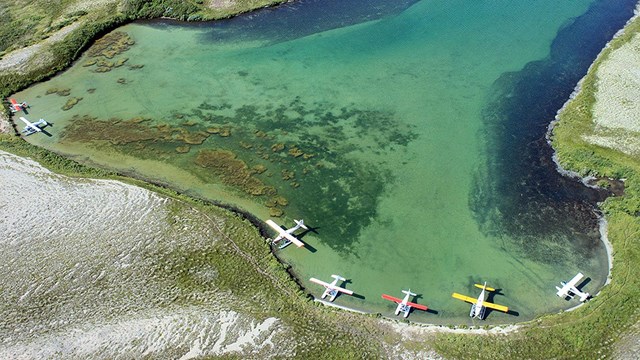
Lake Minchumina is situated near the geographical center of Alaska, 65 miles north-northwest of Mt. McKinley. Historically it has been central as a portage between the navigable waterways of the Yukon-Tanana and Kuskokwim Rivers. Its location was important as a midway point for sled trail mail transportation in the 1920s and 1930s, and for airplane transportation between Fairbanks and McGrath.
South of Lake Minchumina lies a combination of foothills and lowlands that provide big game resources including caribou, moose, sheep and bear, and in the lowlands, furbearers, including mink, marten, beaver, red fox, lynx, otter, wolf and wolverine, and to the northeast in the Muddy River flats region, muskrats. It was a hunting ground for the early aboriginal big game hunters and later an important trapping and hunting area. Hunting and trapping activities remain important to the region. The lake itself, nine miles long and roughly six miles wide, has been a reliable source of whitefish, an important food resource for native residents, especially during lean times, and to later trappers, fur farmers and roadhouse operators.
This central location at the headwaters of the Muddy River and the availability of subsistence resources made Lake Minchumina an attractive location for native Athabascans, prospectors and trappers, as well as current residents. From prehistory to the early 1900s, Athabascans hunted big game on the lands that would later become Denali National Park and Preserve. As the native population declined due to warring, disease, and a move to the rivers, prospectors and trappers utilized the same areas. They hunted in the foothills and carved out trapping areas in the lowlands. With the enactment of the Alaska National Interest Lands Conservation Act (ANILCA) in 1980, federally managed lands were extended virtually to the Lake Minchumina doorstep on the east and south. ANILCA allows local rural subsistence users to continue the practice of traditional hunting and gathering activities on those lands added to Denali National Park and preserve.
..
It is believed Interior Alaska has been inhabited for the past 10,000 years, but artifacts show that the Kantishna-Minchumina area was inhabited at least 2,500 years ago. Not much is known of this early life though. Recorded information of these people did not come about until the late 1800s and early 1900s when explorers finally reached the heart of Alaska. Thus, it is from this time that we can gather the most information on the early life of Minchumina area native groups.
'Minchumina' comes from the Athabascan words Menchu Mene' or Menhchu Mene'. To the Athabascan Indians, Minchumina and Minkhotana meant the 'lake people.' The people who lived in Minchumina were known as the Minkhotanas. (Gudgel-Holmes, p. 111) The Minkhotanas spoke the Koyukon dialect but because of living close to the language border of the upper Kuskokwim they could speak that dialect as well
There were two main sub-groups of Koyukon Indians that utilized the Minchumina area. These were the Minchumina-Bearpaw and Cosna-Manley. Minchumina was an important portage between the Yukon-Tanana-Kantishna River drainages and the Upper Kuskokwim River drainage. Both of these clans shared the same type of ecological zones, the only exception being that the Cosna-Manley group used more of the salmon runs on the Yukon and Tanana rivers
Life of the Koyukon Indians was focused around seasonal activities. Big game hunting was the main year round activity for the Koyukons in the Minchumina area. Most of the hunting took place inside the old McKinley Park boundary. During the summer, caribou, sheep and sometimes bear were taken. After an animal was killed, the hunters would dry the meat and cache it before moving on. Berries were also picked when they were ripe. The hunters would be in the hills until snowfall, when they would then transport the dried meat back to the main camps.
In the fall time, late salmon on the Kantishna and other drainages in the Minchumina area were fished. This worked out well because the runs came after most of the summer hunting. The fall migration of caribou was also very important. Fences were thought to have been used during caribou migrations until the advent of the rifle when hunting became less of a cooperative effort. Snares were also used on caribou. Sheep hunting was also important and was conducted up in the foothills of the Alaska Range.
After the fall salmon run, the people would move to the winter camps. These camps were located where freshwater fish and caribou would be available year round. The supplies from other camps were transported to the winter camp when the snow came, so dogs could be used to haul materials. Trapping became a big part of winter after the fur trade started, and became a main source of income for the people.
Hunting was maintained during the winter too. Caribou hunting continued, and moose also became an important food source. Bears were fat, and provided an important staple too. Small game was also hunted and trapped.
In winter, families would travel long distances to attend potlatches held in Minchumina, Nenana, Cosjacket, and Tanana. Many of the events would last up to a month. Potlatches were held to help pass the winter, to share food, and were a time to look forward to.
In early spring caribou hunting was very important to the Koyukon groups. Caribou hunting took place towards the Alaska Range, on the Foraker and McKinley rivers. The caribou were killed, the meat dried, and then stored for later use in underground pits. Today you can still see some of the pits above Mary Flood's new house. In later times, after axes were used, the meat was stored in elevated log caches. Waterfowl and beaver were also important food sources in the spring. Muskrat did not become a large resource until the fur trade.
In late March and April groups moved to spring camp which was usually located along the Muddy River where lakes and marshes existed. There were also spring camps at Lake Minchumina, along the Kantishna, and north of the Tanana River (for Cozna groups). Spring camp was a time when families could get back together from the long winter for a few months, and children could have fun. When the ice broke up in May on the Muddy and Kantishna rivers, families would move in boats and canoes for summer camp.
During the summer months there were three main activities that went on, salmon fishing, caribou hunting, and trading fairs. Fishing was very important, and that was probably why most summer camps were built near an abundant fish source. Most groups capitalized on early and late salmon runs, but this might not have been the case for Minchumina and Birch Creek clans. These groups stayed at places like Minchumina, where fresh water fishes (whitefish, pike, burbot) and waterfowl were plentiful. This enabled the hunters to go away looking for big game without the young and elderly going hungry.
The Koyukon populations were once thought to have been quite large, but due to wars between Koyukon and Tanana groups in the 19th century, and diseases in the 20th century their numbers decreased tremendously. Measles, diphtheria, and influenza took untold numbers in the early 1900s. Tuberculosis was probably the worst disease to hit the natives, and is still a threat today.
As to how many native people lived in the Minchumina area at any given time, no one really knows for sure. Around the 1920s and 30s there were a couple of families that have been fairly well documented. At that time there was Andrew Evan, his wife Abbey Duddia, and her niece, Helen. At Birch Creek, there was Roosevelt John, his first wife, and Abbie Joseph's two daughters (Abbie Joseph had moved to Cosjacket in 1920). Both Andrew Evan and Helen died at Lake Minchumina. After their deaths, Abbie Duddia moved to Telida for her last years. They were the last of the Koyukon Athabascans in the area.
The Minchumina area was talked and heard about but wasn't actually visited by explorers until the turn of the century. A U.S. Army expedition led by Lieutenant Herron in 1899 is credited as the one that put Minchumina on the map, and was one of the first expeditions in the area.
Judge James Wickersham, in his 1903 trip to Mt. McKinley, gathered a lot of information on the native groups and geography. This information is some of the earliest and most detailed. The U.S. Geological survey sent many geologists to the Minchumina area after these early explorers, too. George Gordon, of the Museum of the University of Pennsylvania, and his brother, during their trip up the Kantishna River, recorded lots of information on the native language.
After the first explorers came to the Minchumina area, miners and
trappers began to arrive. From the 1940s on, the population has been
mainly non-Native.