Denali Area History |
|||
|
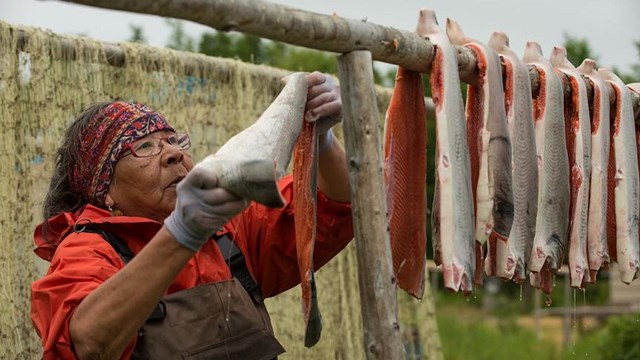
Native people have lived and traveled in the Denali area for thousands of years. The Athabascan people depended on the land to supply all their needs for food, clothing and shelter. All of their activities were related to survival. Their success in hunting and fishing depended on their knowledge of the terrain and animal behavior. They would leave their semi-permanent winter dwellings with the spring thaw to hunt the spring moose and caribou. In summer they set up fish camps where they fished for salmon and picked berries. Even though the Russians claimed all of Alaska, few of their explorers went much beyond the coastal areas. However, their trade goods did reach the Denali area. Since the natives basic needs were met by their own resources, most of them traded furs for practical items like axes or luxury items such as exotic clothing, beads and tobacco. Eventually guns, powder and shot became part of this trade as well. Mining In1903 Judge James Wickersham makes the first attempt to climb Mt. McKinley and in the process staked four gold claims on Chitsia Creek in the northern Kantishna area. This news brought a small stampede of miners from other areas of Alaska to the Kantishna Hills. The towns of Diamond, Glacier City and Roosevelt were established as supply points along the rivers leading to the mining district. The town of Eureka became the hub of the Kantishna mining district. In 1905, when the post office was established, the town name was changed from Eureka to Kantishna. The Kantishna stampede ended rather quickly. Thousands of miners left in the spring of 1906 when their claims show little or no gold. Kantishna and Glacier City survived but the other towns disappeared as everyone left. Joe Dalton and Joe Quigley were two of the miners who succeeded in finding gold on Eureka and Glacier Creeks and would stay in the area working their mines for most of the rest of their lives. The lack of available transportation would make mining an expensive and difficult task for the miners who had successfully found ore. Claims would be mined or not depending on whether the market price was high enough to make it profitable at the time. In the 1920's it became typical for prospectors to lease their claims to larger mining operations. This would give them the money to find more claims which they would also lease out. Since most natives were not allowed to file mining claims leasing gave them the opportunity to mine they otherwise wouldn't have had. Gold was not the only metal mined in the Denali area. The hills also held working deposits of copper, silver, lead, zinc and antimony. Antimony became an important discovery because it was a necessary ingredient in making munitions and became very profitable during war years. The Stampede antimony mine, owned by Earl Pilgrim, was a large operation during World War II and one of the major suppliers to the U.S. government and was in operation until Pilgrim sold it in 1978. Transportation The decision by the U.S. government to build a railroad into the Interior was very important. It would mean lower transportation costs for miners trying to get their ore to market and allow tourists to access the park easily for the first time. The route the railroad would take was determined in 1915 and was to cause a number of changes in the Denali area. Athabascan natives living in the village of "Old Denali" moved their village to Cantwell because of the job opportunities they knew the railroad construction would create. As cash became more important to native life, jobs which could produce cash became more important to natives. It also brought Pat Lynch and Maurice Morino, an Italian immigrant, who opened the first roadhouses in the McKinley Station area because they knew the railroad was coming. They both catered to the railroad workers and miners but Lynch didn't stay long and his roadhouse was abandoned. In 1923 Morino built a new roadhouse closer to the new railroad bridge over Riley Creek in the what he called the"Alaskan-Italian" style . His new roadhouse became the center of the community in the McKinley Station area. He ran this roadhouse, which continued to cater to tourists and railroad workers, until his death in 1937. He is buried in the park. When the Denali highway opened in the 1950's visitors could drive cars and buses to the park for the first time. In 1959 Eielson Visitor Center opened and the park road was upgraded because of increased vehicle traffic. An outcry in 1966, led by Adolph Murie, halts the road upgrades and the final eighteen miles are left in their original state with only bridges being replaced. Tourism In 1910 four miners from Fairbanks and Kantishna (the Sourdough Expedition) decided that the first people to climb Mt. McKinley should be Alaskans. Because of their experience with the area terrain they plotted a route using Muldrow Glacier and were the first to successfully climb Mt. McKinley with two of them reaching the north peak (19,470). Because they had no photos and two of the miners stayed in Kantishna to work their claims nobody believed them. Three years later their story was confirmed by another expedition that reached the higher south peak (20,320). Most of the climbing on Mt. McKinley in the 1930s and 1940s was done by research expeditions. In 1960 Bradford Washington's map of Mt. McKinley, the result of fifteen years of study, was published and is still used by climbers today. Recreational climbing on the mountain slowly increased in the 1950s, 1960s, and 1970s. In recent years, over a thousand climbers a season attempt to make the summit with about 50% of them being successful. With the completion of the railroad in 1923 visitors began arriving at McKinley Park Station. They would get off the train and ride pack horses to the Savage River Tourist Camp run by Dan Kennedy. The camp consisted of tent cabins and a mess hall. Horses were the means of transportation. The park would not have a real hotel for visitors until the McKinley Park Station hotel was finished in 1938. Each improvement in transportation to the Denali area has led to increased visitor traffic with a huge increase when the Parks Highway was finished in the early 1970s. With the area now accessible from paved roads, railroad and airplane the tourist traffic has reached 500,000 visitors a year and most of the economy in the Denali area is based on the tourist trade. A shuttle bus system and restrictions on private vehicles is in place to relieve the congestion on the only road into the park itself. Planners are looking to the north and south ends of the park to provide possible additional access routes and accommodations for the increased number of tourists. |
|||