National Park Service arrowhead logo National Park Service, US Department of Interior
Visit ParkWise!Home for ParkWiseTeacher Resources Student Resources
Activities
Data
Reference Library
Park Facts
Links
Maps
Photo Gallery

ParkWise > Students > Documents

People on the Land
Overview of Alaskan Native Cultures

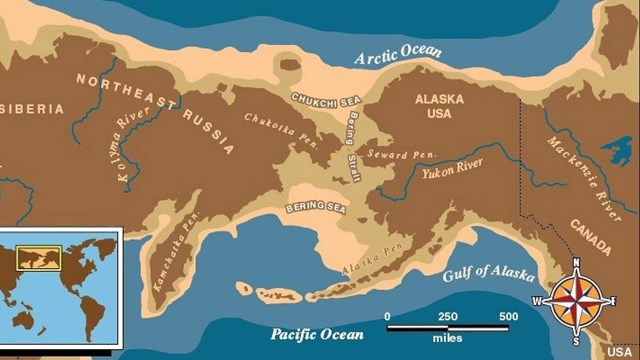
Many of the people that crossed Beringia moved and followed large land mammals into North America, some traveled as far as South America. As time went on, the weather started getting warmer. Glaciers melted and the sea level rose. About 10,000 years ago, the sea flooded Beringia, separating Siberia and Alaska. Scientists have found evidence that ancient settlements were established about that time around the state. Today's descendants of these early travelers still live in areas inhabited thousands of years ago. These early travelers are Alaska's indigenous people or Alaskan Natives. Alaskan Natives can be placed into five major groups, based on their location in the state. They are the Inupiat, the Siberian and Central Yupik, the Athabascan, the Aleut, the Alutiiq, and the Tlingit and Haida.

Map of Major Native Groups of Alaska

There are many similarities among the Native groups present in Alaska. They have all depended upon subsistence hunting, fishing and gathering for their survival. Their food consists of the animals and plants found in the area they live in. They gather food at certain times of the year. They try to use their resources conservatively and respectfully. When an animal is harvested, almost every part of it is utilized.

Before western contact, many Alaskan Natives lived in dugout houses with roofs made of sod or grass. In areas where wood was present, they used wooden beams for support. In arctic areas like northwestern Alaska, they used whale bones and other animal remains that were available. In the Interior and in Southeast Alaska where trees are available, Natives built houses entirely of wooded.


Athabaskan
These Indians occupy interior Alaska . Traditionally they were nomadic hunters and fishermen. They subsist mostly on salmon, moose and caribou. Before western contact they lived in dugout log or wood framed houses which had above ground entries. They developed the "cache" to store and keep food away from wild animals.


Tlingit and Haida
These Indians live on the islands and mainland of Southeast Alaska. They are members of the Northwest Coast Culture which is recognized for totem poles and other carvings. They subsist mainly on a variety of different foods from the sea, including shellfish, eulachon (a small, oily fish), halibut, and salmon. Although the villages are located on the coast, they rarely hunt for whales. They are very effective salmon gatherers. They continue to use traditional methods like weirs and traps to harvest fish. Depending on the location, Tlingits and Haidas hunted land animals as well, such as deer, mountain goat, and moose. The Tlingit an Haida had access to wood and traditionally lived in large wooden houses shared with large extended families.

Aleut
Aleuts live on the Aleutian Islands and the Alaska Peninsula of western Alaska. Their settlements include villages and seasonal camps strategically placed on the islands and on the mainland. The Aleuts were the first people to be colonized by the Russians, and their population was decimated by hardship and disease under Russian rule. The Aleuts subsist mostly on fish, intertidal resources, and marine mammals, such as Stellar sea lions, seals, sea otters and whales. Traditionally, the Aleuts used kayaks or baidarkas for hunting and travel. Before western contact, Aleuts lived in pit houses or semisubterranean (partially underground) houses with wood or whale bones for beams that were covered with grass or sod. Aleuts are known for their very-finely woven grass baskets.

Central and Siberian Yupik
These Eskimos live in a wide area around the coast from St. Lawrence Island in the central Bering Sea all the way to Prince William-Sound. Their diets are different and depend on the local food sources available. The Siberian Yup'ik, mainly people from St. Lawrence Island, subsist on large marine mammals like bowhead whales, seals, and walrus. Central Yupik populations subsist on salmon, sea lions, sea otters, beluga whales and shellfish. Siberian Yupik still use skin boats or umiaks to hunt. Traditionally, the central Yupik peoples used kayaks or baidarkas. Before western contact, Yupik people lived in pit houses or semi-subterranean houses with wood or whale bones for beams that were covered with grass or sod.

Alutiiq
The Alutiiq people live in the coastal regions of south-central Alaska, from Prince William Sound in the east to the north Alaska Peninsula and Kodiak Island to the west. The land is a rugged combination of sea, fjord, mountain and tundra, and weather that is often extreme. On the sea, Alutiit fish and hunt seals, sea lions and otters. They gather berries and fish for salmon in the streams. They are less dependent upon land mammals, but in different locations they hunt caribou, black bear, and brown bear. Traditionally, the Alutiit live in large villages, but their populations were depleted due to war and disease when Russians came in the late 18th century. Many aspects of Russian culture (food, customs and religion) have been incorporated into the Alutiiq culture today.

Inupiat
The Inupiat population covers a large portion of the coast of northern Alaska. Formerly, many Inupiat also lived inland, but Anaktuvuk Pass is the one village that remains of the Nunamiut, or people of the land. They subsist on marine mammals like whale and walrus and also fish and hunt for water fowl. Inland Inupiat hunt land mammals, especially caribou. Traditionally, the Inupiat traveled in the umiak, a large skin boat, and sometimes by kayak, a smaller boat. They lived in pit houses, or semi-subterranean houses.