|
ParkWise
> Students >
Documents
The
Lost Continent of Beringia
Beringia
The term Beringia
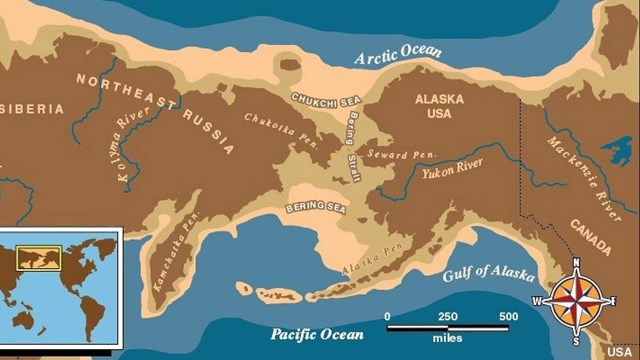
refers to the 1,000-mile long landmass that connected Asia and North
America 10,000-25,000 years ago. During this time, glaciers up to
two miles thick covered large parts of North America, Europe and
Asia. The period was called the Pleistocene Ice Age. Some very dry
areas were ice-free during this time. Much of the Earth's water
was locked up in the glaciers. Because of this sea level dropped
significantly, up to 300 feet! Some areas that are now under water
became dry land. The result was an intermittent land bridge stretching
between the two continents under the present day Bering and Chukchi
Seas. Scientists believe that Beringia was at its widest point about
15,000 years ago. Although called a "bridge," the land
was really a broad, grassy plain, which many animals stopped to
feed on.
View
the Postglacial
Flooding of the Bering Land Bridge:
A Geospatial Animation to see an animation of the
rising sea levels and the disappearance of Beringia.
Early
Occupants
Early migration of animals and humans could have been made completely
by land instead of water. Scientists are not positively sure how
long ago the migration took place, but they believe between 10,000
and 25,000 years ago. This slow migration over thousands of years
is what is believed to be responsible for the population of plants,
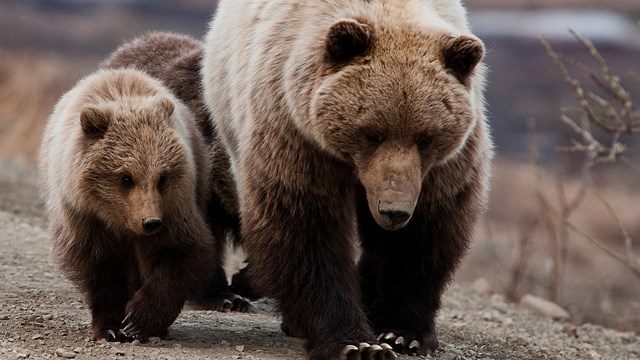
animals and people to North and South America. Animals such as wolves,
bears, lions, woolly mammoths, bison, caribou, horses and antelope
wandered and fed on the plain. Hunting groups followed game animals
through the ice-free lowland areas not realizing they crossed over
to a new continent. Without the presence of the land bridge these
areas may not have been inhabited until much later. Over time, the
massive ice sheets melted slowly raising water levels, covering
up the shallow ocean floor.
Evidence of the Past
Scientists are learning more and more each day about the time period
and migrations of animals, plants and people. The migrations of
animals and people traveled on to southern parts of the continent
while others stayed in the ice-free parts of Alaska. Similarities
between the peoples of Siberia and Alaska including language, shared
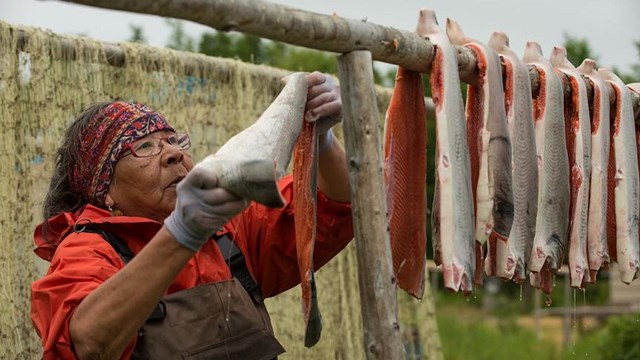
spiritual practices, hunting tools and methods of food preservation
help to prove that the land bride existed. In addition, the remains
of some prehistoric tools date back to 27,000 years ago. Bison bones
found in the Trail Creek Cave sites date to 15,000 years old. The
bones had been broken, as if the animal was butchered. This is a
strong indicator that early settlers of some kind were present at
that time.
Scientists have also
investigated the similarities of some plant species in Siberia and
Alaska in the vicinity of the land bridge. There are many species
that are exactly the same. Because of the large numbers of similar
species, scientists hypothesize that the seeds of these plants could
not have been disbursed by the wind and birds alone. Also, there
is an extraordinary amount of paleontological evidence that large
land animals (terrestrial megafauna), like the woolly mammoth, could
not have simply swam across the Bering Sea. The distance is too
long for most land mammals. A land bridge had to be in existence
in order for so many of the same species to be present in such large
numbers on both continents.
The Land Bridge Today
Today, the continents of Asia and North America are separated at
their closest points, by a 55-mile stretch of water called the Bering
Strait. The Bering Strait connects the Bering Sea to the south with
the Chukchi Sea to the north. Russia and Alaska were inhabited by
what scientists conclude are descendants of the early travelers
across Beringia. Bering Straits Eskimos of this area depend on subsistence
hunting for their livelihood and make seasonal migrations within
the area to gather their food for the year.
|