National Park Service arrowhead logo National Park Service, US Department of Interior
Visit ParkWise!Home for ParkWiseTeacher Resources Student Resources
Activities
Data
Reference Library
Park Facts
Links
Maps
Photo Gallery

ParkWise > Students > Documents

What is Bering Land Bridge
National Preserve?

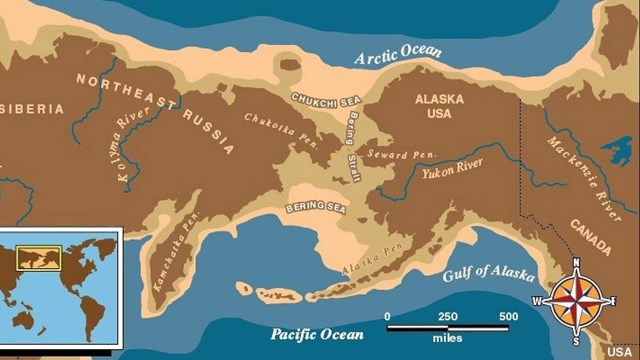
As vast ice bodies locked up large portions of Earth’s water during the ice ages, sea levels dropped by as much as 350 feet in the Bering Straits region. At such times a land bridge across the Bering Sea was exposed, connecting the two continents and providing a migratory corridor for both plants and animals.

Bering Land Bridge National Preserve, located on the northern Seward Peninsula, lies at the heart of this continental crossroads that has profoundly influenced the distribution of life in the northern hemisphere. While much of the bridge itself is now overlain by the Bering and Chukchi Seas, the 2.7 million acre Preserve provides an opportunity for research and interpretation of the intermittent, 1,000 mile-wide land link that existed as recently as 10,000 years ago.

Approximately 500 miles northwest of Anchorage, the Preserve occupies about one-third of the Seward Peninsula. The northern most point, Cape Espenberg, extends just north of the Arctic Circle. The westernmost point, near Cape Prince of Wales, lies only 70 miles from Eastern Asia.

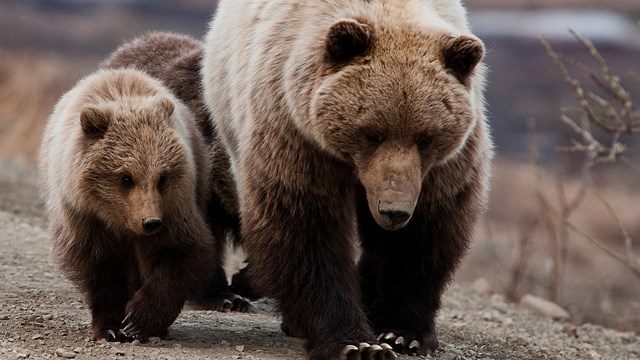
The landscape is a treeless expanse of tundra, mountains and serpentine streams. It is sprinkled with lakes, bare rocky ridges and low growing willow and shrub. The land is home to a variety of arctic and subarctic wildlife including moose, bear, muskox, and caribou. Many species of mammals that lived here during the ice ages are now extinct. Others have simply left the area. Still others have moved into the region from other parts of North America.

The Preserve is still a place where the interchange of animals and plants between Asia and North America can be seen. Birds from every continent on earth travel here to nest. The bristle-thighed curlew migrates from Tahiti. Wheateaters come from the north coast of Africa. Mammals, including polar bear, walrus, Gray and bowhead whales, travel to and from the region, oblivious to international or political boundaries.

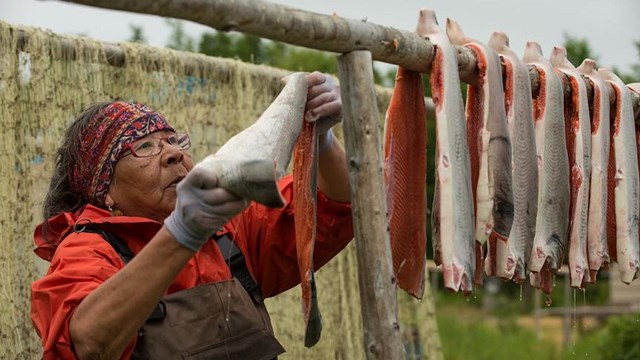
Inupiaq Eskimo.residents of local villages continue to depend upon the land, just as their ancestors had done thousands of years ago. Subsistence hunting, fishing and gathering comprises much of the human activity occurring in the Preserve today. These activities provide for both the nutritional needs and the cultural continuity of peoples whose ties to the region go back generations.

Bering Land Bridge National Preserve provides an opportunity to seek a better understanding of the migration of humans and other life forms between Asia and North America. Research continues to uncover the significance of the land bridge, particularly as it relates to cultural, geographic and climatic history, along with the biological evolution of northern North America. The establishment of the Preserve ensures that a portion of the ancient land link between continents remains much like the land that accommodated travelers-human, plant and animal-on their way to and from the old and new worlds.

Becoming a Preserve

Bering Land Bridge National Preserve was established by the Alaska National Interest Lands Conservation Act (ANILCA) in 1980. The purpose of this act is to preserve certain lands and waters in the State of Alaska that contain nationally significant natural scenic, historic,- archeological; geological, scientific, wilderness, cultural, recreational and wildlife values, for the benefit, use, education, and inspiration of present and future generations.

The primary purpose of the Bering Land Bridge National Preserve is to preserve and protect for research and interpretation the 1,000-mile wide land link that connected Asia and North America 10,000-25,000 years ago. These lands contain important information about the migration of people, plants and animals across the land bridge. The Preserve also contains significant arctic plant communities, geological formations, and critical habitat for wildlife and populations of migratory birds.

Nome, Shishmaref, Deering, and Wales are all present day settlements that border the Preserve. The residents of these and other surrounding villages use the Preserve to continue their subsistence lifestyles. Reindeer herding and grazing is also permitted in the Preserve.

Points of Interest: Towns and Landmarks

There are many significant places and landmarks in Bering Land Bridge National Preserve. There are also four main settlements outside of the Preserve. The residents of Nome, Shishmaref, Deering, and Wales and other villages on the Seward Peninsula are the primary users of the Preserve's resources. Below are descriptions of significant places in or around the Preserve.

Serpentine Hot Springs is one of the main use areas in the Preserve. It serves as a traditional healing place and subsistence use area for local residents. Serpentine Hot Springs has a bunkhouse and bathhouse for public use.

Trail Creek Caves contain bison bones dated to 15,000 years ago. The bones are possibly linked to early hunters, perhaps travelers of the land bridge. The bones were broken as if someone might have cut them for harvesting. Archaeologists have shown that the caves were used by humans 9,500 years ago.'

The Maar Lakes are the largest maar lakes in the world. They were formed by a volcanic explosion that left craters that filled with water. They are rimless and surrounded by volcanic ash. The names of these lakes are: Devil Mountain Lakes, Killiak Lakes and White Fish Lake.

Cape Espenberg is an area that was traditionally used for sea mammal hunting and later a summer reindeer herding area. There are many archaeological sites at Cape Espenberg. It is located just south of the Arctic Circle.

Lost Jim Lava Flow is a 1,000-2,000 year old lava flow. It covers an area 88 square miles. It is located in the southeastern portion of the Preserve.

Nome is located on the southern part of the Seward Peninsula. It is the most populated area near the Preserve. The Preserve's headquarters are located in Nome.

Shishmaref is a village located on Sarichef lsland. It is bordered by the Preserve's boundary on all three sides. It is the largest village near the Preserve. On a clear day, one may be able to see mainland Russia from Shishmaref.

Deering is located on the south side of Kotzebue Sound at the mouth of the Inmachuk River.

Wales is located at Cape Prince of Wales and is the western most point on the North American continent.