National Park Service arrowhead logo National Park Service, US Department of Interior
Visit ParkWise!Home for ParkWiseTeacher Resources Student Resources
Activities
Data
Reference Library
Park Facts
Links
Maps
Photo Gallery

ParkWise > Students > Documents

Footprints into the Past and Future
Bering Land Bridge National Preserve
Glossary

Adaptation: a trait that helps an organism survive in a particular environment.

Arctic Circle: the parallel of latitude 66 degrees 33 minutes north; the boundary between the North Temperate and North Frigid zones.

Arctic: the area extending from the North Pole to the northern timberline.

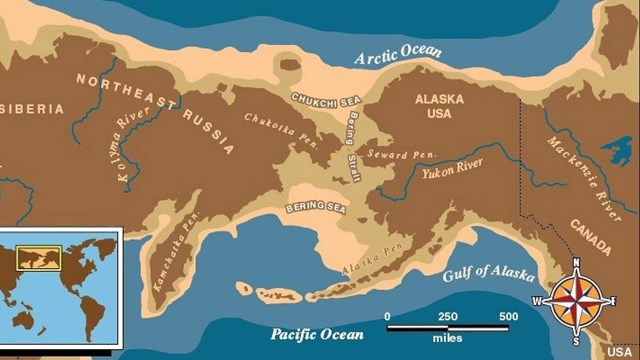
Beringia: the 1,000-mile land bridge that connected Asia with North America 10,000 to 25,000 years ago.

Camouflage: markings or coloration that help disguise an animal so it is less visible to predators of prey.

Conservation: the use of natural resources in a way that assures their continuing availability to future generations: the wise and intelligent use or protection of natural resource. Wise use of resources.

Ecosystem: all the non-living and living things and their interaction in a specific area.

Extinct: the condition of having been removed from existence. An animal or plant facing extinction is one in danger of vanishing from our world.

Glacier: a huge mass of moving ice originating from compacted snow.

Harvest: the act or process of gathering a crop or animals. In wildlife management, hunting is considered a form of harvest in which individual animals are killed.

Hot springs: a spring that is naturally heated by volcanic vents.

Insulation: In animals and plants, fur, feathers, fuzz etc., that prevent heat loss.

Kiviut: the soft under hair or fur of musk oxen. Kiviut is often made into yarn.

Lichen: an organism that consists of a fungus and an algae existing together to the mutual benefit of each other. Lichens often grow in harsh conditions that are too exposed for other plants. Because of their sensitivity to air pollution, many are useful indicators of air quality. Lichen are an important food source for caribou.

Maar lake: a lake created by an volcanic explosion that makes a crater, which then fills with water from rain and snow melt.

Migration: a regular, seasonal movement of an animal from one place on earth to another.

Migratory: in wildlife usage, birds or other animals that make annual migrations, e.g., travel distances in seasonal movements. Migrations may be great, or very short, depending upon the species.

National Park Service: A division of the Department of the Interior whose mission is to protect the natural and cultural resources in such a way that they will last unimpaired for future generations.

Northern Hemisphere: The northern half of the earth, divided by the equator.

Ordinance: regulation.

Periodic: recurring at regular intervals; can refer to seasonal cycles or daily cycles.

Permafrost: permanently frozen ground that may or may not contain ice. In the arctic tundra, permafrost may extend 60-1000 feet (18-305 m) below the surface.

Population: the number of people, animals or plants living in a place.

Preservation: protection, which emphasizes nonconsumptive values and uses, including no direct use by humans, contrasted with conservation which emphasizes both consumptive and nonconsumptive values and uses.

Preserve: to keep safe, to keep or remain intact.

Reindeer: a domesticated caribou.

Resource: A resource is something that has a value. Natural resources occurring naturally, such as plants and animals, mountains and rivers, forest and tundra, natural quiet and scenery. Cultural resources have to do with past and present cultures, and include such things as archaeological sites and artifacts, locations of ceremonial or religious importance, traditional hunting grounds.

Subarctic: regions just under the Arctic Circle.

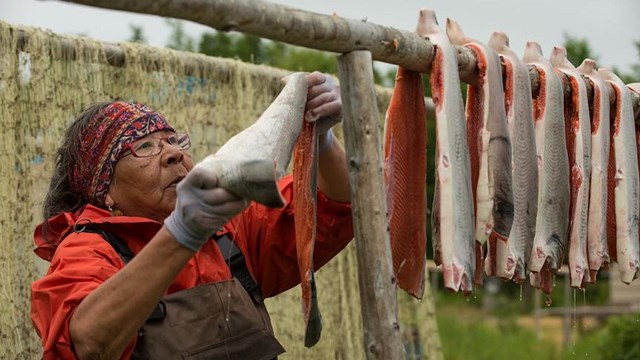
Subsistence lifestyle: living off the land.

Tundra: the windy, treeless, and periodically cold environments that occur at high latitudes and at high elevations.

Woolly Mammoth: An Ice Age mammal that crossed over the Bering Land Bridge. The woolly mammoth, which resembles the elephant, became extinct 10,000 years ago