National Park Service arrowhead logo National Park Service, US Department of Interior
Visit ParkWise!Home for ParkWiseTeacher Resources Student Resources
Activities
Data
Reference Library
Park Facts
Links
Maps
Photo Gallery

ParkWise > Students > Documents

Geology in
Bering Land Bridge National Preserve:
Past Volcanic Activity

There are many geological features in the Bering Land Bridge National Preserve. Some features are associated with volcanic activity. They are: Maar Lakes, Serpentine Hot Springs, and the Lost Jim Lava Flow.

The Maar Lakes
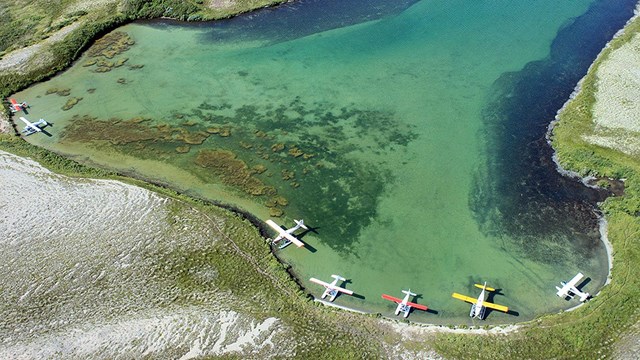
Bering Land Bridge National Preserve contains the largest maar lakes in the world. These lakes are the Devil Mountain Lakes, Killiak Lakes, and White Fish Lake. Earth movements such as volcanoes, erosion, deposition, or erosion and deposition form lakes. Maar lakes are formed by volcanoes that erupt and form craters. The craters fill up with water from rain and snowmelt and create maar lakes.

graphic depiction of a maar lake photograph of a maar lake

Serpentine Hot Springs
Serpentine Hot Springs is a significant geothermal resource set in a strikingly scenic valley where granite tors (chimney-like rock formations) rise to 100 feet. The hot springs were formed when surface water or spring water seeps into the ground and is heated by hot rocks. As the water heats up it rises to the surface and forms a pool or hot spring. The water in the Serpentine pool is between 140 and 170 degrees Fahrenheit.graphic showing the geology of hot springs

The Lost Jim Lava Flow
The Lost Jim Lava Flow is an 88 square mile pahoehoe flow. A pahoehoe flow is a flow where the top layer of lava cools and the bottom layer still flows. Pahoehoe lava looks like wrinkles with fast flowing lava beneath it. The Lost Jim Lava Flow is a recent flow; it is young in geologic time, only 1,000 to 2,000 years old.

graphic of a pahoehoe lava flow