National Park Service arrowhead logo National Park Service, US Department of Interior
Visit ParkWise!Home for ParkWiseTeacher Resources Student Resources
Activities
Data
Reference Library
Park Facts
Links
Maps
Photo Gallery

ParkWise > Students > Documents

Archaeology in
Bering Land Bridge National Preserve

There are hundreds of archaeological sites located in Bering Land Bridge National Preserve. These sites are important in the documentation of the migration early peoples that came across Beringia or the Bering Land Bridge. Many sites are along the coast of the Preserve from Cape Espenberg to the Ikpik Lagoon area (see laminated brochure map). There are a few archaeological sites in the interior of the Preserve.

The age of archaeological sites on the coast range from being a few hundred years old to about 4,000 years old. There are 500 documented semi-subterranean (partially underground) pit houses on the coast of the Preserve. One site, located south of Cape Espenberg is Ublasaun. Ublasaun is a traditional sea mammal hunting area. It was also a summer reindeer herding camp used up until the 1950's. People use the area today to hunt, fish and gather subsistence resources.

The two most prevalent inland sites are: Trail-Creek Caves and Twin Calderas associated with the Lost Jim Lava Flow. Trail Creek Caves, which is dated to 9,500 years old for human occupation, is one of the oldest archaeological sites in Alaska. Other sites located at Twin Calderas contain stone cairns (rock mounds) up to 300 years old used for mostly hunting purposes. There are other lesser-known sites on the coast and inland.

Archaeology is the study of past human life and activities or the study of past human cultures. Archaeological sites both in the Preserve and in general, are important because they show us what people were like in the past, and how they lived their lives. From archaeological sites, artifacts people left behind, and information from the ancestors of the people who left things behind, archaeologists can make inferences about what the culture was like.

Archaeology is important because:

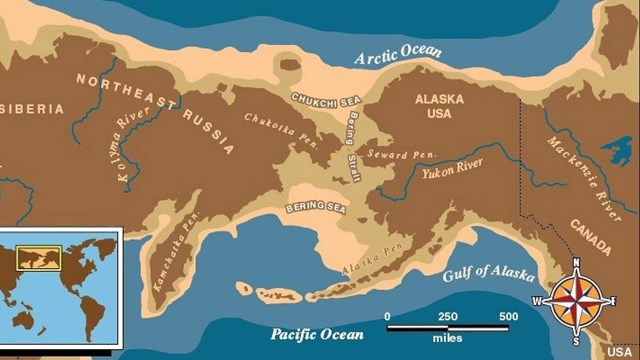
1) It shows what people of the past were like, and how they lived their lives. It traces the course of human development in areas such as technology (methods of satisfying human needs for food, shelter, and fire), material culture (the products of technology: tools, shelters, boats, weapons, etc.), and population movements (migration patterns, such as crossing the Bering Land Bridge from Asia to Alaska 10,000-25,000 years ago.)

2) It is important to who we are and where we came from - it gives us a sense of place and history.

3) For some like the Native Alaskans, it is a look back at their own ancestors and heritage. For others, it is a chance to learn about the different peoples and cultures that have inhabited the world, and to respect their different accomplishments.

4) It studies past environments, how they have changed and how people interacted with the environments. It answers questions like: what people ate (bones, seeds), how they procured their food (hunting techniques), what their environment was like (pollen studies.) This information may hold valuable clues on how we can live in our present environment.

5) Archaeology is fun and exciting! Archaeologists are kind of like detectives. Walking among ghosts of former times - seeing where they lived, holding their tools, boots, cups, really brings you into the past; it's like a time machine.


Because archaeological sites are important for so many different reasons, archaeological sites on federal public lands are protected by law. The Archaeological Resources Protection Act (ARPA) makes it illegal to excavate, damage, remove, sell, or transport any archaeological resource located on federal public lands.

It is everyone's responsibility to protect archaeological sites; they are part of our national heritage. Once an archaeological resource is destroyed it is gone forever!