|
ParkWise
> Students >
Documents
Arctic
Adaptations
Biologists
call the physical, physiological and behavioral traits that help
an organism survive in a particular environment "adaptations".
Organisms that live in the arctic and subarctic must have adaptations
to help them survive and raise young despite the periodic extreme
cold, persistent winds, short growing seasons and other difficulties
posed by their severe environment.
Tundra bumble bees provide
a fascinating example of arctic adaptation. Many insects cease functioning
during winter. Since they are poikilothermic or "cold-blooded",
insect body temperatures are closely related to the temperature
of their surroundings. The chemical reactions necessary for insect
movement do not occur at cold temperatures. Tundra bumble bees have
developed a dense hair on their bodies which slows heat loss to
the air. They also "shiver" their flight muscles to generate
heat. This heat is temporarily trapped within their velvet coat.
Some bumblebees can keep, their body temperatures 20-30, degrees
C (68-86 degrees F) above air temperatures and are easily active
while other insects are too cold to move.
The furry and wax-like
coatings of certain tundra plants are adaptations that enable them
to resist cold and wind. The fine dense hair around the flowers
of the woolly lousewort not only reduces wind chill, but also traps
heat from sunlight like the glass of a greenhouse. The flowers are
thus surrounded by relatively warm air, sometimes 20 degrees C (34
degrees F) warmer than the environment. This is quite important
because the process of cell division necessary for the formation
of seeds cannot occur at cold temperatures. In addition, many tundra
plants retain rather than shed their dead leaves each year. The
dead leaves serve no apparent purpose except to insulate fragile
new buds from the wind and cold.
Most living things are
made up of 70% water. When water freezes, it expands and forms ice
crystals. Repeated freezing and thawing can destroy living tissue.
The Alaska blackfish overcomes this problem by producing chemicals
within its body that lowers the freezing temperature of cell fluids.
Much like the antifreeze we add to the water in our vehicles, the
"antifreeze" of the Alaska blackfish prevents the formation
of large ice crystals within its cells, even at low temperatures.
The Alaska blackfish can survive temperatures of-20 degrees C (4
F) and the complete freezing of some body parts, including their
heads, for up to several days.
One of the most obvious
adaptations for life in a cold environment is insulating feathers
or fur. Most tundra birds and mammals actually have two coats. Ptarmigan,
whose feathery coats and thick down even cover their feet and provide
a "snowshoe" effect, have the best insulation of any Alaska
bird. They can keep their body temperatures at 40 degrees C (104
degrees F) without increasing their respiration rate, even at air
temperatures of-34 C (-29 F). The ptarmigan's white winter feathers
(brown during summer) not only help camouflage it in the snow from
predators, but radiate less heat back to the frigid air than would
dark feathers.
In addition to the insulation
provided by feathers and fur, large size and short appendages are
adaptations that reduce heat loss and resist cold. Since small animals
have more surface area relative to their weight than large animals,
they lose heat more quickly. Musk oxen are one of the largest mammals
found in the arctic. An average-sized adult bull may weigh 340 kilograms
(750 pounds). Their relatively short legs and inconspicuous tails
minimize heat loss. Only a small patch between the musk oxen's'
nostrils and lips is hairless. The rest of the body, including the
head and ears, are all densely haired. In addition to the animal's
long, course, guard hairs is an exceptionally effective insulating
layer of the finest wool grown by any mammal. Below -40 c (-40 F),
musk oxen lie with their backs or sides to the wind and choose sheltered
valleys or slopes during storms. Slow movements conserve energy
in winter and reduce the likelihood of overheating during the brief
but warm temperatures of summer.
Here are some other
interesting animal adaptations in the arctic:
Caribou
Caribou are generally associated with arctic tundra, mountain tundra
and northern forests. The species has been a distinctive part of
Alaska for thousands of years. Approximately 500,000 wild caribou
exist in Alaska in about 25 more or less distinct herds. They are
large, stout members of the deer family. Caribou have developed
large, concave hoofs that spread widely to support the animals in
deep snow and soft tundra and function well as paddles when they
swim.
Brown Bear
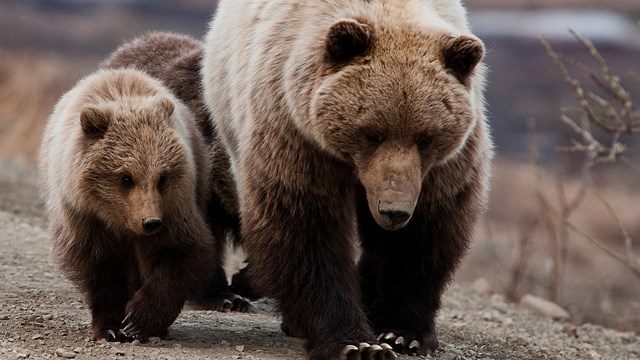
Brown bears occur throughout much of Alaska. "Brown" and
"grizzly" bears are now classified as the same species.
In winter when food is unavailable or scarce, most Alaska brown
bears enter dens and sleep through winter. In northern Alaska where
the winters are long and harsh, brown bears may spend as much as
6 to 7 months asleep in their dens.
Polar Bear
Polar bears and brown bears evolved from a common ancestor and are
closely related. However, polar bears spend much of their life on
the sea ice. Their white coats are made up of water repellent guard
hairs combined with a dense underfur that covers to the bottom of
their feet. Polar bears have short, thickly furred snouts and ears
that minimize heat loss to the environment. They also have extremely
sensitive noses. Polar bears can smell a seal up to 20 miles away
or under three feet of ice.
Moose
Moose are the largest member of the deer family in the world, and
the Alaska race is the largest of all the moose. Moose are long-legged
and thick-bodied, adaptations that enable them to move about through
deep snow and wet lands and to carry sufficient fat stores. Their
thick, hollow hair is fatter at the tip than at the base. The shape
helps trap an efficient insulating layer of air next to their bodies.
Wolf
Wolves inhabit approximately 85 percent of Alaska's 586,000 square-miles.
They are extremely adaptable animals and exist in a wide variety
of habitats extending from the rain forests of the southeastern
Panhandle to the arctic tundra along the Beaufort Sea. In northern
Alaska, the wolf is dependent on migratory caribou. Though wolf
packs tend to remain within a home range of 200 to 600 square miles,
they will abandon their range and travel longer distances if necessary
to follow the migrating herds.
Wolverine
Wolverines, relatives of the mink and weasel, are common residents
of mainland Alaska. Wolverines have tremendous physical endurance.
They may travel up to 40 miles each day in search of food, a necessity
for an animal that does not hibernate. Despite their size (an adult
male averages about 14.5 kg or 32 pounds), wolverines are capable
of bringing down some of Alaska's largest hoofed mammals. Reports
of wolverine predation on caribou and reindeer are fairly common.
Red Fox
Red foxes, members of the dog family, are the subject of many stories,
songs and fables. The red foxes' reputation for cunning and intelligence
is probably due to their well-developed senses o of sight, smell
and hearing. When the red foxes' home range overlaps with that of
the arctic fox in northern Alaska, the red fox is dominant. Red
foxes have been observed digging white (arctic) foxes from their
dens and killing them. Red foxes cache excess food when hunting
is good and can be seen digging up and reburying their stores, apparently
seeking reassurance that the food is still there.
Arctic Fox
Arctic foxes are found in the treeless coastal areas of Alaska from
the Aleutian Islands north to Point Barrow. Arctic foxes molt twice
each year with the changing of the seasons. The white foxes begin
to shed their long winter fur in early April and by late June, the
face, legs and upper parts of the body are covered with short, brown
summer fur. The change to winter's camouflage begins in September
and by October or November, the luxurious white winter coat is complete.
Lynx
Lynx, shy and unobtrusive animals, are the only cats native to Alaska.
Lynx inhabit much of Alaska's forested terrain and use a variety
of habitats including spruce and hardwood forests and both subalpine
and successional shrub communities. Lynx reproduction is highly
influenced by small game populations. When prey are abundant, a
high percentage of female lynx produce kittens. When prey is scarce,
the number of adults that breed declines and few offspring are produced.
Snowshoe Hare
Snowshoe hares are the most common and widespread of the two hare
species found in Alaska. Unlike rabbits, hares are born fully furred
with eyes open and can walk by the time their fur is dry. Populations
of snowshoe hares are subject to cycles of high abundance and scarcity.
In times of great numbers, they may compete with larger animals
such as moose for forage. The hare's summer coat of yellowish to
grayish brown is replaced by white pelage in winter.
Visit the University
of Guelph's Canada's
Polar Life site for more information on plant and animal adaptations
to life in the arctic.
|