|
ParkWise
> Students >
Park
Facts > Denali
Frequently
Asked Questions about
Denali National Park and Preserve
Q. How
do people travel in Denali National Park?
A. People can travel
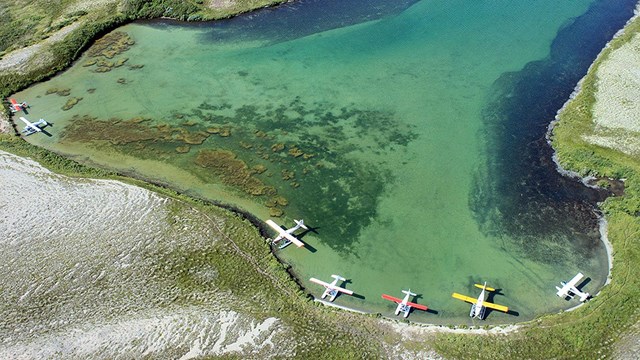
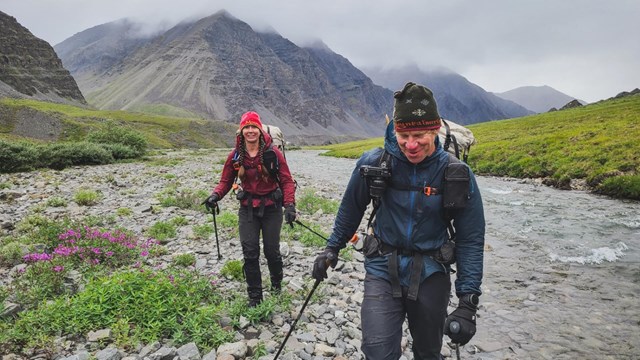
in the park by foot, dogsled, bus, airplane, and boat. There is
a no-car rule, but it has five basic exceptions:
- People staying at
Teklanika Campground are allowed to drive in at the beginning
of their stay and out at the end of it but cannot use their cars
while at the campground and may not drive further than the campground.
- Professional photographers
are given special permits to practice their trade. Applicants
must have published photographs in publications with a large distribution.
Only five permits are granted per day.
- Individuals owning
property in Kantishna are able to use the road to access their
land since the road provides the only access for vehicles. The
Kantishna exception also includes family, friends, and invited
guests of these landowners as well as employees of businesses
in the town.
- Researchers who need
vehicles are sometimes allowed to drive cars on the road.
- People with severe
physical disabilities who cannot take the regular or wheelchair
accessible buses.
In addition, Park Service
employees drive the road to perform maintenance and law enforcement
duties. Rangers living inside the road-restricted area of the park
are given a limited number of permits to drive out.
Q. Who gets special
access to Denali National Park?
A. Back to the Park Service
mission: preservation a and access. Professional photographers allow
thousands of people to experience the park even if they are never
able to visit. They also provide the park with free publicity. Professional
photographers also donate slides to the park slide file.
Q. How much snow does
Denali National Park get?
A. Headquarters gets
an average of 80 inches a year, but it can vary from as little as
13 inches to as much as 174 inches.
Q. Is there fishing
in Denali National Park?
A. Sure, and you don't
even need a license. Problem is that there are very few fish. Glacial
silt in the rivers discourages fish from inhabiting the river water
along the park road. You may find an occasional clear stream with
grayling such as Caribou Creek or Hogan Creek. There is also lake
trout in Wonder Lake.
Q. Is there hunting
allowed in Denali National Park?
A. No sport hunting is
allowed inside either the wilderness area or the new park boundary.
Sport hunting is allowed in the Preserve, but that area is not accessible
by bus. Subsistence hunting for individuals possessing subsistence
permits is allowed inside the new park, but not inside the wilderness
area.
Q. Is the Denali National
Park road open in winter?
A. No. It is open as
far as Teklanika until the park gets its first snow, but then it
is closed at Headquarters.
Q. How long does the
Denali National Park road stay open?
A. It is open for buses
from Memorial Day weekend through about the second week in September
(variable). Usually there is a short period during which private
vehicles are allowed to drive the road in the third week of September.
This privilege is granted by lottery. Inquiry at the VC for details
or refer to the Alpenglow.
Q. Do the river beds
ever fill up during spring melt-off?
A. No. Denali's river
beds never fill up. There is never enough water to fill the entire
bed. Denali's rivers are known as braided rivers because they are
always in several channels. Most of the rivers in the park begin
at glaciers. As a result they carry a large amount of silt. As the
rivers flow the silt is deposited. Over time the silt builds up
to the point that it changes the course of the river. Thus, the
river is always changing but always in channels on the river bed.
Q. What do sheep eat?
A. Sheep eat a variety
of different plant species. Many of the tundra plants (such as Dryas
sp.) are evergreen so that they don't have to waste the short growing
season sprouting new leaves each year. These evergreen plants provide
the sheep a year round source of nutrients and energy.
Q. Do the sheep stay
up high in the mountains in the winter?
A. Yes. Since the sheep's
chief defense from predators is its maneuverability on steep slopes,
it is important for them to stay high during the winter while wolves
are hunting large prey packs. They usually move off the northern
slopes of the Alaska Range and into the Outer Range where it snows
less and it is easier to paw through to find food.
Q. What is the difference
between black and white spruce?
A. Black and white spruce
are two different species of tree which can look so much alike it
is difficult to tell the difference outside of a laboratory. The
following are indicators which may help differentiate the two:
- Habitat. White spruce
thrive in well-drained areas while black spruce can only compete
on bogs or on moist ground.
- Size of cones. Black
spruce cones are smaller.
- Shape. White spruce
have a Christmas tree shape while black spruce look more like
pipe cleaners.
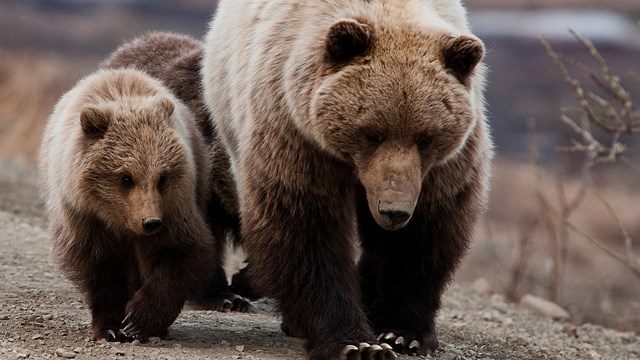
Q. How many bears
are in Denali National Park?
A. No biological surveys
have been conducted, but the grizzly population has been estimated
at 200-300. We know even less about black bears.
Q. Are there any black
bears in Denali National Park?
A. Yes, but you are unlikely
to see them. The park road travels through grizzly habitat and black
bears cannot compete. An occasional black bear has been spotted
in forested patches along the road.
Q. Do you control
game populations in Denali National Park?
A. No. Denali National
Park is an intact ecosystem. Natural balances are allowed to reign
unaltered by people. In the park, we prefer to call animals "wildlife"
rather than game.
Q. Why are some areas
of Denali National Park closed?
A. Closures exist to
protect both people and wildlife. Areas with a high risk of bear
danger - around a kill, for instance - are closed. Denning or nesting
sites are also protected along with any other resource where managers
feel it is important for animals and vegetation to be undisturbed.
Q. How many rangers
work in Denali National Park?
A. There are approximately
141 summer employees in Denali. In winter, there are 100 permanent
employees plus a handful of temporary staff.
Q. What kind of wolves
are in Denali National Park?
A. The wolves in Denali
are commonly called gray wolves. The scientific name is Canis
lupis. This is the same animal seen in the upper peninsula of
Michigan or Minnesota. However, in those areas the commonly used
name is timber wolf. The only other species of wolf in the U.S.
is the red wolf found in southeast states.
Q. What is the difference
between caribou and reindeer?
A. Caribou and reindeer
are the same species, Rangifer tarandus. Reindeer are the
European subspecies, tending to be smaller and domesticated. Reindeer
were introduced to the Seward peninsula of Alaska a few decades
ago and are now flourishing there.
Q. Is there elk or
deer in Denali National Park?
A. Denali has only two
members of the deer family, moose and caribou.
Q. Are there any bald
eagles in Denali National Park?
A. Only an occasional
one passing overhead. Bald eagles are fish eaters and the park has
virtually no fish.
Q. Does Denali National
Park have a problem with poaching?
A. The park does have
some poaching problems. Most poaching occurs just inside the park
boundaries and can involve either aerial or ground-based hunters.
There are two to three know occurrences each year. Poaching activity
tends to concentrate along the south boundary of the park.
Q. Does the Park Service
limit the number of planes and helicopters flying over the park?
A. No. In Alaska, the
National Park Service has no authority to regulate its own airspace.
At Denali, we have an informal agreement with local helicopters
and small plane tour operators to stay within certain travel corridors
and 500 feet above the ground.
|