|
ParkWise
> Students >
Activities> Math
Practice > Converting between meters and feet
Math
Practice:
Converting between miles and kilometers
Assume 1 kilometer =
0.62 miles, or 1 mile = 1.6 kilometers
- In June of 1912, the
severe earthquakes rocked the area around Katmai
National Park and Preserve for a week before the Novarupta
volcano exploded. For several days volcanic ash, rock and gas
were ejected and darkened the sky over most of the Northern Hemisphere.
When it was over more than 65 square kilometers of lush green
land lay buried benearth volcanic deposits as much as 200 meters
deep. How may square miles of land were covered?
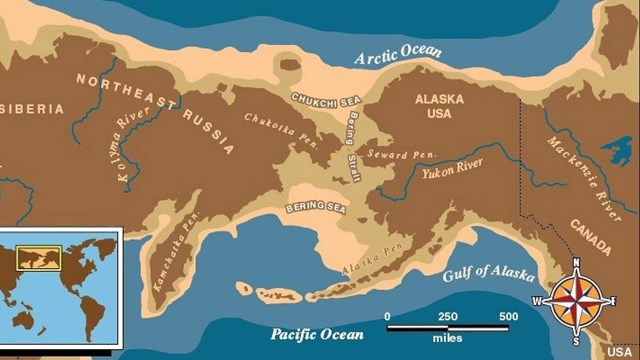
- About 20,000 years
ago, so much of the earth's water supply was locked up in huge
ice masses that the sea level fell 280 to 350 feet below today's
level, exposing vast areas of land formerly under water. The result
was a land bridge between Siberia and Alaska called the Bering
Land Bridge, now part of Bering
Land Bridge National Preserve. Most archaeologists agree that
it was across this land bridge that humans first came from Asia
to populate the Americas. If the land bridge was 55 miles long
and up to 1,000 miles wide, how long and wide was it in kilometers?
- During the summer,
Bering Land Bridge
National Preserve, is home to birdlife from six continents;
some birds migrate as far as 20,000 miles yearly. How far is this
in kilometers?
- The Yukon River cuts
all the way across Alaska from east to west as part of which is
protected within Yukon - Charley
Rivers National Preserve. It served as a throroughfare for
Alaska natives and early traders. It stretches for 1,979 river
miles (miles measured along the winding river) from its headwaters
in Canada's Yukon Territory, to its mouth at the Bering Sea. It
flows for 1,250 river miles within Alaska. How long is the river
in kilometers, and how long is the stretch within Alaska in kilometers?
- When gold was discovered
in Alaska and the Yukon in the 1890s, tens of thousands of prospectors
headed north. The Chilkoot Trail into Alaska (now preserved with
Klondike Gold
Rush National Historic Park) was treacherous because of the
steep slopes leading to the pass. Prospectors took the ferry up
from Seattle to Dyea. Prospectors hiked 16.5 miles up to Chilkoot
Pass and down another 16.5 miles to Bennet, where they would build
a boat and float their supplies along the lakes and rivers to
Dawson. How many miles did they travel to the pass, down to Bennet,
and total.
- Extra Credit:
Prospectors taking the Chilkoot Trail into Dawson were required
to bring a year's worth of supplies, approximately 1000 pounds.
More than any miner can carry by himself. If a miner is only to
carry about 80 pounds, he would need to a load up the trail, put
it down, and go back for another load until all the supplies were
moved part way up the trail. He would have to do this repeatedly
until he had moved all of his supplies to Bennett. How far would
a miner have to walk in order to carry 1,000 pounds of supplies
from Dyea to Bennet carrying 80 pounds at a time. Express your
answer in both miles and kilometers.
- In 1794, Captain George
Vancouver found Icy Strait in what is now choked with ice and
Glacier Bay was a barely indented glacier. By 1879 naturalist
John Muir found that the ice had retreated 48 miles up the bay.
By 1916, the Grand Pacific Glacier headed Tarr Inlet 65 miles
from the mouth of Glacier Bay. The Bay is now protected within
Glacier Bay
National Park and Preserve.
a) How many kilometers did the glacier retreat between 1794 and
1879?
b) How many kilometers did the glacier retreat between 1879 and
1916?
c) What was the average rate glacial retreat (km / yr) between
1794 and 1879, between 1879 and 1916, and between 1794 and 1916?
- Glacier
Bay National Park and Preserve is home to a variety of marine
mammals. Orcas (also known as killer whales) hunt in teams and
have no natural enemies. They can swim at a steady rate of 29
miles per hour. Minke whales eat mostly cod and pollock in the
northern waters. They swim up to 20 miles per hour. Express both
of these swimming rates in kilometers per hour.
- Wrangell
- St. Elias National Park and Preserve is the largest national
park in the United States (6 times bigger than Yellowstone), and
it contains 9 of the 16 highest peaks in the United States. The
Wrangell volcanoes are some of the largest by volume in the world.
Mt. Wrangell and Mt. Sanford, for example, each consist of about
250 cubic miles of lava. Compare that to about 8 cubic miles for
Mt. St. Helens and 47 cubic miles for Mt. Rainier, or even Mt.
Fujiyama with 184 cubic miles. Compare these volumes in cubic
meters. (Hint - be careful these are cubic measurements).
- Caribou are know as
"nomads of the north", roaming over thousands of miles
bewteen their calving grounds, their post-calving areas and their
wintering grounds. Much of their habitat and migration routes
are protected within the Northwest
Arctic Parklands. Their range is over 140,000 square miles.
How many square kilometers is their range?
|